
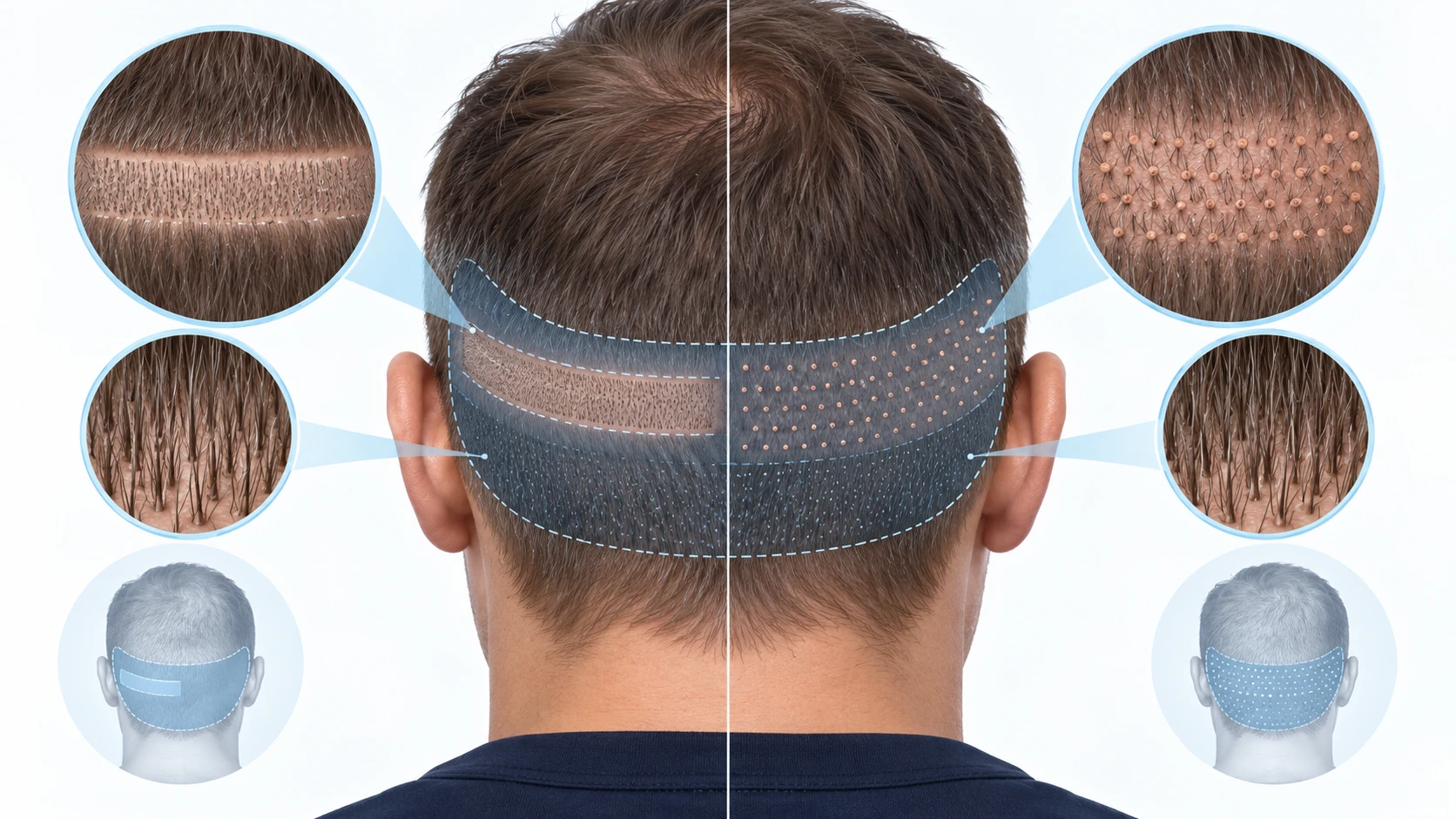
FUT leaves a line. FUE leaves dots. Neither method is scar-free.
Technique matters, but diagnosis, surgeon skill, donor preservation, graft handling and a sustainable hairline usually matter more than marketing labels.
FUT removes a donor strip; FUE excises follicular units individually.
FUT usually creates one linear donor scar and can provide many grafts in a suitable patient. FUE distributes many small circular extraction scars and may accommodate shorter hairstyles.
Neither is universally better. Scalp laxity, donor density, hair caliber, haircut preference, prior surgery and lifetime graft demand all influence the choice.
The donor supply does not regenerate
Every harvested follicle reduces what remains for future procedures.
FUT preserves uncut donor zones
Strategic strip harvesting may leave other areas available, but the linear scar is permanent.
FUE distributes injury
Extraction pattern and safe-zone selection are central to avoiding a moth-eaten appearance.
Growth timelines are similar
Recipient follicles usually shed and regrow on broadly comparable cycles regardless of harvest method.
Choose the lifetime donor plan before choosing the extraction tool.
A low hairline or large single session can consume supply needed if native loss progresses. A good plan estimates future demand and explains what density is realistically possible.
Some patients may use both techniques over time; others are poor surgical candidates regardless of method.

Match each method to anatomy and hairstyle—not a universal ranking.
These are considerations for a surgical consultation, not self-selection rules.
- A larger graft session is needed
- Scalp laxity is adequate
- Longer hair can conceal a line
- Limited donor shaving is preferred
- Future donor strategy supports it
- Avoiding a linear scar is important
- Shorter hairstyles are preferred
- Scalp laxity is limited
- Small or selective sessions are planned
- Extraction can remain safely distributed
Surgical candidacy begins with the diagnosis and donor—not the technique name.
A clinical trichologist may document the pattern; a qualified physician or hair-restoration surgeon determines candidacy and performs surgery.
- 01 · Confirm permanent lossExclude unstable shedding, infection, alopecia areata and active scarring disease.
- 02 · Measure donor characteristicsAssess density, caliber, curl, miniaturization, laxity and prior scars.
- 03 · Forecast progressionPlan the hairline and reserve for future native loss.
- 04 · Verify the surgical teamClarify who performs extraction, incisions, placement and complication care.
When the story needs medical attention.
Hair loss may be one clue within a larger health issue. Seek timely evaluation when any of these apply.
- Increasing pain, heat or swelling
- Pus, odor or fever
- Wound separation or heavy bleeding
- Dark or blistered skin
- Rapid donor depletion
- Breathing difficulty or severe allergic reaction
Recovery differs at the donor site; graft maturation remains slow.
The operating team’s instructions override general timelines.
Linear-incision healing
Sutures or staples, tightness, sensation and scar maturation require follow-up.
Distributed extraction healing
Small wounds heal across a broader area while density and dot scars remain permanent considerations.
Protect implanted grafts
Use approved washing, activity and sun guidance.
Preserve native hair
Ongoing treatment may be discussed because transplantation does not stop hereditary loss.
Donor wounds heal before the cosmetic result matures.
Early healing
Crusts and swelling settle; FUT closure and FUE extraction sites follow different care.
Shedding phase
Transplanted shafts often release while follicles remain.
Growth and scar maturation
Coverage develops gradually while donor scars continue settling.
Donor-Area Management
See how safe-zone selection, extraction distribution and linear-scar planning preserve future surgical options.
Read next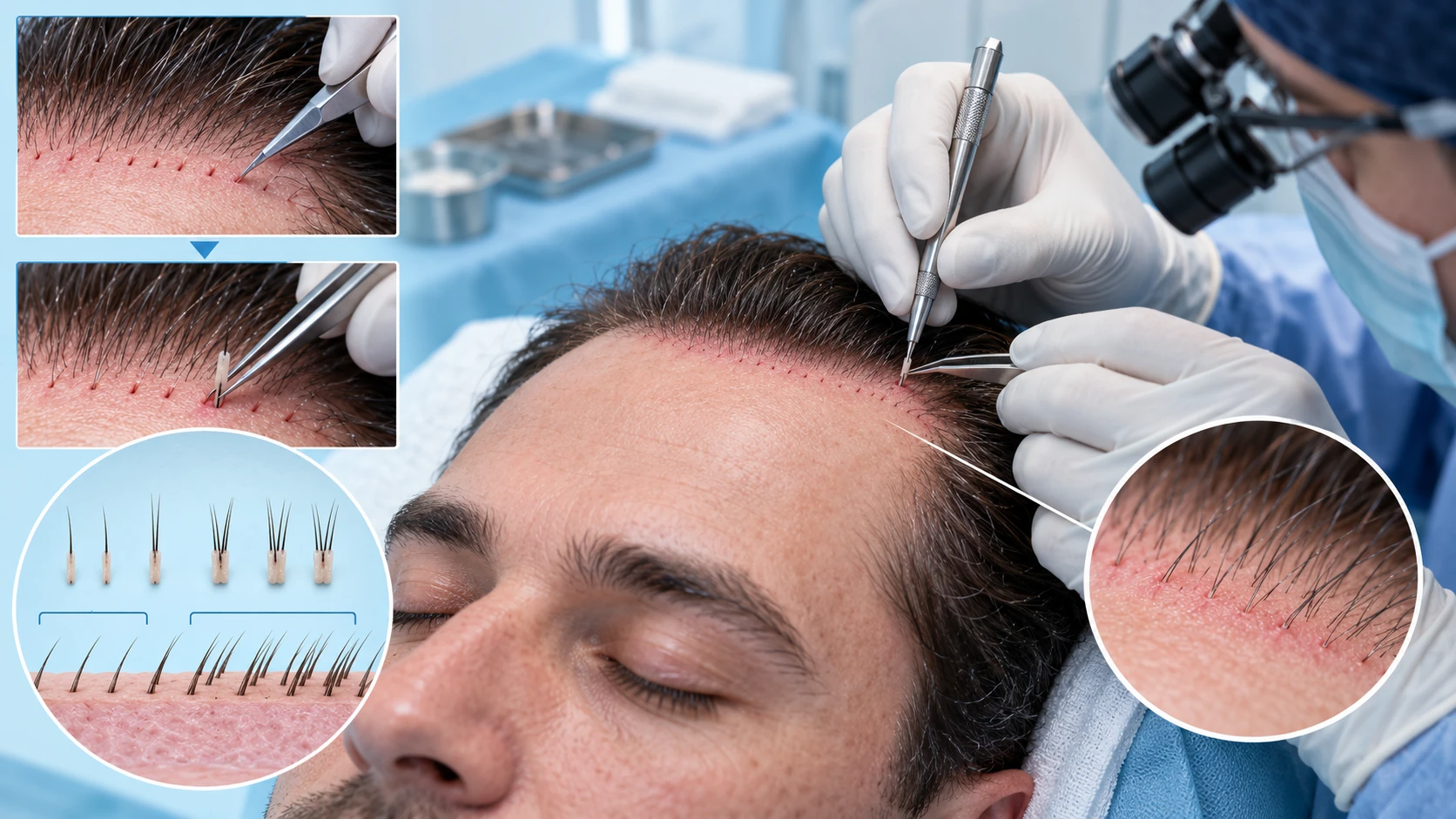

Clear answers to the next questions.
Which is better, FUT or FUE?
Neither is universally better; the choice depends on anatomy, donor strategy, hairstyle and surgical plan.
Is FUE scarless?
No. It creates multiple small circular scars.
Does FUT always provide more grafts?
It may efficiently provide many grafts in selected patients, but anatomy and safe planning determine the number.
Which heals faster?
FUE avoids a strip incision, while FUT has a linear closure; individual recovery varies.
Can both methods be used?
Yes, a combined lifetime strategy may fit some patients but is not necessary for everyone.
Will either method stop future loss?
No. Native non-transplanted hair can continue to miniaturize.