
DHT matters. Follicle sensitivity decides where.
Genetic pattern hair loss is not simply a high-hormone problem. It is a gradual conversation between androgen signaling and susceptible follicles.
DHT contributes when scalp follicles are genetically susceptible.
Dihydrotestosterone (DHT) is a normal androgen formed from testosterone by 5-alpha-reductase. In susceptible scalp areas, repeated androgen signaling can shorten the active growth phase and produce progressively finer, shorter hairs.
This process is androgenetic alopecia. It commonly affects the temples and crown in men and the central or upper scalp in women. DHT does not explain sudden shedding, bald patches, inflammation or every form of hair loss.
Sensitivity can exist with normal levels
Pattern loss can develop even when testosterone or DHT falls within a laboratory reference range.
Scalp regions respond differently
Frontal and crown follicles may be susceptible while many side and back follicles remain relatively resistant.
Minoxidil is not a DHT blocker
It supports follicle activity through a different mechanism and may be used with or without a DHT-targeting drug.
Several causes can coexist
Iron deficiency, thyroid disease, telogen effluvium or scalp inflammation can reduce density on top of a genetic pattern.
Miniaturization happens across repeated growth cycles.
DHT binds androgen receptors in susceptible follicles. Over time, terminal hairs may become finer, shorter, less pigmented and less visible above the scalp.
Androgenetic alopecia is non-scarring, but advanced miniaturization can be difficult to recover. That is why preserving still-active follicles is a central treatment goal.

Pattern loss leaves a recognizable map.
Men and women often show different distributions, while abrupt or symptomatic loss points elsewhere.
- Temple or frontal recession in men
- Crown thinning in men
- Widening central part in women
- Reduced upper-scalp density
- Finer hairs within affected regions
- Sudden heavy diffuse shedding
- Completely smooth isolated patches
- Broken hairs from traction or grooming
- Pustules, pain or marked scale
- Shiny scar-like scalp change
Two scales describe two different pattern maps.
Classification gives clinicians a shared language for documenting visible severity and change over time. It does not identify the cause by itself, predict how quickly loss will progress or replace scalp examination.
Norwood–Hamilton scale
Typical male-pattern recession and vertex loss- I
Minimal change
Little or no visible recession at the frontal hairline.
- II
Early temple recession
Mild triangular recession develops at both frontotemporal corners.
- III
Defined pattern loss
Deeper, usually symmetrical temple recession marks the first clearly established stage. The III Vertex variant adds early crown thinning with less frontal recession.
- IV
Front and crown separate
Frontal recession and a larger vertex area are still divided by a band of hair across the top.
- V
The bridge narrows
The frontal and vertex areas enlarge while the band between them becomes thinner and less dense.
- VI
Front and crown merge
The separating bridge is lost, creating one larger area of upper-scalp loss.
- VII
Advanced horseshoe pattern
Only a narrower band of hair remains around the sides and back of the scalp.
Type A patterns move backward as one continuous frontal edge, generally without a separate vertex patch.
Sinclair scale
Female-pattern widening through the central part- 1
Baseline part
The central part appears normal or shows no clinically meaningful widening.
- 2
Early widening
The central part begins to widen, often before overall density loss is obvious.
- 3
Widening plus side density loss
The part is broader and density is reduced on both sides of the central line.
- 4
Pronounced upper-scalp thinning
Diffuse loss becomes more visible across the top, while the frontal edge is often still present.
- 5
Advanced central loss
Marked scalp visibility extends across the central and upper scalp.
The Ludwig scale describes female-pattern loss more broadly as Grades I–III: mild, moderate and advanced diffuse thinning over the crown and top.
Confirm miniaturization before targeting DHT.
The diagnosis is based on the visible pattern, tempo, family history and scalp examination—not a single hormone test.
- 01 · HistoryReview onset, family pattern, medications, illness, dieting and associated symptoms.
- 02 · PhotographyTrack the hairline, temples, crown or part under consistent conditions.
- 03 · TrichoscopyLook for variation in shaft diameter and miniaturized hairs.
- 04 · Rule out overlapInvestigate sudden shedding, scalp inflammation or systemic clues selectively.
When the story needs medical attention.
Hair loss may be one clue within a larger health issue. Seek timely evaluation when any of these apply.
- Sudden or rapidly accelerating shedding
- Patchy smooth loss
- Scalp pain, burning or pustules
- Loss of follicular openings
- New endocrine symptoms
- Systemic side effects after treatment
Know which therapies target DHT—and which support growth another way.
A proper protocol identifies the pattern and contributing drivers before selecting natural, prescription or growth-support options. Treatment is individualized by sex, age, medical risks, reproductive plans and severity.
Standardized saw palmetto
Serevelle™ is a proprietary, concentrated fatty-acid extract from saw palmetto (Serenoa repens). A randomized placebo-controlled study in adults with self-perceived thinning reported improvements in measured hair-count outcomes over 180 days.
This emerging evidence does not establish equivalence to prescription DHT-lowering drugs. Supplements can cause side effects or interactions and are not appropriate during pregnancy or breastfeeding without medical guidance. Explore Maximum Strength DHT BlockerFinasteride or dutasteride
These medicines reduce conversion of testosterone to DHT. Finasteride is used for male pattern loss; dutasteride and selected use in women are off-label in many settings.
Sexual, mood and reproductive safety considerations require an individualized medical discussion. Greater DHT suppression does not make a treatment appropriate for everyone.Spironolactone
This prescription antiandrogen may be considered for selected women, particularly when clinical signs suggest androgen activity.
It requires clinician oversight. Pregnancy, plans to conceive, blood pressure, kidney function and medication interactions affect suitability.Topical or oral minoxidil
Minoxidil is not a DHT blocker. It may support diameter, density and growth in selected patients.
Oral use is off-label and requires medical oversight for systemic side effects.LLLT, PRP or microneedling
These options may support density in selected patients but do not all directly reduce DHT.
Evidence, protocols and outcomes vary.Genetic loss and its treatment move slowly.
Document the pattern
Create standardized images before combining therapies.
Watch stabilization
Some people first notice less progression or early caliber change.
Judge the plan
Review photographs, tolerance and maintenance needs with the treating clinician.
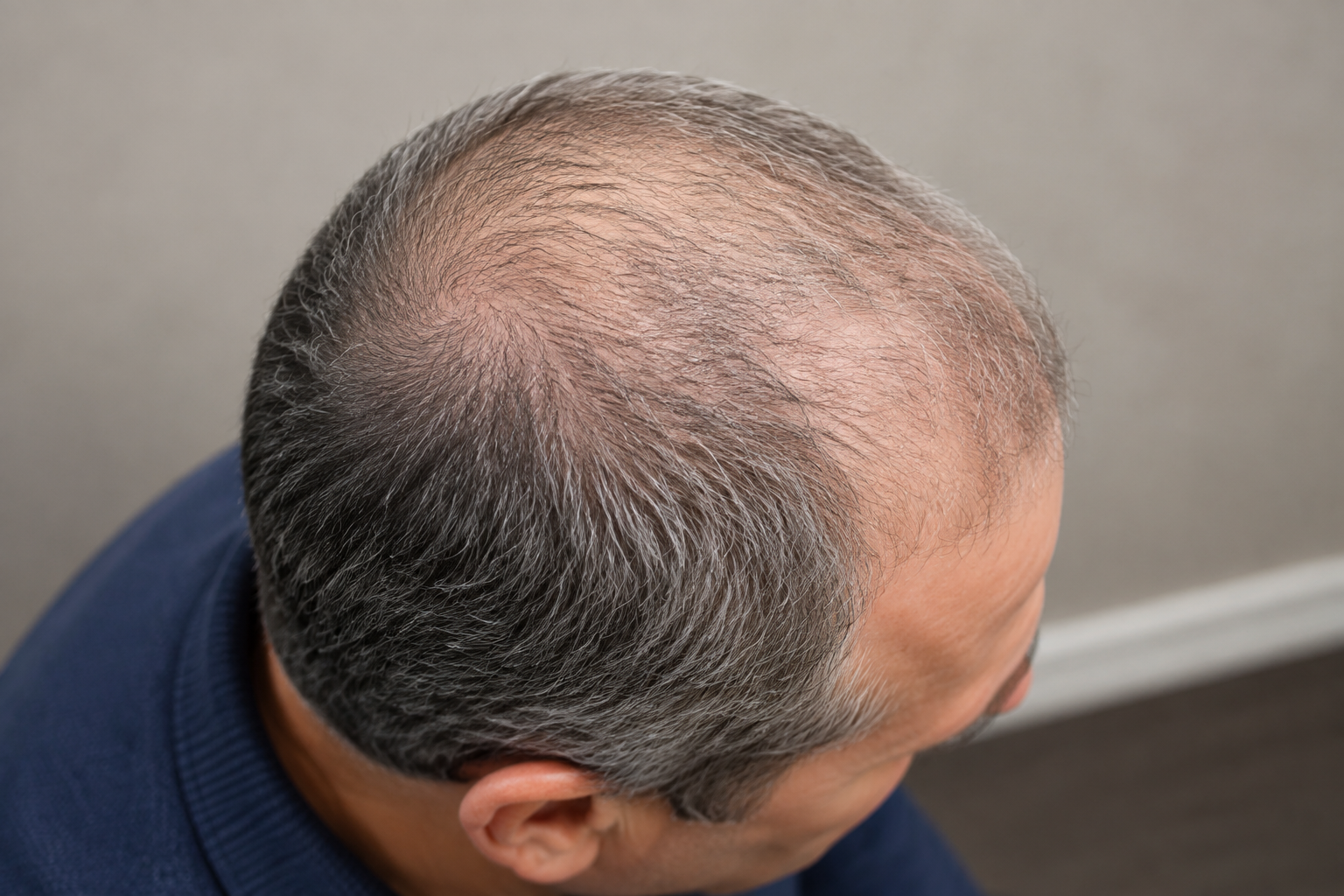
Androgenetic Alopecia
See how inherited follicle sensitivity produces different patterns in women and men.
Read next

Clear answers to the next questions.
Does high DHT always cause hair loss?
No. Follicle susceptibility is critical, and many people with normal circulating androgens develop pattern loss.
Is genetic hair loss inherited only from the mother’s side?
No. Susceptibility is polygenic and can come from either side of the family.
Is minoxidil a DHT blocker?
No. It supports growth through a different mechanism.
Does finasteride block DHT?
It inhibits type II 5-alpha-reductase and lowers DHT, but individual suitability and response vary.
Are natural DHT blockers equivalent to prescription drugs?
No. Evidence and standardization are generally more limited, and natural does not mean risk-free.
Will loss return if treatment stops?
Hair maintained by an effective ongoing therapy may gradually be lost after it is discontinued.