
Finasteride vs.
Saw Palmetto
A comparative review of DHT inhibition, clinical efficacy, tolerability, and treatment selection in androgenetic alopecia

 Dr. Anish Desai, MDPhysician · Medical reviewer
 William Gaunitz, FWTSClinical trichologist · Expert reviewer
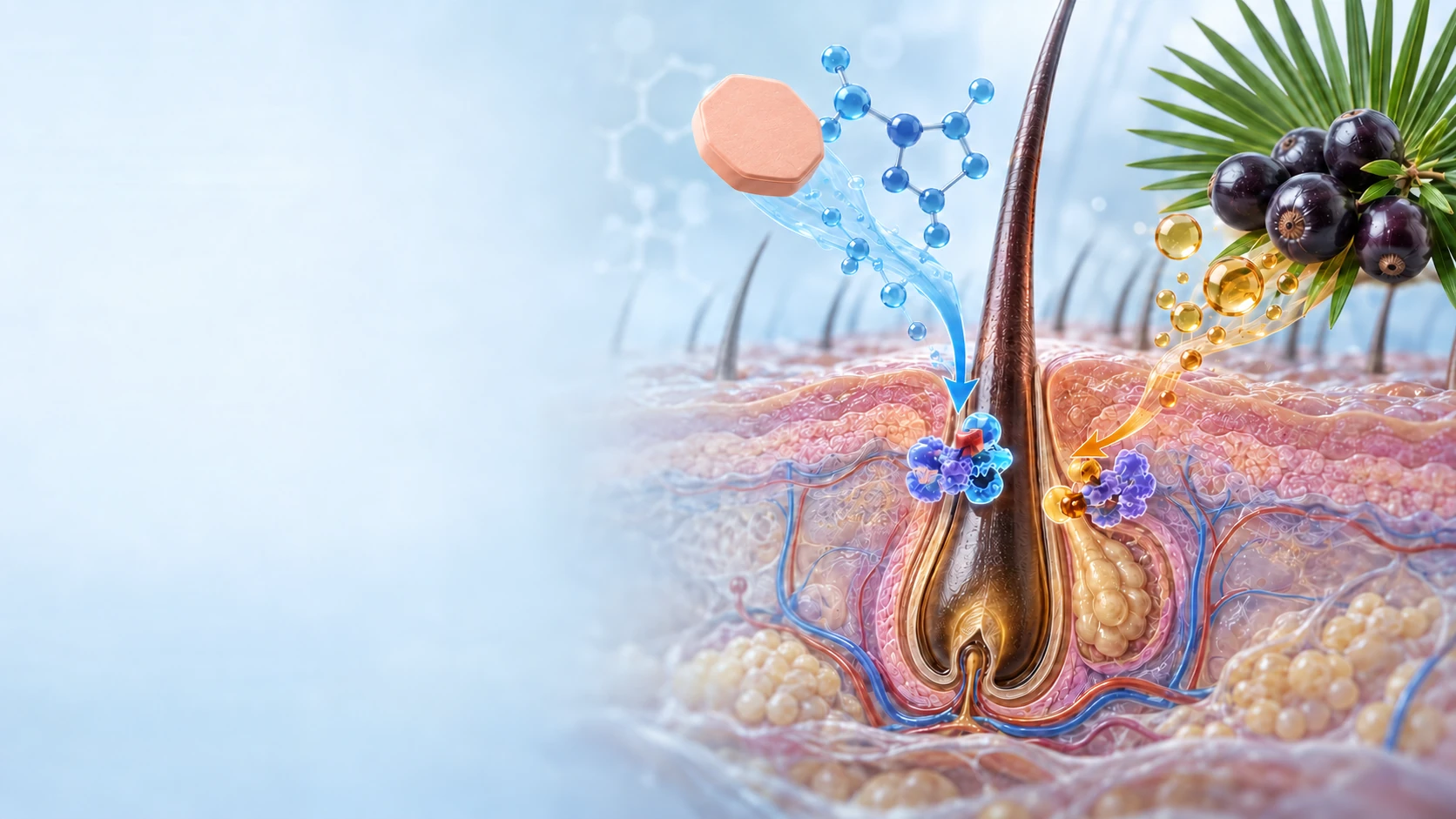
Compare evidence, exposure, and individual risk—not just the label “natural.”
This editorial navigation layer highlights the questions the physician-authored review addresses. Select a topic to move directly into the approved manuscript.
Finasteride directly inhibits 5-alpha-reductase; saw palmetto’s androgen effects are less clearly defined and extract-dependent.
Compare the proposed pathways →Finasteride has substantially broader and more mature evidence for male androgenetic alopecia.
Review the comparison →The following review is reproduced in full from the supplied physician-approved source.
Review: Finasteride vs. Saw Palmetto in DHT Inhibition and Hair Loss Treatment
Androgenetic alopecia (AGA), commonly known as patterned hair loss, affects a significant portion of the population.1 The main culprit in this type of alopecia is a genetic sensitivity to the androgen dihydrotestosterone (DHT), which can appear in a person’s life at a certain time or due to changes in gene expression.2 Compared to testosterone, DHT is more potent and has a much greater affinity for the androgen receptor in people whose hair follicles are genetically more sensitive to DHT.3
Another important factor in the hormonal cascade leading to hair loss is the 5-alpha reductase enzyme (5-AR), which is responsible for converting testosterone to DHT.4 You will see the name of this enzyme appear throughout this article. Those without a genetic sensitivity to DHT do not experience hair loss related to androgens.5
Among pharmacological interventions, finasteride is widely recognized for its ability to inhibit systemic DHT production by blocking 5α-reductase6. On the other hand, saw palmetto (Serenoa repens), a botanical extract, is often marketed as a natural alternative, purportedly preventing DHT from binding to its receptor rather than reducing overall systemic DHT levels7.
However, confusion persists regarding how saw palmetto actually works and whether it can be equated to finasteride in terms of efficacy.
This article presents a comparative review of finasteride and saw palmetto, dissecting their respective mechanisms, clinical efficacy, and implications for AGA treatment.
The Mechanism of Finasteride: A Systemic 5α-Reductase Inhibitor
Finasteride is a synthetic 5α-reductase inhibitor that selectively targets type II and III isoforms of the enzyme, effectively reducing the conversion of testosterone into DHT.
Through data from meta-analyses of numerous clinical trials, finasteride reduces serum DHT by approximately 68% and scalp DHT by 64% 6. By lowering systemic and localized DHT levels, finasteride mitigates follicular miniaturization and supports hair regrowth.
Clinical Efficacy of Finasteride
A two-year clinical trial involving 1,879 men found that 66% of finasteride users experienced hair regrowth, compared to only 7% in the placebo group8. Additionally:
- 83% of finasteride users had no further hair loss after two years.
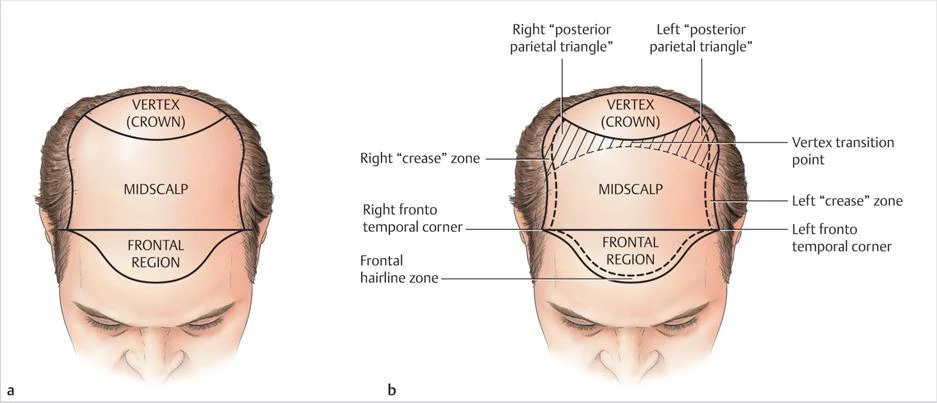
- Hair density improved significantly, particularly in both the vertex and frontal scalp regions, the most predominant areas of hair loss in AGA (Figure 1).
- Finasteride’s effectiveness was most pronounced in Hamilton II-III AGA stages.

This systemic suppression of DHT explains why finasteride remains the gold standard in pharmaceutical AGA treatment.
Side Effects of Finasteride
Despite its efficacy, finasteride is associated with androgen suppression side effects, including8:
- Decreased libido and erectile dysfunction (~3.8% of users, per clinical studies).
- Post-Finasteride Syndrome (PFS) – Persistent sexual and neurological symptoms reported in a minority of users.
Users suffering from these rare side effects report moderate to severe depression, falling self-confidence, and an overall decrease in quality of life stemming from sexual dysfunction11.
To make matters worse, recent reports have raised concerns about the accessibility of finasteride through telehealth platforms, such as Hims and Keeps, which market the medication without adequately disclosing potential side effects.
This lack of transparency has led to instances where young men seeking quick solutions for hair loss experience serious adverse effects. These include the aforementioned sexual dysfunction, as well as anxiety and panic attacks.
Telehealth companies exploit regulatory loopholes, allowing them to omit risk information in branding and advertisements. They fail to provide proper warnings or conduct thorough individualized examinations before prescribing finasteride.
This underscores the need for more transparency and caution in the promotion of finasteride.
The Mechanism of Saw Palmetto: A Receptor-Level DHT Blocker?
Saw palmetto (Serenoa repens) is a botanical extract containing liposterolic compounds that modulate androgen activity. Unlike finasteride, which directly inhibits 5α-reductase, saw palmetto is believed to work primarily at the receptor level, preventing DHT from binding to androgen receptors in hair follicles7.
However, conflicting data exists regarding whether it also partially inhibits systemic 5α-reductase activity.
Clinical Evidence on Saw Palmetto
A 16-week placebo-controlled study on VISPO™ saw palmetto extract found that oral administration significantly reduced serum DHT levels12.
However, a separate two-year comparative study reported that saw palmetto was less effective than finasteride, with only 38% of users experiencing hair regrowth compared to 68% of finasteride users13.
Key takeaways include:
- Oral saw palmetto may have some systemic DHT reduction (~20-30%) but is weaker than finasteride.
- Saw palmetto primarily affects the vertex rather than the frontal scalp.
- Stabilization of hair loss (52%) rather than regrowth was the dominant outcome.
Comparison of Saw Palmetto to Finasteride
| Feature | Finasteride (1 mg/day) | Saw Palmetto (320 mg/day) |
|---|---|---|
| Mechanism | Inhibits 5α-reductase (type II, systemic inhibition) | May inhibit 5α-reductase weakly but primarily blocks DHT at receptors |
| DHT Reduction | 68% systemic & scalp DHT reduction | Moderate (20-30%) systemic reduction, mostly receptor-based action |
| Hair Growth Success | 66-68% of users see regrowth | 38% of users see regrowth |
| Hair Stabilization | Prevents further loss in 83% of cases | Stabilizes loss in 52% of cases |
| Effectiveness on Scalp Regions | Effective in both the vertex & frontal scalp | Mainly effective in the vertex |
| Side Effects | Sexual dysfunction (~3-5% users), potential PFS | Minimal side effects, better tolerability |
Implications for AGA Treatment: Choosing Between Finasteride and Saw Palmetto
For individuals with moderate to severe AGA (Hamilton II-IV), finasteride presents the strongest option for hair regrowth. Its ability to systemically suppress DHT makes it particularly useful for patients experiencing aggressive hair loss in both the vertex and frontal regions.
Additionally, individuals looking for FDA-approved solutions with substantial clinical backing are more likely to benefit from finasteride.
However, side effects remain a significant concern. Patients experiencing libido changes, sexual dysfunction, or mood alterations may prefer to avoid finasteride altogether or seek alternative options like saw palmetto. Those who previously discontinued finasteride due to adverse effects might also find saw palmetto a safer substitute.
Conversely, saw palmetto is a viable option for those seeking a natural approach with fewer risks. It is particularly suitable for mild to moderate AGA, especially for individuals focused on hair loss stabilization rather than significant regrowth.
Patients wary of systemic hormone manipulation may prefer saw palmetto since it primarily affects receptor-level DHT binding rather than drastically altering systemic androgen levels.
Combining Saw Palmetto with Finasteride for Enhanced Results
Saw palmetto may complement finasteride, potentially enhancing results while mitigating side effects. Because saw palmetto blocks DHT at the receptor level, it could enhance local follicular protection while allowing finasteride to reduce systemic DHT more effectively.
Some users informally report that combining both treatments allows for a lower finasteride dose, thereby reducing the risk of side effects while maintaining effectiveness.
More studies are needed to confirm these benefits, and significant caution should be taken, as taking a higher dose of DHT blockers may lead to worsening side effects.
You should consult a healthcare professional to create an optimal dosing regimen, and repeated follow-ups may be necessary to track progression and any side effects that may occur when taking both compounds.
Conclusion
The distinction between finasteride’s systemic inhibition of DHT and saw palmetto’s receptor-based modulation is critical for patient decision-making.
While finasteride remains the gold standard as the most studied and effective treatment for AGA, saw palmetto offers a moderate, lower-risk alternative that may appeal to individuals prioritizing safety over maximum regrowth.
For patients navigating treatment decisions, understanding these mechanistic differences is key to setting realistic expectations and selecting the most appropriate therapy based on their hair loss progression and risk tolerance.
References
- Hamilton, JB. Patterned loss of hair in man; types and incidence. Ann N Y Acad Sci. 1951;53(3):708-728. doi:10.1111/j.1749-6632.1951.tb31971.x
- Kaufman KD. Androgens and alopecia. Mol Cell Endocrinol. 2002;198(1-2):89-95. doi:10.1016/S0303-7207(02)00372-6
- Hamilton, J.B. Male hormone stimulation is prerequisite and an incitant in common baldness. Am. J. Anat., 1942;71: 451-480. https://doi.org/10.1002/aja.1000710306
- Dhurat R, Sharma A, Rudnicka L, et al. 5‐Alpha reductase inhibitors in androgenetic alopecia: Shifting paradigms, current concepts, comparative efficacy, and safety. Dermatol Ther. 2020;33(3). doi:10.1111/dth.13379
- Ho CH, Sood T, Zito PM. Androgenetic Alopecia. In: StatPearls. StatPearls Publishing; 2025. Accessed March 21, 2025. http://www.ncbi.nlm.nih.gov/books/NBK430924/
- Zito PM, Bistas KG, Patel P, Syed K. Finasteride. In: StatPearls. StatPearls Publishing; 2025. Accessed March 19, 2025. http://www.ncbi.nlm.nih.gov/books/NBK513329/
- Saw Palmetto: Usefulness and Safety. NCCIH. Accessed March 21, 2025. https://www.nccih.nih.gov/health/saw-palmetto
- McClellan KJ, Markham A. Finasteride. Drugs. 1999;57(1):111-126. doi:10.2165/00003495-199957010-00014
- Themes UFO. Scalp Anatomy. Plastic Surgery Key. April 6, 2024. Accessed March 20, 2025. https://plasticsurgerykey.com/scalp-anatomy/
- MHR Clinic. Hamilton-Norwood Scale of Baldness & Your Hair Treatment. June 20, 2020. Accessed March 21, 2025. https://mhrclinic.co.uk/the-hamilton-norwood-scale-of-baldness-your-hair-treatment/
- Ganzer CA, Jacobs AR. Emotional Consequences of Finasteride: Fool’s Gold. Am J Mens Health. 2018;12(1):90-95. doi:10.1177/1557988316631624
- Sudeep HV, Rashmi S, Jestin TV, Richards A, Gouthamchandra K, Shyamprasad K. Oral and Topical Administration of a Standardized Saw Palmetto Oil Reduces Hair Fall and Improves the Hair Growth in Androgenetic Alopecia Subjects – A 16-Week Randomized, Placebo-Controlled Study. Clin Cosmet Investig Dermatol. 2023;16:3251-3266. doi:10.2147/CCID.S435795
- Rossi A, Mari E, Scarnò M, et al. Comparitive Effectiveness and Finasteride Vs Serenoa Repens in Male Androgenetic Alopecia: A Two-Year Study. Int J Immunopathol Pharmacol. 2012;25(4):1167-1173. doi:10.1177/039463201202500435
- Al Najjar OA, Alkhars MA, Al Molhim SF, et al. The Impact of Androgenic Alopecia on the Quality of Life of Male Individuals: A Cross-Sectional Study. Cureus. 15(10):e47760. doi:10.7759/cureus.47760
- Penugonda K, Lindshield BL. Fatty Acid and Phytosterol Content of Commercial Saw Palmetto Supplements. Nutrients. 2013;5(9):3617-3633. doi:10.3390/nu5093617
- Saw palmetto berry Extract prosterol | Euromed. April 10, 2024. Accessed April 7, 2025. https://euromedgroup.com/saw-palmetto-berry-extract-prosterol/
- USPlus® Pure Lipidosterolic Extract. Valensa. Accessed April 7, 2025. https://valensa.com/vproducts/usplus/