
Replace what is missing—not everything marketed for hair.
Nutritional treatment should identify a meaningful limitation, find out why it developed and replace it safely—while continuing to treat any genetic or inflammatory hair loss.
Review the blood-test pathway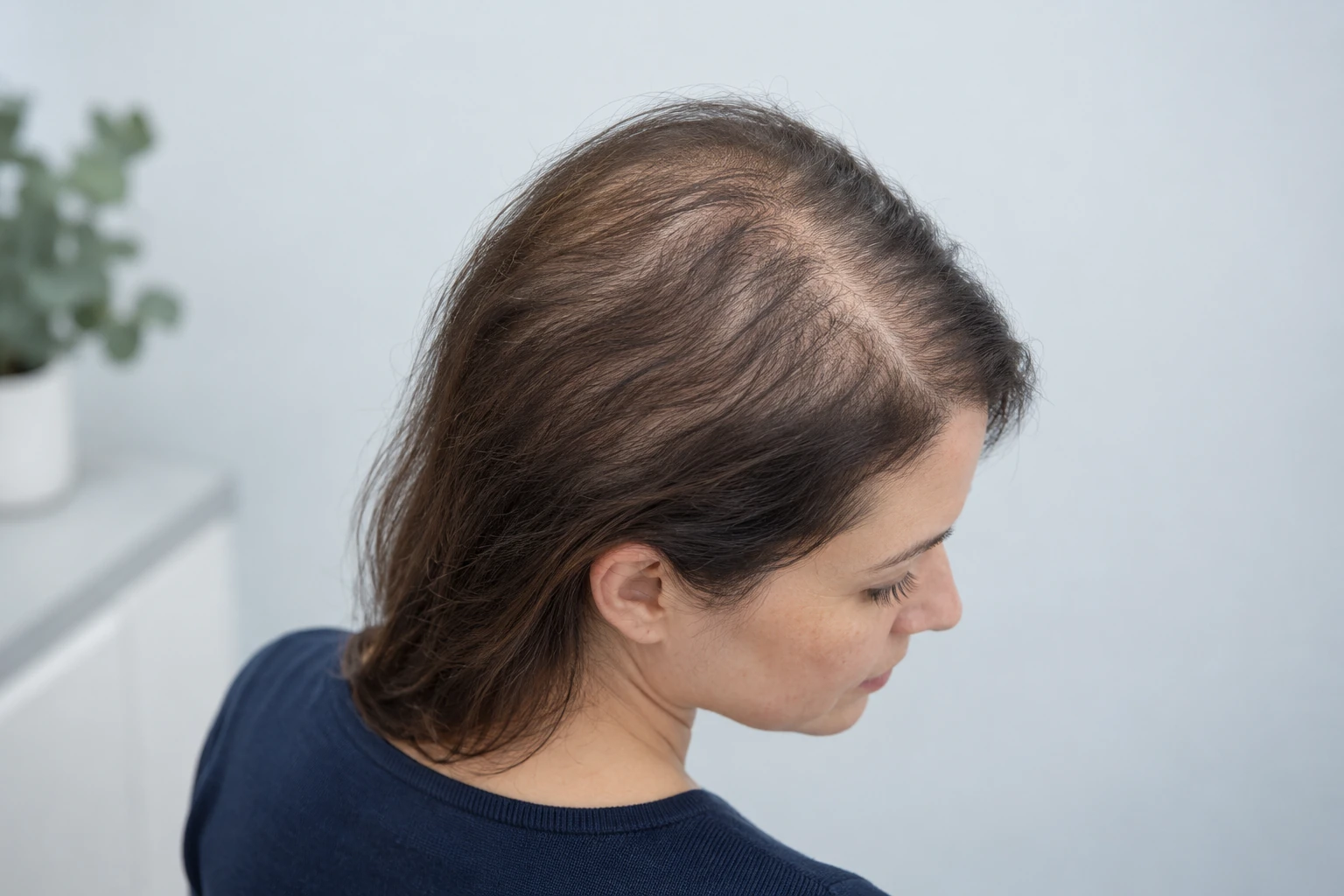

Nutrition-related loss usually changes density across the entire scalp.
Inadequate energy, protein or a clinically meaningful micronutrient deficiency can disrupt rapidly active follicle cells or shift more hairs into the resting and shedding phase. The result is commonly increased shedding, reduced ponytail volume or diffuse thinning rather than one isolated bald spot.
The term nutritional alopecia describes the relationship; it does not identify which nutrient is involved or exclude telogen effluvium, androgenetic alopecia, thyroid disease, medication effects or inflammatory disease.
Compare causes of diffuse hair lossEach marker answers a different part of the regrowth question.
If a relevant nutrient is truly deficient, it can hold back recovery in many hair-loss scenarios. The goal is an individualized, clinically appropriate level—not indiscriminate supplementation or one universal “optimal” number.
Vitamin D3 status
25-hydroxy vitamin DVitamin D signaling participates in follicle cycling. Low status may coexist with several forms of hair loss, but supplementation benefit is clearest when deficiency is documented.
Dose to the measured level and medical context; excess can cause toxicity.Iron stores
Ferritin + full iron contextIron deficiency can contribute to diffuse shedding, sometimes before anemia is obvious. Ferritin must be interpreted with serum iron, TIBC, blood counts, symptoms and inflammation.
Do not use one universal ferritin target or take high-dose iron without monitoring.Zinc
Serum zincEstablished zinc deficiency can cause diffuse shedding and brittle hair. Risk increases with restricted intake and several malabsorptive conditions.
Excess zinc can reduce copper status and create a second imbalance.Copper
Serum copperCopper supports enzymes involved in connective tissue, pigment and iron metabolism. Deficiency is uncommon but becomes relevant with malabsorption or prolonged high-dose zinc use.
Interpret alongside zinc, diet, supplements and the clinical picture.Vitamin B12
Serum B12; confirmatory testing when indicatedB12 supports DNA synthesis and blood-cell production. Deficiency may accompany restricted diets, pernicious anemia, gastric disease, surgery or medication-related malabsorption.
A B12 result alone does not prove it is the cause of hair loss.Measure before replacing—and interpret the results together.
When the pattern, history or symptoms make nutritional loss plausible, blood testing is one of the clearest ways to look for correctable limitations. A result should be read with the laboratory range, symptoms, inflammation, medicines and the reason it may be low.
Screens for anemia and changes in red-cell size; it can be normal in earlier iron depletion.
A circulating snapshot that varies and should not be interpreted alone.
Adds context about the blood’s iron-binding capacity and helps calculate saturation.
Estimates stored iron, but inflammation can raise it and obscure depletion.
Useful when risk factors or compatible symptoms exist; timing and inflammation can affect interpretation.
Screens for low status; methylmalonic acid may help when the result and symptoms do not agree.
Especially relevant with malabsorption, anemia or sustained high-dose zinc exposure.
The standard blood marker used to assess vitamin D status.
Replacement cannot work well if intake, absorption or ongoing loss remains unresolved.
Malnutrition and restrictive diets can reduce what enters the body. Medical conditions—including celiac disease, inflammatory bowel disease, pancreatic insufficiency, pernicious anemia and some postsurgical states—can impair absorption. Medicines can also affect selected nutrients.
Gut dysbiosis may coexist with gastrointestinal symptoms and dietary restriction, but it should not be assumed to cause a specific deficiency without appropriate assessment. Persistent or multiple abnormalities deserve medical evaluation for an underlying digestive condition.
- 01
Intake
Is enough energy, protein and nutrient-dense food consistently available?
- 02
Absorption
Can the gastrointestinal tract absorb and use what is consumed?
- 03
Loss or demand
Is bleeding, illness, pregnancy, inflammation or another factor increasing need or depletion?
- 04
Response
Do repeat labs improve with treatment, and does the hair cycle follow over time?
Correcting nutrition supports recovery—but does not replace driver-specific treatment.
Miniaturization plus diffuse shedding
A deficiency may add shedding or weaken recovery across the scalp while DHT-sensitive follicles continue to miniaturize on top. Address both pathways when both are present.
Explore DHT-focused treatmentDisease activity plus nutritional stress
Nutritional limitations may add systemic stress, shedding or impaired tissue recovery. They can make the overall presentation harder to stabilize, but supplements do not control immune or scarring disease.
Explore inflammatory treatment pathwaysIdentify, replace, recheck and keep treating the actual hair-loss condition.
- 01
Confirm the diffuse pattern
Document shedding and density across the scalp while looking for miniaturization, patches, breakage or inflammation.
- 02
Find the nutritional risk
Review diet, weight change, blood loss, gastrointestinal health, surgery, medicines and systemic symptoms.
- 03
Order targeted blood tests
Use the history to select and interpret CBC, iron studies, ferritin, zinc, copper, B12 and 25-OH vitamin D.
- 04
Replace the documented need
Select dose, route and duration for the individual rather than starting a broad high-dose stack.
- 05
Correct the reason and monitor
Address intake, absorption or ongoing loss; repeat appropriate labs and track the hair cycle over several months.
High-dose iron, zinc, vitamin D and other concentrated nutrients can cause toxicity, interact with medicines or create another deficiency. Zinc can lower copper; ferritin can rise with inflammation; and excess supplementation does not accelerate hair recovery once a true need has been corrected.
Nutritional alopecia, clearly answered.
What is nutritional alopecia?
It is a descriptive term for hair loss associated with inadequate calories, protein or specific nutrients. It most often appears as diffuse shedding or reduced density, but the underlying deficiency and the type of hair loss still need to be identified.
Does nutritional hair loss affect the whole scalp?
Often, yes. A nutritional stress commonly shifts follicles across the scalp into a shedding phase, producing diffuse loss rather than a confined hairline or crown pattern. Another condition may be present at the same time.
Can low nutrients make genetic hair loss worse?
A meaningful deficiency can add diffuse shedding or limit recovery while androgenetic alopecia continues to miniaturize susceptible follicles. Correcting the deficiency does not replace DHT-focused treatment when pattern loss is active.
Can nutritional problems worsen inflammatory hair loss?
They can add physiological stress, shedding or impaired tissue recovery to an inflammatory disorder. However, nutrient replacement is supportive care and does not substitute for diagnosis and treatment of alopecia areata, infection or scarring alopecia.
Do I need every blood test listed here?
Not necessarily. These tests form a useful discussion panel when nutritional risk is credible, but a clinician should tailor testing to diet, symptoms, blood loss, gastrointestinal history, medicines and the visible pattern.
Should I supplement to an optimal range?
Correct documented deficiency and monitor the response. Hair-specific optimal targets are not universally established for every marker, and pushing levels beyond an appropriate clinical range can cause toxicity or another imbalance.