
The Prostaglandin-Hair Axis
The article introduces prostaglandin production and signaling within the hair follicle.

 William Gaunitz, WTSClinical Trichologist · Expert Reviewer
Inside this review
Use these questions to navigate the complete physician-authored review below.
The article introduces prostaglandin biosynthesis and production within the follicle.
Read this section →Explore the receptors and signaling pathways discussed for PGD2 and PGE2.
Read this section →Complete production article and literature cited.
The Prostaglandin-Hair Axis
How PGD2, PGE2, and Prostaglandin Signaling Regulate Hair Growth and Follicular
Miniaturization
Key Takeaways
- Prostaglandins are key lipid mediators that modulate hair follicle cycling. ● PGD2 inhibits hair growth, whereas PGE2 and PGF2α promote anagen maintenance
- and hair shaft elongation. ● Local prostaglandin balance, not systemic levels, dictates follicular outcomes. ● Dysregulation contributes to androgenetic alopecia, telogen effluvium, and other hair
- disorders. ● Targeting prostaglandin pathways therapeutically may restore follicular function when
- miniaturization is reversible.
Introduction
Hair loss is a multifactorial clinical problem, traditionally attributed to hormonal, nutritional, or genetic causes. However, accumulating evidence demonstrates that prostaglandins – small lipid signaling molecules derived from arachidonic acid – play a central role in regulating hair follicle biology¹. Hair follicles are highly metabolically active organs whose cycling is finely tuned by local paracrine and autocrine signals. Among these, PGD2, PGE2, and PGF2α act as modulators of anagen, catagen, and telogen phases.
PGD2 has been identified as a negative regulator of hair growth in balding scalp, whereas PGE2 and PGF2α promote hair shaft elongation, follicular survival, and stem-cell activation². Dysregulation in prostaglandin signaling contributes to shortened anagen, miniaturized follicles, and diffuse shedding. Understanding the prostaglandin-hair axis provides trichologists with a mechanistic basis for clinical evaluation, treatment selection, and prognostic assessment.
This article explores prostaglandin biosynthesis, receptor biology, downstream signaling effects, and implications for hair loss treatment, mirroring the detailed mechanistic approach applied to androgenetic alopecia in previous trichology studies.
Prostaglandin Biosynthesis and Follicular Production
Prostaglandins are synthesized from arachidonic acid via cyclooxygenase enzymes (COX-1 and COX-2) and prostaglandin synthases, producing distinct PG species that exert opposing effects on follicular cycling³. Within the hair follicle, dermal papilla cells, keratinocytes, and immune cells contribute to local prostaglandin production.
PGD2 acts as an inhibitory signal, engaging the GPR44 (DP2) receptor on follicular keratinocytes, suppressing stem-cell proliferation, and inducing premature catagen. Elevated PGD2 levels are documented in androgen-sensitive scalp regions of patients with androgenetic alopecia. In contrast, PGE2 and PGF2α engage EP2/EP4 and FP receptors, respectively, stimulating matrix cell proliferation, hair shaft elongation, and maintenance of anagen.

Figure 1. Prostaglandin biosynthesis pathways from arachidonic acid in the hair follicle.⁷
Local prostaglandin production, rather than systemic PG concentrations, determines follicular behavior. Factors such as inflammation, oxidative stress, and androgen signaling modulate this balance, influencing hair growth outcomes.
Prostaglandin Receptors and Follicular Signaling
Prostaglandins mediate their effects through specific G-protein coupled receptors (GPCRs) expressed in dermal papilla cells, follicular keratinocytes, and bulge stem cells. PGD2 binding to GPR44 inhibits follicular stem-cell activation and reduces anagen duration⁴. Conversely, PGE2 and PGF2α signaling via EP2/EP4 and FP receptors promotes matrix cell proliferation and prolongs anagen.
Activation of these receptors alters downstream intracellular pathways, including cAMP, PI3K/Akt, and Wnt/β-catenin signaling. This crosstalk determines the balance between hair growth promotion and inhibition. Excess PGD2, relative to PGE2/PGF2α, leads to follicular miniaturization, resembling the progressive changes seen in androgenetic alopecia.
Dysregulation and Hair Loss
Abnormal prostaglandin signaling is implicated in multiple hair disorders:
1. Androgenetic Alopecia: Elevated PGD2 levels in balding scalp contribute to
follicular miniaturization, particularly in androgen-sensitive areas. 2. Telogen Effluvium: Chronic stress, inflammation, or systemic illness can shift
prostaglandin synthesis toward inhibitory pathways, promoting premature telogen entry and diffuse shedding. 3. Scarring Alopecias: Immune-mediated inflammation increases local PGD2,
contributing to follicular destruction and irreversible hair loss.
The net effect is shortened anagen, weakened follicles, and gradual visible hair thinning. Dysregulated prostaglandin signaling often overlaps with other pathogenic mechanisms, including androgenic signaling, oxidative stress, and impaired microvascular function.
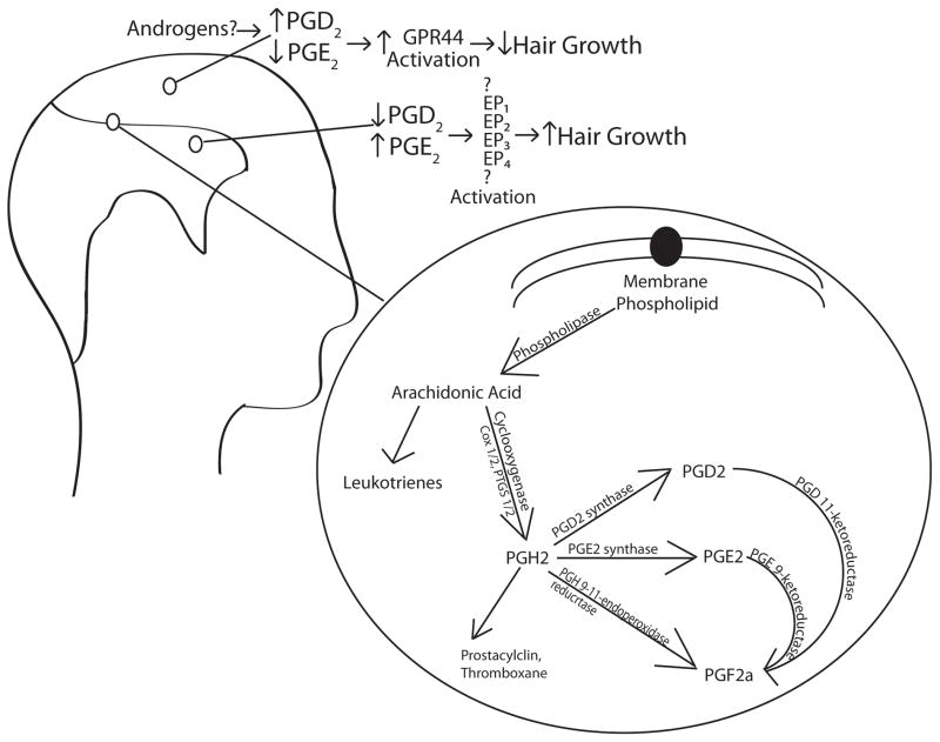
Figure 2. Prostaglandin signaling and receptor pathways in human hair follicles.⁸
Therapeutic Implications
Clinical modulation of prostaglandin signaling offers a potential avenue for hair restoration:
- PGD2 Inhibition: Topical GPR44 antagonists or COX-2 modulators may reduce
PGD2-mediated suppression of hair growth. ● PGE2/PGF2α Enhancement: Analogues such as latanoprost or bimatoprost
stimulate follicular proliferation and extend anagen. ● Combination Approaches: Targeting prostaglandin pathways alongside
microenvironmental optimization (oxygenation, nutrition, anti-inflammatory measures) maximizes follicular recovery.
Therapeutic efficacy is contingent on follicular viability. Miniaturized but structurally intact follicles respond best, while follicles replaced by fibrosis are unlikely to recover.
Implications for Trichology Practice
Understanding prostaglandin dynamics equips clinicians to:
1. Identify patients with high PGD2 levels who may benefit from targeted therapy. 2. Implement early interventions before irreversible follicular miniaturization occurs. 3. Combine prostaglandin modulation with supportive measures, such as scalp vascular
optimization, anti-inflammatory therapy, and metabolic support, for improved clinical outcomes.
Differentiating prostaglandin-mediated inhibition from permanent follicle loss informs prognosis and guides individualized treatment plans.
Conclusion
Prostaglandins act as critical modulators of hair follicle biology. PGD2 functions as a potent inhibitor, while PGE2 and PGF2α maintain anagen and promote hair shaft elongation. Dysregulation in prostaglandin balance contributes to androgenetic alopecia, telogen effluvium, and other hair disorders.
For trichology practice, assessment of prostaglandin signaling, early intervention, and optimization of the follicular microenvironment provide a mechanistic framework for rational, evidence-based management of hair loss.
References
1 Stenn KS, Paus R. Controls of hair follicle cycling. Physiol Rev. 2001;81(1):449–494. https://doi.org/10.1152/physrev.2001.81.1.449
² Woodward DF, Jones RL, Narumiya S. International Union of Basic and Clinical Pharmacology. LXXXIII: classification of prostanoid receptors, updating 15 years of progress. Pharmacol Rev. 2011;63(3):471–538. https://doi.org/10.1124/pr.110.003517
3 Funk CD. Prostaglandins and leukotrienes: advances in eicosanoid biology. Science. 2001;294(5548):1871–875. https://doi.org/10.1126/science.294.5548.1871
4 Garza LA, Liu Y, Yang Z, et al. Prostaglandin D2 inhibits hair growth and is elevated in bald scalp of men with androgenetic alopecia. Sci Transl Med. 2012;4(126):126ra34. https://doi.org/10.1126/scitranslmed.3003122
5 Sinclair R, Torkamani N, Jones L. Androgenetic alopecia: new insights into the pathogenesis and mechanism of hair loss. F1000Res. 2015;4:585. https://doi.org/10.12688/f1000research.6401.1
6 Khidhir KG, Woodward DF, Farjo NP, et al. The prostamide-related glaucoma therapy, bimatoprost, offers a novel approach for treating scalp alopecias. FASEB J. 2013;27(2):557–567. https://doi.org/10.1096/fj.12-218156
⁷ Shin DW. The physiological and pharmacological roles of prostaglandins in hair growth. Korean J Physiol Pharmacol. 2022;26(6):405–413. Available at: https://www.kjpp.net/journal/view.html?doi=10.4196/kjpp.2022.26.6.405
⁸ Garza LA, Liu Y, Yang Z, et al. Prostaglandin signaling in bald scalp. Sci Transl Med. 2012;4(126):126ra34. Available at: https://www.ncbi.nlm.nih.gov/pmc/articles/PMC3982925/