
Central centrifugal cicatricial alopecia
Understanding CCCA: hair loss that begins around the center of the scalp, the symptoms to notice, and the role of diagnosis and early care.
Educational guide · A visible pattern alone cannot confirm the cause
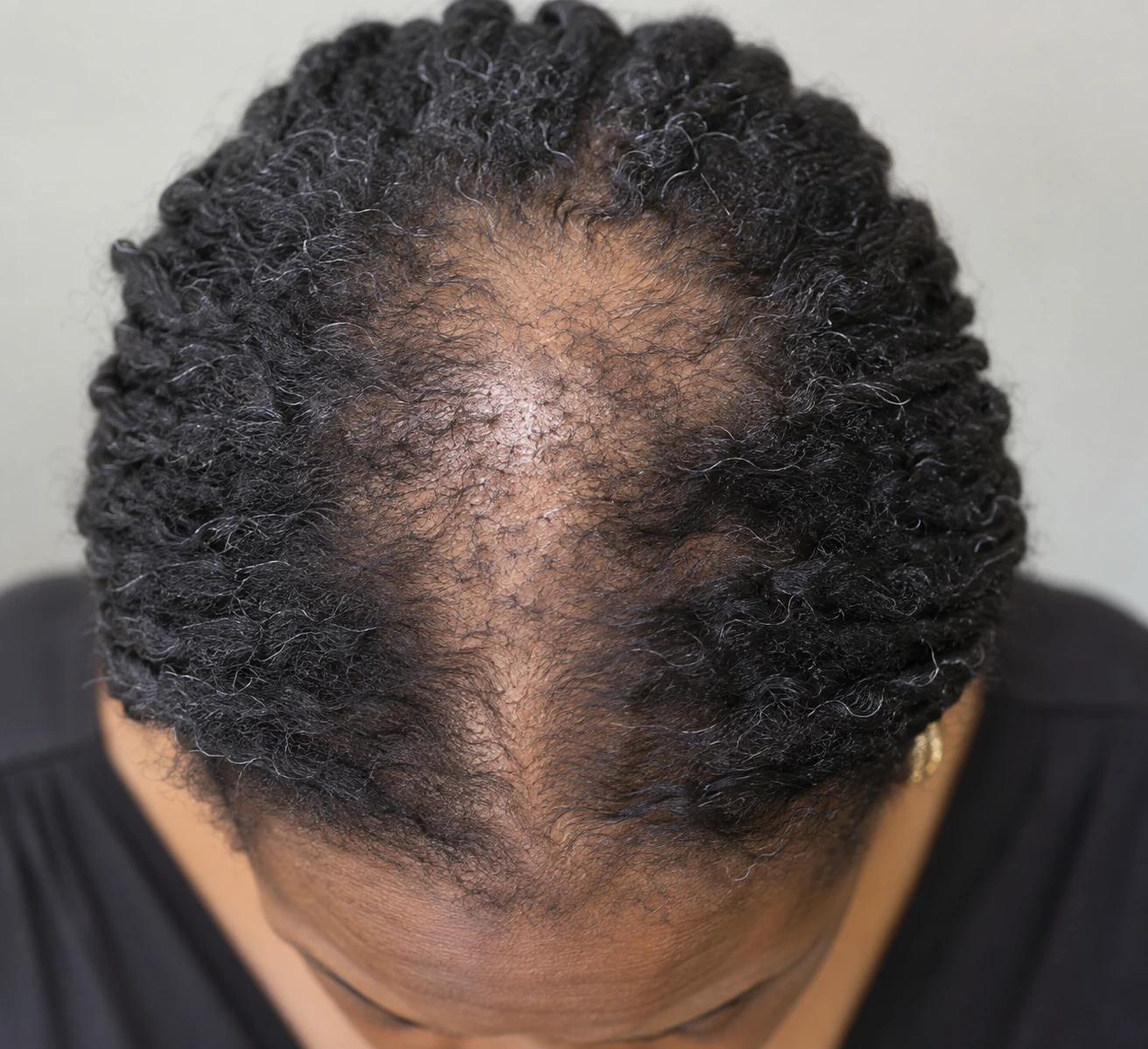
What is CCCA?
Central centrifugal cicatricial alopecia (CCCA), also known as hot comb alopecia or follicular degeneration syndrome, is a type of hair loss that primarily affects women of African descent. It is a scarring alopecia, which means that hair loss is permanent due to the destruction of hair follicles and replacement with scar tissue. CCCA is thought to be caused by a combination of genetic, environmental, and hair care practices.
The change often starts near the center of the scalp.
Central scalp thinning
The original article describes thinning that begins in the central scalp area.
An expanding area
The area of hair loss may gradually spread outward.
Scalp discomfort
Itching, burning or tenderness may accompany the hair loss.
Scarring changes
The article explains how damaged follicles can be replaced by scar tissue.
The symptoms of CCCA usually begin with a gradual thinning of hair in the central scalp area, which eventually leads to a bald spot. The hair loss may be accompanied by itching, burning, or tenderness of the scalp. Over time, the bald spot may expand and merge with other areas of hair loss, eventually leading to complete baldness in the affected area. The hair loss in CCCA is usually permanent, as the hair follicles are replaced with scar tissue.
CCCA does not always look the same.
Compare three possible presentations. These examples are not a staging scale or a way to diagnose hair loss.

Central thinning
Hair loss may first become noticeable around the center or crown of the scalp.
A wider crown pattern
The central area of hair loss can expand outward, involving a broader area of the scalp.
Scattered patches
Rarely, CCCA appears as scattered patches rather than a single central area.
Actual appearances vary and can overlap with other conditions. A clinician evaluates the scalp and may use a biopsy to establish the cause.
Pattern descriptions: American Academy of Dermatology ↗Inflammation can change the follicle permanently.
Pathophysiology of CCCA
The pathophysiology of CCCA involves inflammation and destruction of hair follicles, leading to permanent hair loss. The exact mechanism by which this occurs is not fully understood, but it is thought to involve an abnormal immune response in susceptible individuals. Inflammation of hair follicles can lead to scarring and fibrosis, which eventually destroys the follicle and leads to permanent hair loss.
The original article considers several contributing factors.
Risk Factors of CCCA
There are several risk factors associated with CCCA, including genetics, environmental factors, and hair care practices. Studies have shown that there is a strong familial association with CCCA, suggesting a genetic component to the disease. Environmental factors such as UV radiation and pollution may also contribute to the development of CCCA. However, the most significant risk factor is thought to be hair care practices such as chemical processing, heat styling, and tight hairstyles.
Chemical Processing and CCCA
In addition to chemical processing, other hair care practices may also contribute to the development of CCCA. Tight hairstyles such as braids, weaves, and extensions can cause traction alopecia, which is a form of hair loss caused by prolonged tension on the hair follicles. Traction alopecia can lead to inflammation and scarring of hair follicles, which may contribute to the development of CCCA. Heat styling, such as the use of flat irons or curling irons, can also cause damage to the hair shaft and hair follicles, leading to hair breakage and hair loss.
Assessment helps distinguish CCCA from other causes of hair loss.
Clinical examination
The source article describes examining the scalp and the distribution of hair loss.
Scalp biopsy
A small scalp sample may be examined microscopically to help confirm the diagnosis.
Other possible causes
The assessment considers other forms of hair loss, including alopecia areata and telogen effluvium.
Diagnosis of CCCA is typically made through a combination of clinical examination and scalp biopsy. A scalp biopsy involves removing a small piece of scalp tissue for microscopic examination. The biopsy can help to confirm the diagnosis of CCCA and rule out other causes of hair loss, such as alopecia areata or telogen effluvium.
Early care focuses on limiting further follicular damage.
Early intervention
The original review discusses slowing or halting progression.
Inflammation control
Topical and oral medicines are discussed as options prescribed to reduce inflammation.
Scarring context
The article explains why hair loss is usually permanent once follicles are replaced by scar tissue.
Selected procedures
Hair transplantation is discussed for some patients, with limitations in scarring alopecia.
Treatment of CCCA is challenging, as the hair loss is usually permanent. However, early intervention may help to slow or halt the progression of the disease. Topical and oral medications may be prescribed to reduce inflammation and prevent further scarring of hair follicles. Hair transplantation may be an option for some patients, although the success rate may be lower in patients with scarring alopecia.
Read next: compare related conditions.
Explore other patterns of scarring and tension-related hair loss.
About this guide
The original Trichology.com article text is retained within this condition-guide layout. The visual examples are educational illustrations, with pattern descriptions informed by the American Academy of Dermatology.
This content is educational and does not replace diagnosis or care from a qualified health professional.