Frequently Asked Questions About Vitamin D3 Deficiency and Hair Loss
Vitamin D and Hair Loss
- Can vitamin D3 deficiency cause hair loss?
- Vitamin D3 deficiency may contribute to hair loss in some people. However, hair loss often has several causes. Vitamin D should be assessed alongside ferritin, thyroid function, hormones, stress, medication, and scalp health.
- What type of hair loss is associated with low vitamin D?
- Low vitamin D has been associated with telogen effluvium, female pattern hair loss, male androgenetic alopecia, and alopecia areata. An association does not prove that vitamin D deficiency caused the condition.
- Can low vitamin D cause diffuse hair shedding?
- Low vitamin D may contribute to diffuse shedding in some people. However, telogen effluvium can also follow illness, stress, childbirth, medication, rapid weight loss, low ferritin, or thyroid disease.
- Can low vitamin D cause patchy hair loss?
- Patchy loss may occur with alopecia areata, which has been associated with lower vitamin D levels. However, patchy loss needs professional assessment because autoimmune, infectious, and scarring conditions can look similar.
- Does vitamin D block DHT?
- No. Vitamin D is not an established DHT blocker. It may support general follicle and immune function, but it does not replace diagnosis-specific treatment for androgenetic alopecia.
- Can vitamin D regrow a receding hairline?
- Vitamin D cannot reliably regrow a receding hairline caused by androgenetic alopecia. Correcting a deficiency may support general health, but pattern loss usually needs a separate treatment plan.
Testing and Blood Levels
- How do I know whether low vitamin D is affecting my hair?
- Hair shedding, fatigue or weakness cannot establish vitamin D deficiency or prove that it caused hair loss. A clinician can decide whether a serum 25(OH)D test is appropriate and interpret the result with the wider assessment.
- Which vitamin D blood test should I ask for?
- When testing is clinically indicated, serum 25-hydroxyvitamin D, or 25(OH)D, is the usual measure. Ask whether it is appropriate for your case rather than assuming routine screening is needed.
- What vitamin D level is considered deficient?
- Levels below 12 ng/mL, or 30 nmol/L, are generally considered too low. Results between 12 and below 20 ng/mL may be inadequate for some people. A clinician should interpret the result in context.
- What vitamin D level is best for hair growth?
- No universally accepted vitamin D level has been proven to optimise hair growth for every person. Hair-loss treatment should not target an arbitrary online number.
- What else should be tested besides vitamin D?
- Depending on the symptoms, a clinician may consider ferritin, iron studies, a complete blood count, thyroid markers, vitamin B12, folate, zinc, hormones, and inflammatory markers.
Supplements, Dosage and Recovery
- Should I take vitamin D3 supplements for hair loss?
- Supplements may be appropriate when testing confirms low vitamin D or a clinician identifies a clear need. High-dose treatment should not be started without guidance.
- How much vitamin D3 should I take for hair loss?
- There is no universal hair-loss dose. The correct amount depends on the blood level, age, health history, diet, kidney function, medication, and treatment plan.
- Is 2,000 IU of vitamin D3 safe?
- Two thousand IU is below the general adult upper intake level of 4,000 IU per day. However, whether it is appropriate depends on your blood level, other sources of vitamin D, medical history, medicines, and clinician’s advice.
- Is 5,000 IU of vitamin D3 safe?
- Five thousand IU exceeds the general adult upper intake level of 4,000 IU per day. A clinician may use this amount in selected cases, but it should not become automatic long-term self-treatment.
- How long does vitamin D take to help hair?
- There is no established vitamin-D-specific timetable for hair recovery. Blood levels and hair changes do not improve on the same schedule. Response depends on the diagnosis and other treatment; arrange follow-up with the treating clinician.
- Will hair grow back after correcting vitamin D deficiency?
- Hair may recover when deficiency was an important contributor and the follicles remain active. Regrowth is less predictable when another condition, such as pattern hair loss or scarring alopecia, is present.
- Is vitamin D2 or vitamin D3 better?
- Both forms can raise vitamin D levels. Vitamin D3 may maintain levels more effectively in some situations, but the best option depends on the treatment plan and individual needs.
- Which vitamin D3 supplement should I choose?
- Choose a clearly labelled product and match the dose to your blood result and treatment plan. Advanced Trichology Liquid Vitamin D3 + K2 is one option for readers who prefer drops. FoliGROWTH is a broader multi-ingredient hair-nutrition formula rather than a stand-alone vitamin D product. Review the complete label, other supplements, allergen information, serving size, expiry details, and current seller before purchase.
Safety and Other Causes
- Can too much vitamin D make hair loss worse?
- Excess vitamin D can cause toxicity and high blood calcium. Severe illness, kidney problems, dehydration, or nutritional imbalance may also affect overall health and hair cycling.
- Can vitamin D supplements cause side effects?
- Appropriate doses are often well tolerated. Excessive intake may cause nausea, weakness, constipation, excessive thirst, frequent urination, confusion, kidney stones, or kidney damage.
- What if my hair is still falling after my vitamin D improves?
- Another cause may still be active. Possibilities include low ferritin, thyroid disease, androgenetic alopecia, telogen effluvium, medication, stress, inflammation, or scalp disease.
- Should I see a trichologist or dermatologist?
- A trichologist can assess the visible p
29ASSESSMENT & SUPPORT
Find a Trichologist Near You
Vitamin D deficiency may be one part of the hair-loss picture, but shedding and thinning often have overlapping causes. A qualified trichologist can assess the visible pattern and identify signs that require medical testing or referral.
The public practitioner directory is being reopened in stages. Check the current directory availability rather than relying on the retired state listings.
30UNDERSTAND THE DETAILSConclusion: Can Vitamin D3 Deficiency Cause Hair Loss?
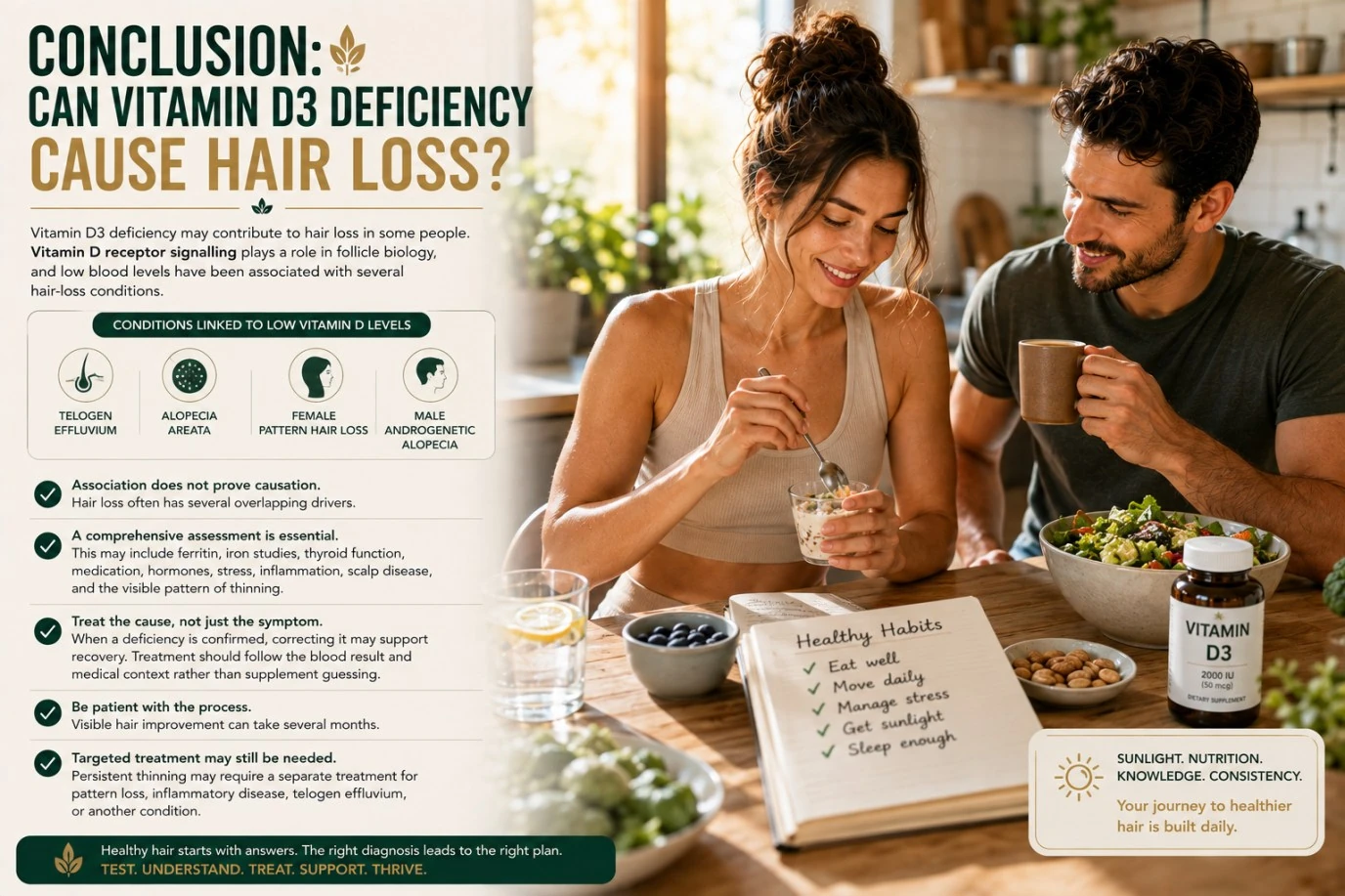
Vitamin D3 deficiency may contribute to hair loss in some people. Vitamin D receptor signalling plays a role in follicle biology, and low blood levels have been associated with several hair-loss conditions.
These conditions include telogen effluvium, alopecia areata, female pattern hair loss, and male androgenetic alopecia.
However, association does not prove that vitamin D deficiency is the only cause. Hair loss often has several overlapping drivers.
A broader clinical assessment can determine whether vitamin D testing is indicated. Depending on the case, it may also consider iron status, thyroid function, medication, scalp disease and the pattern of thinning.
When a deficiency is confirmed, correcting it may support recovery. However, treatment should follow the blood result and medical context rather than supplement guessing.
If a correctable contributing factor is identified, visible change is not immediate and timing varies. Persistent thinning may also require separate assessment or treatment for pattern loss, inflammatory disease, telogen effluvium, or another condition.
01Ready to Review Your Options?
Start with professional assessment and testing when clinically indicated. When supplementation is appropriate, compare the dose, complete formula, and all other supplements you already use.
View Advanced Trichology Vitamin D3 + K2 View Advanced Trichology FoliGROWTH Check the current label, dose, ingredients, warnings, seller, price, and availability before purchase. Do not use an affiliate product recommendation as a substitute for testing or professional guidance.
Next step: Read about ferritin deficiency and hair loss, review the nutritional deficiencies guide, or check directory availability.
31SOURCESReferences and Further Reading
04Medical disclaimer: This article is for general informational and educational purposes only. It does not provide medical advice, diagnosis, laboratory interpretation, or a personalised recommendation to use vitamin D, another supplement, medicine, serum, shampoo, or procedure. Do not start or continue high-dose vitamin D without appropriate professional guidance. Seek prompt assessment for sudden shedding, rapid progression, bald patches, scalp pain, inflammation, infection, eyebrow loss, or smooth and scar-like areas.
CONTINUE LEARNINGRead next
Explore related guides for your next step.
01START HEREVitamin D3 Deficiency and Hair Loss: Causes, Signs, Treatment and Recovery

Vitamin D3 deficiency may contribute to hair loss in some people, but it is rarely the only possible cause.
Hair loss can also result from genetics, stress, thyroid disease, low ferritin, iron deficiency, inflammation, autoimmune disease, medication, illness, hormonal changes, or scalp disorders.
Vitamin D supports bone health, immune function, and normal cell activity. It also appears to play a role in hair-follicle signalling and the normal hair-growth cycle.
Some people with low vitamin D experience increased shedding, slower recovery, or reduced hair density. However, these symptoms do not confirm a vitamin D deficiency.
Start with a clinical assessment. Ask a healthcare professional whether vitamin D testing is appropriate for your symptoms, history and findings. Routine screening is not recommended for generally healthy adults without an established indication. A wider assessment may consider iron stores, thyroid function, recent illness, medication, scalp health and the pattern of hair loss.
This guide explains how vitamin D relates to hair follicles, which types of hair loss have been associated with low levels, how deficiency is tested, when supplements may help, and how long recovery may take.
Medical note: This article provides general educational information only. It does not diagnose hair loss or replace advice from a doctor, dermatologist, pharmacist, registered dietitian, or another appropriately qualified healthcare professional.
02UNDERSTAND THE DETAILSKey Takeaways
01Vitamin D3 deficiency may contribute to hair loss. Low levels may affect follicle cycling, immune activity, and normal hair growth.02Several hair-loss conditions have been associated with low vitamin D. These include telogen effluvium, androgenetic alopecia, female pattern hair loss, and alopecia areata.03An association does not prove causation. Low vitamin D may coexist with hair loss without being its main cause.04Hair follicles contain vitamin D receptors. Vitamin D receptor signalling plays an important role in follicle biology and hair cycling.05Testing is selected according to clinical need. Symptoms and hair shedding alone cannot confirm deficiency; a clinician can decide whether a 25(OH)D test is indicated.06Supplements should not be taken blindly. Excessive vitamin D can raise blood calcium and cause serious toxicity.07Recovery takes time. Even after blood levels improve, visible hair changes may take several months.08Other causes still need attention. Ferritin, thyroid function, stress, medication, inflammation, hormones, and pattern hair loss may overlap.03PRACTICAL STEPSQuick Next Steps
01Check the pattern: Diffuse shedding, a widening part, recession, bald patches, and breakage have different causes.02Test before taking high doses: Ask whether a 25-hydroxyvitamin D blood test is appropriate.03Review overlapping factors: Ferritin, thyroid function, protein intake, medication, hormones, stress, and scalp health may also matter.04Track progress objectively: Take photographs every three months under the same lighting and camera angle.05Watch for warning signs: Sudden loss, bald patches, pain, burning, redness, pustules, or scar-like areas need assessment.06Read the related guides: Learn about nutritional deficiencies linked to hair loss and ferritin deficiency and hair loss .04UNDERSTAND THE DETAILSNot Sure Whether Low Vitamin D Is Affecting Your Hair?
A widening part, heavy shedding, slow regrowth, and reduced density can have several causes. Vitamin D deficiency may contribute, but low ferritin, thyroid disease, stress, inflammation, medication, and pattern hair loss may also be involved.
A trichologist can assess the visible pattern, scalp condition, shedding history, and hair-shaft quality. They can also identify signs that require medical testing or dermatology referral.
05UNDERSTAND THE DETAILSWhat Is Vitamin D3?

Vitamin D3, also called cholecalciferol, is a fat-soluble form of vitamin D.
It supports:
01Calcium absorption.02Bone and muscle health.03Immune regulation.04Normal cell growth and signalling.05Neuromuscular function.The body can produce vitamin D3 when ultraviolet B radiation reaches the skin. The liver then converts vitamin D into 25-hydroxyvitamin D. After that, the kidneys and other tissues convert it into an active hormonal form.
Vitamin D also affects skin and follicle biology. For this reason, researchers have studied its possible role in hair growth, shedding, and inflammatory hair-loss conditions.
06UNDERSTAND THE DETAILSHow Vitamin D3 Deficiency May Affect Hair Health
Hair follicles move through repeated stages of growth, transition, rest, and shedding.
The active growth stage is called anagen. During this stage, follicle cells divide and produce a new hair shaft.
Vitamin D signalling appears to contribute to normal follicle activity. Therefore, low vitamin D may affect the follicle environment in some people.
Possible hair-related effects may include:
01Increased diffuse shedding.02Slower recovery after telogen effluvium.03Reduced density.04Changes in follicle cycling.05Overlap with inflammatory or autoimmune hair loss.However, none of these symptoms is specific to vitamin D deficiency.
Low ferritin, thyroid disease, illness, stress, medication changes, hormonal shifts, insufficient protein, and scalp inflammation can cause similar changes.
When clinically indicated, vitamin D testing can form part of a wider assessment; it is not automatically required for every hair-loss case.
07UNDERSTAND THE DETAILSThe Role of Vitamin D Receptors in Hair Follicles
Hair follicles contain vitamin D receptors, also known as VDRs.
These receptors help regulate follicle biology and hair cycling. Research into rare genetic disorders has shown that severe disruption of VDR function can cause sparse hair or alopecia.
For example, some people with hereditary vitamin D-resistant rickets develop alopecia because their vitamin D receptors do not function normally.
This evidence confirms that VDR signalling matters to hair biology.
However, receptor dysfunction is not the same as an ordinary low vitamin D blood result. Therefore, it does not prove that every person with low vitamin D will lose hair or that supplementation will regrow hair in every case.
08UNDERSTAND THE DETAILSVitamin D3 Deficiency and Different Types of Hair Loss
01Telogen Effluvium
Telogen effluvium causes increased shedding across the scalp.
Common triggers include:
- Illness or fever.
- Emotional stress.
- Surgery.
- Childbirth.
- Rapid weight loss.
- Medication changes.
- Low calorie or protein intake.
- Nutritional deficiencies.
Some studies have found lower vitamin D levels in people with telogen effluvium. However, that finding does not prove that vitamin D deficiency is always the main trigger.
A complete assessment should also consider ferritin, iron status, thyroid function, diet, recent illness, medication, and psychological or physical stress.
02Female Pattern Hair Loss

Female pattern hair loss usually causes a widening part and reduced density across the top of the scalp.
Some studies have reported lower vitamin D levels among women with this condition. However, female pattern hair loss is mainly influenced by genetics, age, hormone sensitivity, and follicular miniaturisation.
Correcting a confirmed vitamin D deficiency may support general health. Still, it does not replace established treatment for androgenetic alopecia.
Read more about androgenetic alopecia and its treatment options.
03Male Pattern Hair Loss
Male pattern hair loss often causes temple recession, a receding hairline, crown thinning, or reduced density across the top of the scalp.
Research has explored links between vitamin D status and male androgenetic alopecia. However, vitamin D does not directly block DHT or reverse genetic follicle sensitivity.
Therefore, men with progressive pattern loss may need diagnosis-specific treatment even when vitamin D is low.
Learn more about DHT and hair-follicle miniaturisation.
04Alopecia Areata
Alopecia areata is an autoimmune form of hair loss. It often causes round or oval bald patches on the scalp, beard, eyebrows, eyelashes, or body.
Several studies and meta-analyses have found a higher prevalence of vitamin D deficiency among people with alopecia areata.
However, this association does not prove that low vitamin D caused the disease. Alopecia areata requires proper medical diagnosis and may need corticosteroids, JAK inhibitors, contact immunotherapy, or another dermatologist-directed treatment.
Vitamin D correction should not replace autoimmune hair-loss treatment.
05Scarring Alopecia
Scarring alopecia involves inflammation that can permanently damage and destroy hair follicles.
Vitamin D abnormalities have been studied in some scarring conditions. However, correcting vitamin D cannot stop active follicular destruction by itself.
Seek prompt assessment for:
- Scalp pain or burning.
- Persistent redness.
- Pustules or crusting.
- Rapid recession.
- Eyebrow loss.
- Smooth or shiny areas.
- Missing follicular openings.
Learn more in the guide to scarring alopecia.
09UNDERSTAND THE DETAILSWhat Does the Research Say About Vitamin D and Hair Loss?
Research has found associations between low vitamin D and several forms of alopecia.
These include:
01Alopecia areata.02Telogen effluvium.03Female pattern hair loss.04Male androgenetic alopecia.05Some scarring alopecias.Recent reviews have reported lower average 25-hydroxyvitamin D levels or a higher prevalence of deficiency among people with several non-scarring alopecias.
However, most of the available research is observational. Observational studies can identify a relationship, but they cannot prove that low vitamin D directly caused the hair loss.
In addition, treatment evidence remains less certain than association evidence. We still need stronger clinical trials to determine:
01Who is most likely to benefit from supplementation.02Whether correction improves hair independently of other treatment.03Which hair-loss conditions respond best.04What blood level is most relevant to hair outcomes.05How long supplementation should continue.The findings support investigating vitamin D status when clinically indicated and correcting a confirmed deficiency. It does not support treating every case of hair loss with high-dose vitamin D.
10UNDERSTAND THE DETAILSWhat Current Evidence Does Not Prove
The available research does not prove that:
01Low vitamin D is the only cause of hair loss.02Every person with hair loss has a deficiency.03Vitamin D supplements regrow hair in everyone.04A higher dose produces faster hair growth.05Vitamin D can replace minoxidil or prescription treatment.06Vitamin D directly blocks DHT.07Correcting vitamin D cures alopecia areata.08Vitamin D alone stops scarring alopecia.This distinction protects patients from losing time on the wrong treatment.
11UNDERSTAND THE DETAILSWho Is More Likely to Have Low Vitamin D?
Vitamin D deficiency can affect anyone. However, the following factors may increase risk:
01Limited sunlight exposure.02Working mainly indoors.03Living in a region with long winters.04Darker skin pigmentation.05Older age.06Clothing that covers most of the skin.07Digestive conditions that reduce fat absorption.08Celiac disease or inflammatory bowel disease.09A history of bariatric surgery.10Liver or kidney disease.11Obesity.12Medicines that affect vitamin D metabolism.13Very limited dietary vitamin D intake.Having one or more risk factors does not confirm deficiency or automatically require screening. A clinician can decide whether testing is appropriate.
12UNDERSTAND THE DETAILSSigns and Symptoms of Vitamin D3 Deficiency
Vitamin D deficiency may cause no obvious symptoms.
When symptoms occur, they may include:
01Fatigue.02Muscle weakness.03Bone or muscle discomfort.04Low mood.05Reduced physical performance.06Increased shedding in some people.These symptoms are not specific to vitamin D deficiency.
Anaemia, thyroid disease, sleep problems, stress, depression, infection, medication, and other nutritional deficiencies can produce similar symptoms.
Therefore, symptoms alone should not determine the supplement dose.
13UNDERSTAND THE DETAILSHow Vitamin D Deficiency Is Tested
The main blood test used to assess vitamin D status is serum 25-hydroxyvitamin D, written as 25(OH)D.
This test measures the main circulating form of vitamin D.
A healthcare professional should interpret the result because reference points and treatment decisions can depend on:
01The laboratory method.02Age.03Bone health.04Kidney and liver function.05Pregnancy status.06Calcium levels.07Medication.08Malabsorption.09Other medical conditions.01Understanding Vitamin D Blood Levels
25(OH)D Result General Interpretation Important Context Below 12 ng/mL
Below 30 nmol/LGenerally considered too low and associated with deficiency risk Medical review and a correction plan may be needed. 12 to below 20 ng/mL
30 to below 50 nmol/LMay be inadequate for some people Interpretation depends on health history, risk factors, symptoms, and clinical guidance. 20 ng/mL or above
50 nmol/L or aboveAdequate for bone and overall health in most people This does not prove that vitamin D is unrelated to an individual hair-loss case. Above 50 ng/mL
Above 125 nmol/LMay be associated with potential adverse effects Do not continue increasing the dose without professional review. These ranges provide general nutritional context. They are not hair-growth targets.
No universally accepted vitamin D level has been proven to optimise hair growth for every person.
14UNDERSTAND THE DETAILSOther Tests That May Be Relevant for Hair Loss
Vitamin D is only one possible factor.
Depending on the symptoms, history, and visible pattern, a clinician may consider:
01Ferritin.02Serum iron.03Total iron-binding capacity.04Transferrin saturation.05Complete blood count.06Thyroid-stimulating hormone.07Free thyroid hormones when indicated.08Vitamin B12.09Folate.10Zinc or copper in selected cases.11Hormonal testing when symptoms support it.12Inflammatory or autoimmune markers when clinically indicated.Testing should match the individual case. It should not become the same generic checklist for everyone.
For a wider overview, read about nutritional deficiencies that may contribute to hair loss.
15PRACTICAL STEPSHow to Maintain Healthy Vitamin D3 Levels

Vitamin D status may be supported through sunlight, food, supplements when needed, and follow-up testing.
01Safe Sun Exposure
Sunlight helps the skin produce vitamin D3.
However, production varies according to:
- Skin pigmentation.
- Location.
- Season.
- Time of day.
- Age.
- Cloud cover.
- Clothing.
- Sunscreen use.
Do not use prolonged unprotected sun exposure or tanning beds as a vitamin D treatment.
Skin-cancer prevention remains important. People at risk of deficiency should discuss food, supplements, and testing rather than deliberately burning or damaging their skin.
02Vitamin D-Rich Foods
Food sources include:
- Salmon.
- Sardines.
- Trout.
- Mackerel.
- Tuna.
- Egg yolks.
- Fortified dairy products.
- Fortified plant-based drinks.
- Fortified cereals.
- Some UV-exposed mushrooms.
Diet can support vitamin D intake. However, food alone may not correct a substantial deficiency.
03Fortified Foods
Fortified foods can add vitamin D to the diet.
Examples include milk, plant-based drinks, breakfast cereals, and selected juices.
The amount varies considerably between products. Therefore, check the nutrition label rather than assuming that every fortified product provides the same amount.
04Vitamin D3 Supplements
Supplements may help when testing confirms low vitamin D or when a clinician identifies a clear risk.
The appropriate dose depends on:
- The current blood level.
- Age.
- Body size.
- Diet.
- Kidney and liver function.
- Malabsorption.
- Pregnancy status.
- Medication.
- Other health conditions.
High-dose correction plans require professional supervision. Follow-up testing may also be necessary.
16UNDERSTAND THE DETAILSAdvanced Trichology Vitamin D and Hair-Support Options
Only consider vitamin D supplementation after reviewing your blood level, total intake, medicines, and medical history.
The products below are from Advanced Trichology, the hair-health brand founded by trichologist William Gaunitz. They are included for label comparison when supplementation fits an identified nutritional need and an individual care plan. Product inclusion is not evidence that the formula will regrow hair.
They are not substitutes for blood testing, diagnosis, or treatment of the underlying cause of hair loss.
01Liquid Vitamin D3 + K2
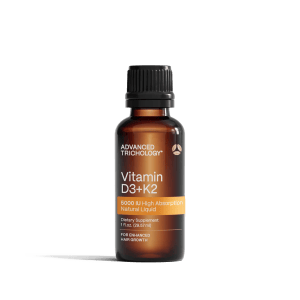
Advanced Trichology Liquid Vitamin D3 + K2 provides vitamin D3 in a liquid format together with vitamin K2.
The liquid format may suit adults who prefer drops instead of capsules. However, the correct serving still depends on the current label, blood-test result, total vitamin D intake, medical history, and clinician guidance.
- Format: Liquid drops.
- Key nutrients: Vitamin D3 and vitamin K2.
- Best considered for: Adults whose blood result and treatment plan support vitamin D supplementation.
- Important: Review the current Supplement Facts panel before use because formulas and serving instructions may change.
View Advanced Trichology Vitamin D3 + K2 02FoliGROWTH Hair Growth Supplement
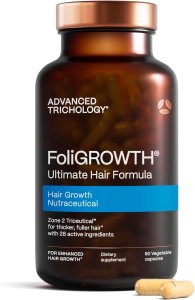
FoliGROWTH is a broader multi ingredient hair nutrition supplement from Advanced Trichology.
The manufacturer’s current label lists 50 mcg (2,000 IU) vitamin D3, 5,000 mcg biotin and 8 mg iron per three-capsule serving. These are label amounts, not a recommendation to take the product. However, it should not be used to guess at a deficiency or replace diagnosis-specific care.
- Format: Multi-ingredient hair supplement.
- Best considered for: Adults whose nutritional needs and clinician’s advice justify the complete formula. Tell the clinician and laboratory about its biotin before blood testing.
- Important: Check for duplicated vitamins, minerals, herbs, and other ingredients across your existing supplements.
- Medical note: A multi-ingredient product cannot correct every cause of hair loss and may not suit every person.
View Advanced Trichology FoliGROWTH on Amazon Affiliate disclosure: Trichology.com may earn a commission from qualifying Amazon purchases at no additional cost to you. Product inclusion does not mean that a supplement can diagnose, prevent, treat, or cure hair loss. Formulas, serving sizes, sellers, prices, availability, and warnings may change. Review the current label before purchase or use.
17UNDERSTAND THE DETAILSHow Much Vitamin D3 Should You Take?
There is no single vitamin D dose that treats hair loss for everyone.
General nutritional intake and medical treatment for deficiency are not the same.
For most adults, the general recommended dietary allowance is:
- 600 IU, or 15 mcg, daily for adults aged 19 to 70.
- 800 IU, or 20 mcg, daily for adults aged 71 and older.
These amounts include vitamin D from food, drinks, and supplements. They are general nutritional recommendations, not treatment doses for confirmed deficiency.
Some adults receive higher clinician-directed doses when deficiency is present. However, the plan should reflect the blood result and individual medical situation.
For adults, the general tolerable upper intake level is 4,000 IU, or 100 mcg, per day. A clinician may temporarily prescribe more for a documented deficiency, but this should not be done through self-treatment.
More vitamin D does not produce faster hair growth.
01Why High-Dose Self-Treatment Is Risky
High-dose products may provide:
- 5,000 IU per capsule.
- 10,000 IU per capsule.
- 50,000 IU per weekly capsule.
These amounts may be used in selected medical treatment plans. However, they should not be chosen simply because hair is shedding.
Before taking a high-dose product, review the blood result, calcium status, kidney health, other supplements, and treatment plan with a qualified professional.
18UNDERSTAND THE DETAILSVitamin D2 Versus Vitamin D3
Supplements usually contain vitamin D2 or vitamin D3.
Vitamin D2 is called ergocalciferol. It is often produced from fungal or yeast sources.
Vitamin D3 is called cholecalciferol. It may come from animal-derived lanolin or vegan lichen sources.
Both forms can raise vitamin D levels. However, vitamin D3 may maintain circulating levels more effectively in some situations.
The best option depends on:
01The prescribed treatment plan.02Product availability.03Dietary preference.04Current blood level.05Adherence.06Clinician guidance.19UNDERSTAND THE DETAILSTreating Hair Loss Linked to Vitamin D3 Deficiency
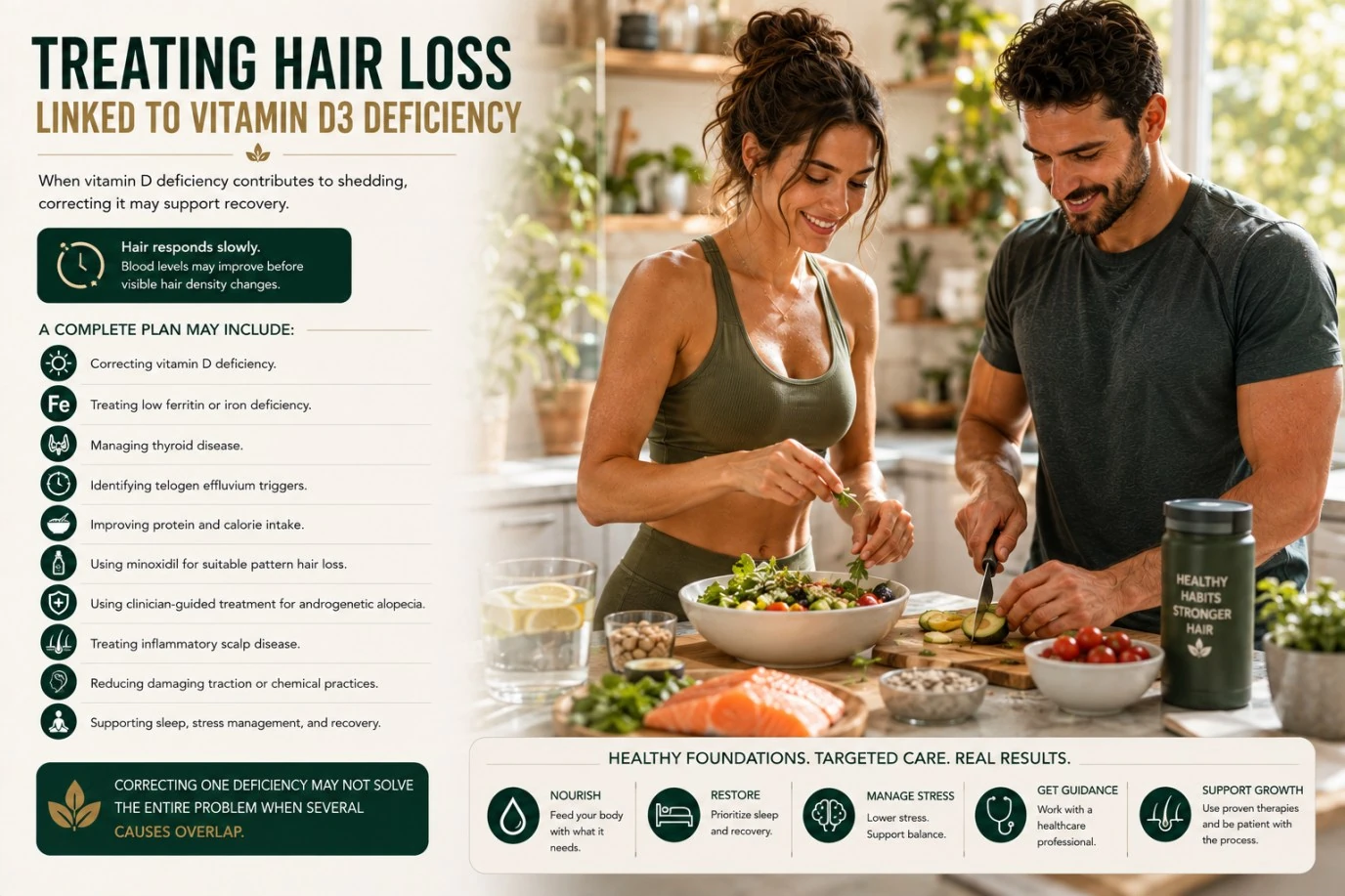
When vitamin D deficiency contributes to shedding, correcting it may support recovery.
However, hair responds slowly. Blood levels may improve before visible hair density changes.
A complete plan may include:
01Correcting vitamin D deficiency.02Treating low ferritin or iron deficiency.03Managing thyroid disease.04Identifying telogen effluvium triggers.05Improving protein and calorie intake.06Using minoxidil for suitable pattern hair loss.07Using clinician-guided treatment for androgenetic alopecia.08Treating inflammatory scalp disease.09Reducing damaging traction or chemical practices.10Supporting sleep, stress management, and recovery.Correcting one deficiency may not solve the entire problem when several causes overlap.
For further guidance, explore the androgenetic alopecia guide and the DHT-blocker serum guide.
20UNDERSTAND THE DETAILSHow Long Does Hair Recovery Take?

Hair recovery does not begin and finish on the same day that vitamin D levels improve.
Review area What to assess Next step Vitamin D status Correction and monitoring depend on the initial result and clinical context. Follow the clinician’s plan for dose and any repeat testing. Shedding A change in shedding does not establish which treatment caused it. Review persistent or worsening loss and overlapping causes. Visible hair changes Hair grows slowly; improvement varies and is not guaranteed. Use consistent photographs at agreed follow-up intervals. Results vary according to the diagnosis, severity, duration, age, genetics, treatment consistency, and other contributing factors.
21UNDERSTAND THE DETAILSHow to Track Hair Recovery
Use a consistent method rather than relying on daily mirror checks.
01Take baseline photographs: Capture the hairline, temples, part, top, and crown.02Keep conditions consistent: Use the same lighting, distance, hairstyle, and camera angle.03Record treatment: Note the vitamin D product, dose, start date, and other supplements.04Track shedding: Record major changes without counting every individual hair.05Separate shedding from breakage: Short snapped strands are different from hairs released at the root.06Review every three months: Hair-cycle changes are too slow for useful daily comparisons.22UNDERSTAND THE DETAILSCan Too Much Vitamin D Cause Hair Loss?
Excessive vitamin D can cause toxicity.
This usually results from taking too many supplements rather than ordinary food or sunlight exposure.
Vitamin D toxicity can raise calcium levels in the blood. This condition is called hypercalcaemia.
Possible symptoms include:
01Nausea.02Vomiting.03Weakness.04Loss of appetite.05Constipation.06Excessive thirst.07Frequent urination.08Confusion.09Kidney stones.10Kidney damage.11Abnormal heart rhythm in severe cases.Vitamin D toxicity is not a common direct explanation for hair loss. However, severe illness, high calcium, dehydration, kidney problems, and nutritional imbalance can affect overall health and hair cycling.
Therefore, do not use high-dose vitamin D as a trial-and-error hair treatment.
23PRACTICAL STEPSWho Should Use Vitamin D Supplements Carefully?
Seek professional guidance before high-dose supplementation when you:
01Have kidney disease.02Have liver disease.03Have high calcium levels.04Have kidney stones.05Have sarcoidosis or another granulomatous condition.06Have hyperparathyroidism.07Have a malabsorption disorder.08Are pregnant or breastfeeding.09Take thiazide diuretics or other interacting medicines.10Already take several vitamin D or calcium products.Always check multivitamins, hair supplements, calcium products, and fortified foods when calculating total intake.
24UNDERSTAND THE DETAILSWhen Vitamin D Is Not the Complete Answer
Correcting vitamin D will not directly treat every form of hair loss.
Another approach may be needed for:
020304Traction alopecia.06Thyroid disease.07PCOS or another hormonal condition.08Medication-related shedding.09Inflammatory scalp disease.More than one cause may be present. For example, a person may have both female pattern hair loss and low vitamin D.
25UNDERSTAND THE DETAILSStill Shedding After Correcting Vitamin D?
Persistent hair loss may involve low ferritin, thyroid disease, stress, medication, pattern hair loss, inflammation, or a scalp condition.
A trichologist can assess the visible pattern and help identify the next step. A dermatologist or doctor may also be needed for diagnosis, laboratory interpretation, prescription treatment, or inflammatory hair loss.
26ASSESSMENT & SUPPORTWhen to See a Trichologist, Doctor or Dermatologist

Discuss your hair and scalp concerns with a qualified professional. 01When to See a Trichologist
Consider a trichology assessment when:
- Diffuse shedding continues for several months.
- You cannot tell whether the problem is shedding, thinning, or breakage.
- Another type of hair loss may overlap with vitamin D deficiency.
- Several supplements or products have not helped.
- You need structured photographs and progress monitoring.
- You need supportive scalp and hair-care guidance.
02When to See a Doctor or Dermatologist
Seek medical assessment when:
- Vitamin D deficiency is severe or persistent.
- Hair loss begins suddenly or progresses rapidly.
- You develop smooth bald patches.
- The scalp becomes painful, inflamed, crusted, or draining.
- Smooth, shiny, or scar-like areas appear.
- Eyebrows or eyelashes begin to fall out.
- You experience fatigue, weakness, fever, or weight changes.
- You have kidney, liver, digestive, calcium, or parathyroid problems.
- You need prescription treatment or a high-dose vitamin D plan.
28UNDERSTAND THE DETAILSFrequently Asked Questions About Vitamin D3 Deficiency and Hair Loss
Vitamin D and Hair Loss
- Can vitamin D3 deficiency cause hair loss?
- Vitamin D3 deficiency may contribute to hair loss in some people. However, hair loss often has several causes. Vitamin D should be assessed alongside ferritin, thyroid function, hormones, stress, medication, and scalp health.
- What type of hair loss is associated with low vitamin D?
- Low vitamin D has been associated with telogen effluvium, female pattern hair loss, male androgenetic alopecia, and alopecia areata. An association does not prove that vitamin D deficiency caused the condition.
- Can low vitamin D cause diffuse hair shedding?
- Low vitamin D may contribute to diffuse shedding in some people. However, telogen effluvium can also follow illness, stress, childbirth, medication, rapid weight loss, low ferritin, or thyroid disease.
- Can low vitamin D cause patchy hair loss?
- Patchy loss may occur with alopecia areata, which has been associated with lower vitamin D levels. However, patchy loss needs professional assessment because autoimmune, infectious, and scarring conditions can look similar.
- Does vitamin D block DHT?
- No. Vitamin D is not an established DHT blocker. It may support general follicle and immune function, but it does not replace diagnosis-specific treatment for androgenetic alopecia.
- Can vitamin D regrow a receding hairline?
- Vitamin D cannot reliably regrow a receding hairline caused by androgenetic alopecia. Correcting a deficiency may support general health, but pattern loss usually needs a separate treatment plan.
Testing and Blood Levels
- How do I know whether low vitamin D is affecting my hair?
- Hair shedding, fatigue or weakness cannot establish vitamin D deficiency or prove that it caused hair loss. A clinician can decide whether a serum 25(OH)D test is appropriate and interpret the result with the wider assessment.
- Which vitamin D blood test should I ask for?
- When testing is clinically indicated, serum 25-hydroxyvitamin D, or 25(OH)D, is the usual measure. Ask whether it is appropriate for your case rather than assuming routine screening is needed.
- What vitamin D level is considered deficient?
- Levels below 12 ng/mL, or 30 nmol/L, are generally considered too low. Results between 12 and below 20 ng/mL may be inadequate for some people. A clinician should interpret the result in context.
- What vitamin D level is best for hair growth?
- No universally accepted vitamin D level has been proven to optimise hair growth for every person. Hair-loss treatment should not target an arbitrary online number.
- What else should be tested besides vitamin D?
- Depending on the symptoms, a clinician may consider ferritin, iron studies, a complete blood count, thyroid markers, vitamin B12, folate, zinc, hormones, and inflammatory markers.
Supplements, Dosage and Recovery
- Should I take vitamin D3 supplements for hair loss?
- Supplements may be appropriate when testing confirms low vitamin D or a clinician identifies a clear need. High-dose treatment should not be started without guidance.
- How much vitamin D3 should I take for hair loss?
- There is no universal hair-loss dose. The correct amount depends on the blood level, age, health history, diet, kidney function, medication, and treatment plan.
- Is 2,000 IU of vitamin D3 safe?
- Two thousand IU is below the general adult upper intake level of 4,000 IU per day. However, whether it is appropriate depends on your blood level, other sources of vitamin D, medical history, medicines, and clinician’s advice.
- Is 5,000 IU of vitamin D3 safe?
- Five thousand IU exceeds the general adult upper intake level of 4,000 IU per day. A clinician may use this amount in selected cases, but it should not become automatic long-term self-treatment.
- How long does vitamin D take to help hair?
- There is no established vitamin-D-specific timetable for hair recovery. Blood levels and hair changes do not improve on the same schedule. Response depends on the diagnosis and other treatment; arrange follow-up with the treating clinician.
- Will hair grow back after correcting vitamin D deficiency?
- Hair may recover when deficiency was an important contributor and the follicles remain active. Regrowth is less predictable when another condition, such as pattern hair loss or scarring alopecia, is present.
- Is vitamin D2 or vitamin D3 better?
- Both forms can raise vitamin D levels. Vitamin D3 may maintain levels more effectively in some situations, but the best option depends on the treatment plan and individual needs.
- Which vitamin D3 supplement should I choose?
- Choose a clearly labelled product and match the dose to your blood result and treatment plan. Advanced Trichology Liquid Vitamin D3 + K2 is one option for readers who prefer drops. FoliGROWTH is a broader multi-ingredient hair-nutrition formula rather than a stand-alone vitamin D product. Review the complete label, other supplements, allergen information, serving size, expiry details, and current seller before purchase.
Safety and Other Causes
- Can too much vitamin D make hair loss worse?
- Excess vitamin D can cause toxicity and high blood calcium. Severe illness, kidney problems, dehydration, or nutritional imbalance may also affect overall health and hair cycling.
- Can vitamin D supplements cause side effects?
- Appropriate doses are often well tolerated. Excessive intake may cause nausea, weakness, constipation, excessive thirst, frequent urination, confusion, kidney stones, or kidney damage.
- What if my hair is still falling after my vitamin D improves?
- Another cause may still be active. Possibilities include low ferritin, thyroid disease, androgenetic alopecia, telogen effluvium, medication, stress, inflammation, or scalp disease.
- Should I see a trichologist or dermatologist?
- A trichologist can assess the visible p
29ASSESSMENT & SUPPORT
Find a Trichologist Near You
Vitamin D deficiency may be one part of the hair-loss picture, but shedding and thinning often have overlapping causes. A qualified trichologist can assess the visible pattern and identify signs that require medical testing or referral.
The public practitioner directory is being reopened in stages. Check the current directory availability rather than relying on the retired state listings.
30UNDERSTAND THE DETAILSConclusion: Can Vitamin D3 Deficiency Cause Hair Loss?
Vitamin D3 deficiency may contribute to hair loss in some people. Vitamin D receptor signalling plays a role in follicle biology, and low blood levels have been associated with several hair-loss conditions.
These conditions include telogen effluvium, alopecia areata, female pattern hair loss, and male androgenetic alopecia.
However, association does not prove that vitamin D deficiency is the only cause. Hair loss often has several overlapping drivers.
A broader clinical assessment can determine whether vitamin D testing is indicated. Depending on the case, it may also consider iron status, thyroid function, medication, scalp disease and the pattern of thinning.
When a deficiency is confirmed, correcting it may support recovery. However, treatment should follow the blood result and medical context rather than supplement guessing.
If a correctable contributing factor is identified, visible change is not immediate and timing varies. Persistent thinning may also require separate assessment or treatment for pattern loss, inflammatory disease, telogen effluvium, or another condition.
01Ready to Review Your Options?
Start with professional assessment and testing when clinically indicated. When supplementation is appropriate, compare the dose, complete formula, and all other supplements you already use.
View Advanced Trichology Vitamin D3 + K2 View Advanced Trichology FoliGROWTH Check the current label, dose, ingredients, warnings, seller, price, and availability before purchase. Do not use an affiliate product recommendation as a substitute for testing or professional guidance.
Next step: Read about ferritin deficiency and hair loss, review the nutritional deficiencies guide, or check directory availability.
31SOURCESReferences and Further Reading
04Medical disclaimer: This article is for general informational and educational purposes only. It does not provide medical advice, diagnosis, laboratory interpretation, or a personalised recommendation to use vitamin D, another supplement, medicine, serum, shampoo, or procedure. Do not start or continue high-dose vitamin D without appropriate professional guidance. Seek prompt assessment for sudden shedding, rapid progression, bald patches, scalp pain, inflammation, infection, eyebrow loss, or smooth and scar-like areas.
CONTINUE LEARNINGRead next
Explore related guides for your next step.
 HAIR & SCALP EDUCATION
Vitamin D3 Deficiency and Hair Loss
Can low vitamin D contribute to hair loss? Learn about the evidence, symptoms, when testing may be appropriate, safe treatment, and other causes of shedding.
01START HEREVitamin D3 Deficiency and Hair Loss: Causes, Signs, Treatment and Recovery
Vitamin D3 deficiency may contribute to hair loss in some people, but it is rarely the only possible cause.
Hair loss can also result from genetics, stress, thyroid disease, low ferritin, iron deficiency, inflammation, autoimmune disease, medication, illness, hormonal changes, or scalp disorders.
Vitamin D supports bone health, immune function, and normal cell activity. It also appears to play a role in hair-follicle signalling and the normal hair-growth cycle.
Some people with low vitamin D experience increased shedding, slower recovery, or reduced hair density. However, these symptoms do not confirm a vitamin D deficiency.
Start with a clinical assessment. Ask a healthcare professional whether vitamin D testing is appropriate for your symptoms, history and findings. Routine screening is not recommended for generally healthy adults without an established indication. A wider assessment may consider iron stores, thyroid function, recent illness, medication, scalp health and the pattern of hair loss.
This guide explains how vitamin D relates to hair follicles, which types of hair loss have been associated with low levels, how deficiency is tested, when supplements may help, and how long recovery may take.
Medical note: This article provides general educational information only. It does not diagnose hair loss or replace advice from a doctor, dermatologist, pharmacist, registered dietitian, or another appropriately qualified healthcare professional.
02UNDERSTAND THE DETAILSKey Takeaways
01Vitamin D3 deficiency may contribute to hair loss. Low levels may affect follicle cycling, immune activity, and normal hair growth.02Several hair-loss conditions have been associated with low vitamin D. These include telogen effluvium, androgenetic alopecia, female pattern hair loss, and alopecia areata.03An association does not prove causation. Low vitamin D may coexist with hair loss without being its main cause.04Hair follicles contain vitamin D receptors. Vitamin D receptor signalling plays an important role in follicle biology and hair cycling.05Testing is selected according to clinical need. Symptoms and hair shedding alone cannot confirm deficiency; a clinician can decide whether a 25(OH)D test is indicated.06Supplements should not be taken blindly. Excessive vitamin D can raise blood calcium and cause serious toxicity.07Recovery takes time. Even after blood levels improve, visible hair changes may take several months.08Other causes still need attention. Ferritin, thyroid function, stress, medication, inflammation, hormones, and pattern hair loss may overlap.03PRACTICAL STEPSQuick Next Steps
01Check the pattern: Diffuse shedding, a widening part, recession, bald patches, and breakage have different causes.02Test before taking high doses: Ask whether a 25-hydroxyvitamin D blood test is appropriate.03Review overlapping factors: Ferritin, thyroid function, protein intake, medication, hormones, stress, and scalp health may also matter.04Track progress objectively: Take photographs every three months under the same lighting and camera angle.05Watch for warning signs: Sudden loss, bald patches, pain, burning, redness, pustules, or scar-like areas need assessment.06Read the related guides: Learn about nutritional deficiencies linked to hair loss and ferritin deficiency and hair loss .04UNDERSTAND THE DETAILSNot Sure Whether Low Vitamin D Is Affecting Your Hair?
A widening part, heavy shedding, slow regrowth, and reduced density can have several causes. Vitamin D deficiency may contribute, but low ferritin, thyroid disease, stress, inflammation, medication, and pattern hair loss may also be involved.
A trichologist can assess the visible pattern, scalp condition, shedding history, and hair-shaft quality. They can also identify signs that require medical testing or dermatology referral.
05UNDERSTAND THE DETAILSWhat Is Vitamin D3?
Vitamin D3, also called cholecalciferol, is a fat-soluble form of vitamin D.
It supports:
01Calcium absorption.02Bone and muscle health.03Immune regulation.04Normal cell growth and signalling.05Neuromuscular function.The body can produce vitamin D3 when ultraviolet B radiation reaches the skin. The liver then converts vitamin D into 25-hydroxyvitamin D. After that, the kidneys and other tissues convert it into an active hormonal form.
Vitamin D also affects skin and follicle biology. For this reason, researchers have studied its possible role in hair growth, shedding, and inflammatory hair-loss conditions.
06UNDERSTAND THE DETAILSHow Vitamin D3 Deficiency May Affect Hair Health
Hair follicles move through repeated stages of growth, transition, rest, and shedding.
The active growth stage is called anagen. During this stage, follicle cells divide and produce a new hair shaft.
Vitamin D signalling appears to contribute to normal follicle activity. Therefore, low vitamin D may affect the follicle environment in some people.
Possible hair-related effects may include:
01Increased diffuse shedding.02Slower recovery after telogen effluvium.03Reduced density.04Changes in follicle cycling.05Overlap with inflammatory or autoimmune hair loss.However, none of these symptoms is specific to vitamin D deficiency.
Low ferritin, thyroid disease, illness, stress, medication changes, hormonal shifts, insufficient protein, and scalp inflammation can cause similar changes.
When clinically indicated, vitamin D testing can form part of a wider assessment; it is not automatically required for every hair-loss case.
07UNDERSTAND THE DETAILSThe Role of Vitamin D Receptors in Hair Follicles
Hair follicles contain vitamin D receptors, also known as VDRs.
These receptors help regulate follicle biology and hair cycling. Research into rare genetic disorders has shown that severe disruption of VDR function can cause sparse hair or alopecia.
For example, some people with hereditary vitamin D-resistant rickets develop alopecia because their vitamin D receptors do not function normally.
This evidence confirms that VDR signalling matters to hair biology.
However, receptor dysfunction is not the same as an ordinary low vitamin D blood result. Therefore, it does not prove that every person with low vitamin D will lose hair or that supplementation will regrow hair in every case.
08UNDERSTAND THE DETAILSVitamin D3 Deficiency and Different Types of Hair Loss
01Telogen Effluvium
Telogen effluvium causes increased shedding across the scalp.
Common triggers include:
- Illness or fever.
- Emotional stress.
- Surgery.
- Childbirth.
- Rapid weight loss.
- Medication changes.
- Low calorie or protein intake.
- Nutritional deficiencies.
Some studies have found lower vitamin D levels in people with telogen effluvium. However, that finding does not prove that vitamin D deficiency is always the main trigger.
A complete assessment should also consider ferritin, iron status, thyroid function, diet, recent illness, medication, and psychological or physical stress.
02Female Pattern Hair Loss
Female pattern hair loss usually causes a widening part and reduced density across the top of the scalp.
Some studies have reported lower vitamin D levels among women with this condition. However, female pattern hair loss is mainly influenced by genetics, age, hormone sensitivity, and follicular miniaturisation.
Correcting a confirmed vitamin D deficiency may support general health. Still, it does not replace established treatment for androgenetic alopecia.
Read more about androgenetic alopecia and its treatment options.
03Male Pattern Hair Loss
Male pattern hair loss often causes temple recession, a receding hairline, crown thinning, or reduced density across the top of the scalp.
Research has explored links between vitamin D status and male androgenetic alopecia. However, vitamin D does not directly block DHT or reverse genetic follicle sensitivity.
Therefore, men with progressive pattern loss may need diagnosis-specific treatment even when vitamin D is low.
Learn more about DHT and hair-follicle miniaturisation.
04Alopecia Areata
Alopecia areata is an autoimmune form of hair loss. It often causes round or oval bald patches on the scalp, beard, eyebrows, eyelashes, or body.
Several studies and meta-analyses have found a higher prevalence of vitamin D deficiency among people with alopecia areata.
However, this association does not prove that low vitamin D caused the disease. Alopecia areata requires proper medical diagnosis and may need corticosteroids, JAK inhibitors, contact immunotherapy, or another dermatologist-directed treatment.
Vitamin D correction should not replace autoimmune hair-loss treatment.
05Scarring Alopecia
Scarring alopecia involves inflammation that can permanently damage and destroy hair follicles.
Vitamin D abnormalities have been studied in some scarring conditions. However, correcting vitamin D cannot stop active follicular destruction by itself.
Seek prompt assessment for:
- Scalp pain or burning.
- Persistent redness.
- Pustules or crusting.
- Rapid recession.
- Eyebrow loss.
- Smooth or shiny areas.
- Missing follicular openings.
Learn more in the guide to scarring alopecia.
09UNDERSTAND THE DETAILSWhat Does the Research Say About Vitamin D and Hair Loss?
Research has found associations between low vitamin D and several forms of alopecia.
These include:
01Alopecia areata.02Telogen effluvium.03Female pattern hair loss.04Male androgenetic alopecia.05Some scarring alopecias.Recent reviews have reported lower average 25-hydroxyvitamin D levels or a higher prevalence of deficiency among people with several non-scarring alopecias.
However, most of the available research is observational. Observational studies can identify a relationship, but they cannot prove that low vitamin D directly caused the hair loss.
In addition, treatment evidence remains less certain than association evidence. We still need stronger clinical trials to determine:
01Who is most likely to benefit from supplementation.02Whether correction improves hair independently of other treatment.03Which hair-loss conditions respond best.04What blood level is most relevant to hair outcomes.05How long supplementation should continue.The findings support investigating vitamin D status when clinically indicated and correcting a confirmed deficiency. It does not support treating every case of hair loss with high-dose vitamin D.
10UNDERSTAND THE DETAILSWhat Current Evidence Does Not Prove
The available research does not prove that:
01Low vitamin D is the only cause of hair loss.02Every person with hair loss has a deficiency.03Vitamin D supplements regrow hair in everyone.04A higher dose produces faster hair growth.05Vitamin D can replace minoxidil or prescription treatment.06Vitamin D directly blocks DHT.07Correcting vitamin D cures alopecia areata.08Vitamin D alone stops scarring alopecia.This distinction protects patients from losing time on the wrong treatment.
11UNDERSTAND THE DETAILSWho Is More Likely to Have Low Vitamin D?
Vitamin D deficiency can affect anyone. However, the following factors may increase risk:
01Limited sunlight exposure.02Working mainly indoors.03Living in a region with long winters.04Darker skin pigmentation.05Older age.06Clothing that covers most of the skin.07Digestive conditions that reduce fat absorption.08Celiac disease or inflammatory bowel disease.09A history of bariatric surgery.10Liver or kidney disease.11Obesity.12Medicines that affect vitamin D metabolism.13Very limited dietary vitamin D intake.Having one or more risk factors does not confirm deficiency or automatically require screening. A clinician can decide whether testing is appropriate.
12UNDERSTAND THE DETAILSSigns and Symptoms of Vitamin D3 Deficiency
Vitamin D deficiency may cause no obvious symptoms.
When symptoms occur, they may include:
01Fatigue.02Muscle weakness.03Bone or muscle discomfort.04Low mood.05Reduced physical performance.06Increased shedding in some people.These symptoms are not specific to vitamin D deficiency.
Anaemia, thyroid disease, sleep problems, stress, depression, infection, medication, and other nutritional deficiencies can produce similar symptoms.
Therefore, symptoms alone should not determine the supplement dose.
13UNDERSTAND THE DETAILSHow Vitamin D Deficiency Is Tested
The main blood test used to assess vitamin D status is serum 25-hydroxyvitamin D, written as 25(OH)D.
This test measures the main circulating form of vitamin D.
A healthcare professional should interpret the result because reference points and treatment decisions can depend on:
01The laboratory method.02Age.03Bone health.04Kidney and liver function.05Pregnancy status.06Calcium levels.07Medication.08Malabsorption.09Other medical conditions.01Understanding Vitamin D Blood Levels
25(OH)D Result General Interpretation Important Context Below 12 ng/mL
Below 30 nmol/LGenerally considered too low and associated with deficiency risk Medical review and a correction plan may be needed. 12 to below 20 ng/mL
30 to below 50 nmol/LMay be inadequate for some people Interpretation depends on health history, risk factors, symptoms, and clinical guidance. 20 ng/mL or above
50 nmol/L or aboveAdequate for bone and overall health in most people This does not prove that vitamin D is unrelated to an individual hair-loss case. Above 50 ng/mL
Above 125 nmol/LMay be associated with potential adverse effects Do not continue increasing the dose without professional review. These ranges provide general nutritional context. They are not hair-growth targets.
No universally accepted vitamin D level has been proven to optimise hair growth for every person.
14UNDERSTAND THE DETAILSOther Tests That May Be Relevant for Hair Loss
Vitamin D is only one possible factor.
Depending on the symptoms, history, and visible pattern, a clinician may consider:
01Ferritin.02Serum iron.03Total iron-binding capacity.04Transferrin saturation.05Complete blood count.06Thyroid-stimulating hormone.07Free thyroid hormones when indicated.08Vitamin B12.09Folate.10Zinc or copper in selected cases.11Hormonal testing when symptoms support it.12Inflammatory or autoimmune markers when clinically indicated.Testing should match the individual case. It should not become the same generic checklist for everyone.
For a wider overview, read about nutritional deficiencies that may contribute to hair loss.
15PRACTICAL STEPSHow to Maintain Healthy Vitamin D3 Levels
Vitamin D status may be supported through sunlight, food, supplements when needed, and follow-up testing.
01Safe Sun Exposure
Sunlight helps the skin produce vitamin D3.
However, production varies according to:
- Skin pigmentation.
- Location.
- Season.
- Time of day.
- Age.
- Cloud cover.
- Clothing.
- Sunscreen use.
Do not use prolonged unprotected sun exposure or tanning beds as a vitamin D treatment.
Skin-cancer prevention remains important. People at risk of deficiency should discuss food, supplements, and testing rather than deliberately burning or damaging their skin.
02Vitamin D-Rich Foods
Food sources include:
- Salmon.
- Sardines.
- Trout.
- Mackerel.
- Tuna.
- Egg yolks.
- Fortified dairy products.
- Fortified plant-based drinks.
- Fortified cereals.
- Some UV-exposed mushrooms.
Diet can support vitamin D intake. However, food alone may not correct a substantial deficiency.
03Fortified Foods
Fortified foods can add vitamin D to the diet.
Examples include milk, plant-based drinks, breakfast cereals, and selected juices.
The amount varies considerably between products. Therefore, check the nutrition label rather than assuming that every fortified product provides the same amount.
04Vitamin D3 Supplements
Supplements may help when testing confirms low vitamin D or when a clinician identifies a clear risk.
The appropriate dose depends on:
- The current blood level.
- Age.
- Body size.
- Diet.
- Kidney and liver function.
- Malabsorption.
- Pregnancy status.
- Medication.
- Other health conditions.
High-dose correction plans require professional supervision. Follow-up testing may also be necessary.
16UNDERSTAND THE DETAILSAdvanced Trichology Vitamin D and Hair-Support Options
Only consider vitamin D supplementation after reviewing your blood level, total intake, medicines, and medical history.
The products below are from Advanced Trichology, the hair-health brand founded by trichologist William Gaunitz. They are included for label comparison when supplementation fits an identified nutritional need and an individual care plan. Product inclusion is not evidence that the formula will regrow hair.
They are not substitutes for blood testing, diagnosis, or treatment of the underlying cause of hair loss.
01Liquid Vitamin D3 + K2
Advanced Trichology Liquid Vitamin D3 + K2 provides vitamin D3 in a liquid format together with vitamin K2.
The liquid format may suit adults who prefer drops instead of capsules. However, the correct serving still depends on the current label, blood-test result, total vitamin D intake, medical history, and clinician guidance.
- Format: Liquid drops.
- Key nutrients: Vitamin D3 and vitamin K2.
- Best considered for: Adults whose blood result and treatment plan support vitamin D supplementation.
- Important: Review the current Supplement Facts panel before use because formulas and serving instructions may change.
View Advanced Trichology Vitamin D3 + K2 02FoliGROWTH Hair Growth Supplement
FoliGROWTH is a broader multi ingredient hair nutrition supplement from Advanced Trichology.
The manufacturer’s current label lists 50 mcg (2,000 IU) vitamin D3, 5,000 mcg biotin and 8 mg iron per three-capsule serving. These are label amounts, not a recommendation to take the product. However, it should not be used to guess at a deficiency or replace diagnosis-specific care.
- Format: Multi-ingredient hair supplement.
- Best considered for: Adults whose nutritional needs and clinician’s advice justify the complete formula. Tell the clinician and laboratory about its biotin before blood testing.
- Important: Check for duplicated vitamins, minerals, herbs, and other ingredients across your existing supplements.
- Medical note: A multi-ingredient product cannot correct every cause of hair loss and may not suit every person.
View Advanced Trichology FoliGROWTH on Amazon Affiliate disclosure: Trichology.com may earn a commission from qualifying Amazon purchases at no additional cost to you. Product inclusion does not mean that a supplement can diagnose, prevent, treat, or cure hair loss. Formulas, serving sizes, sellers, prices, availability, and warnings may change. Review the current label before purchase or use.
17UNDERSTAND THE DETAILSHow Much Vitamin D3 Should You Take?
There is no single vitamin D dose that treats hair loss for everyone.
General nutritional intake and medical treatment for deficiency are not the same.
For most adults, the general recommended dietary allowance is:
- 600 IU, or 15 mcg, daily for adults aged 19 to 70.
- 800 IU, or 20 mcg, daily for adults aged 71 and older.
These amounts include vitamin D from food, drinks, and supplements. They are general nutritional recommendations, not treatment doses for confirmed deficiency.
Some adults receive higher clinician-directed doses when deficiency is present. However, the plan should reflect the blood result and individual medical situation.
For adults, the general tolerable upper intake level is 4,000 IU, or 100 mcg, per day. A clinician may temporarily prescribe more for a documented deficiency, but this should not be done through self-treatment.
More vitamin D does not produce faster hair growth.
01Why High-Dose Self-Treatment Is Risky
High-dose products may provide:
- 5,000 IU per capsule.
- 10,000 IU per capsule.
- 50,000 IU per weekly capsule.
These amounts may be used in selected medical treatment plans. However, they should not be chosen simply because hair is shedding.
Before taking a high-dose product, review the blood result, calcium status, kidney health, other supplements, and treatment plan with a qualified professional.
18UNDERSTAND THE DETAILSVitamin D2 Versus Vitamin D3
Supplements usually contain vitamin D2 or vitamin D3.
Vitamin D2 is called ergocalciferol. It is often produced from fungal or yeast sources.
Vitamin D3 is called cholecalciferol. It may come from animal-derived lanolin or vegan lichen sources.
Both forms can raise vitamin D levels. However, vitamin D3 may maintain circulating levels more effectively in some situations.
The best option depends on:
01The prescribed treatment plan.02Product availability.03Dietary preference.04Current blood level.05Adherence.06Clinician guidance.19UNDERSTAND THE DETAILSTreating Hair Loss Linked to Vitamin D3 Deficiency
When vitamin D deficiency contributes to shedding, correcting it may support recovery.
However, hair responds slowly. Blood levels may improve before visible hair density changes.
A complete plan may include:
01Correcting vitamin D deficiency.02Treating low ferritin or iron deficiency.03Managing thyroid disease.04Identifying telogen effluvium triggers.05Improving protein and calorie intake.06Using minoxidil for suitable pattern hair loss.07Using clinician-guided treatment for androgenetic alopecia.08Treating inflammatory scalp disease.09Reducing damaging traction or chemical practices.10Supporting sleep, stress management, and recovery.Correcting one deficiency may not solve the entire problem when several causes overlap.
For further guidance, explore the androgenetic alopecia guide and the DHT-blocker serum guide.
20UNDERSTAND THE DETAILSHow Long Does Hair Recovery Take?
Hair recovery does not begin and finish on the same day that vitamin D levels improve.
Review area What to assess Next step Vitamin D status Correction and monitoring depend on the initial result and clinical context. Follow the clinician’s plan for dose and any repeat testing. Shedding A change in shedding does not establish which treatment caused it. Review persistent or worsening loss and overlapping causes. Visible hair changes Hair grows slowly; improvement varies and is not guaranteed. Use consistent photographs at agreed follow-up intervals. Results vary according to the diagnosis, severity, duration, age, genetics, treatment consistency, and other contributing factors.
21UNDERSTAND THE DETAILSHow to Track Hair Recovery
Use a consistent method rather than relying on daily mirror checks.
01Take baseline photographs: Capture the hairline, temples, part, top, and crown.02Keep conditions consistent: Use the same lighting, distance, hairstyle, and camera angle.03Record treatment: Note the vitamin D product, dose, start date, and other supplements.04Track shedding: Record major changes without counting every individual hair.05Separate shedding from breakage: Short snapped strands are different from hairs released at the root.06Review every three months: Hair-cycle changes are too slow for useful daily comparisons.22UNDERSTAND THE DETAILSCan Too Much Vitamin D Cause Hair Loss?
Excessive vitamin D can cause toxicity.
This usually results from taking too many supplements rather than ordinary food or sunlight exposure.
Vitamin D toxicity can raise calcium levels in the blood. This condition is called hypercalcaemia.
Possible symptoms include:
01Nausea.02Vomiting.03Weakness.04Loss of appetite.05Constipation.06Excessive thirst.07Frequent urination.08Confusion.09Kidney stones.10Kidney damage.11Abnormal heart rhythm in severe cases.Vitamin D toxicity is not a common direct explanation for hair loss. However, severe illness, high calcium, dehydration, kidney problems, and nutritional imbalance can affect overall health and hair cycling.
Therefore, do not use high-dose vitamin D as a trial-and-error hair treatment.
23PRACTICAL STEPSWho Should Use Vitamin D Supplements Carefully?
Seek professional guidance before high-dose supplementation when you:
01Have kidney disease.02Have liver disease.03Have high calcium levels.04Have kidney stones.05Have sarcoidosis or another granulomatous condition.06Have hyperparathyroidism.07Have a malabsorption disorder.08Are pregnant or breastfeeding.09Take thiazide diuretics or other interacting medicines.10Already take several vitamin D or calcium products.Always check multivitamins, hair supplements, calcium products, and fortified foods when calculating total intake.
24UNDERSTAND THE DETAILSWhen Vitamin D Is Not the Complete Answer
Correcting vitamin D will not directly treat every form of hair loss.
Another approach may be needed for:
020304Traction alopecia.06Thyroid disease.07PCOS or another hormonal condition.08Medication-related shedding.09Inflammatory scalp disease.More than one cause may be present. For example, a person may have both female pattern hair loss and low vitamin D.
25UNDERSTAND THE DETAILSStill Shedding After Correcting Vitamin D?
Persistent hair loss may involve low ferritin, thyroid disease, stress, medication, pattern hair loss, inflammation, or a scalp condition.
A trichologist can assess the visible pattern and help identify the next step. A dermatologist or doctor may also be needed for diagnosis, laboratory interpretation, prescription treatment, or inflammatory hair loss.
26ASSESSMENT & SUPPORTWhen to See a Trichologist, Doctor or Dermatologist
Discuss your hair and scalp concerns with a qualified professional. 01When to See a Trichologist
Consider a trichology assessment when:
- Diffuse shedding continues for several months.
- You cannot tell whether the problem is shedding, thinning, or breakage.
- Another type of hair loss may overlap with vitamin D deficiency.
- Several supplements or products have not helped.
- You need structured photographs and progress monitoring.
- You need supportive scalp and hair-care guidance.
02When to See a Doctor or Dermatologist
Seek medical assessment when:
- Vitamin D deficiency is severe or persistent.
- Hair loss begins suddenly or progresses rapidly.
- You develop smooth bald patches.
- The scalp becomes painful, inflamed, crusted, or draining.
- Smooth, shiny, or scar-like areas appear.
- Eyebrows or eyelashes begin to fall out.
- You experience fatigue, weakness, fever, or weight changes.
- You have kidney, liver, digestive, calcium, or parathyroid problems.
- You need prescription treatment or a high-dose vitamin D plan.
28UNDERSTAND THE DETAILSFrequently Asked Questions About Vitamin D3 Deficiency and Hair Loss
Vitamin D and Hair Loss
- Can vitamin D3 deficiency cause hair loss?
- Vitamin D3 deficiency may contribute to hair loss in some people. However, hair loss often has several causes. Vitamin D should be assessed alongside ferritin, thyroid function, hormones, stress, medication, and scalp health.
- What type of hair loss is associated with low vitamin D?
- Low vitamin D has been associated with telogen effluvium, female pattern hair loss, male androgenetic alopecia, and alopecia areata. An association does not prove that vitamin D deficiency caused the condition.
- Can low vitamin D cause diffuse hair shedding?
- Low vitamin D may contribute to diffuse shedding in some people. However, telogen effluvium can also follow illness, stress, childbirth, medication, rapid weight loss, low ferritin, or thyroid disease.
- Can low vitamin D cause patchy hair loss?
- Patchy loss may occur with alopecia areata, which has been associated with lower vitamin D levels. However, patchy loss needs professional assessment because autoimmune, infectious, and scarring conditions can look similar.
- Does vitamin D block DHT?
- No. Vitamin D is not an established DHT blocker. It may support general follicle and immune function, but it does not replace diagnosis-specific treatment for androgenetic alopecia.
- Can vitamin D regrow a receding hairline?
- Vitamin D cannot reliably regrow a receding hairline caused by androgenetic alopecia. Correcting a deficiency may support general health, but pattern loss usually needs a separate treatment plan.
Testing and Blood Levels
- How do I know whether low vitamin D is affecting my hair?
- Hair shedding, fatigue or weakness cannot establish vitamin D deficiency or prove that it caused hair loss. A clinician can decide whether a serum 25(OH)D test is appropriate and interpret the result with the wider assessment.
- Which vitamin D blood test should I ask for?
- When testing is clinically indicated, serum 25-hydroxyvitamin D, or 25(OH)D, is the usual measure. Ask whether it is appropriate for your case rather than assuming routine screening is needed.
- What vitamin D level is considered deficient?
- Levels below 12 ng/mL, or 30 nmol/L, are generally considered too low. Results between 12 and below 20 ng/mL may be inadequate for some people. A clinician should interpret the result in context.
- What vitamin D level is best for hair growth?
- No universally accepted vitamin D level has been proven to optimise hair growth for every person. Hair-loss treatment should not target an arbitrary online number.
- What else should be tested besides vitamin D?
- Depending on the symptoms, a clinician may consider ferritin, iron studies, a complete blood count, thyroid markers, vitamin B12, folate, zinc, hormones, and inflammatory markers.
Supplements, Dosage and Recovery
- Should I take vitamin D3 supplements for hair loss?
- Supplements may be appropriate when testing confirms low vitamin D or a clinician identifies a clear need. High-dose treatment should not be started without guidance.
- How much vitamin D3 should I take for hair loss?
- There is no universal hair-loss dose. The correct amount depends on the blood level, age, health history, diet, kidney function, medication, and treatment plan.
- Is 2,000 IU of vitamin D3 safe?
- Two thousand IU is below the general adult upper intake level of 4,000 IU per day. However, whether it is appropriate depends on your blood level, other sources of vitamin D, medical history, medicines, and clinician’s advice.
- Is 5,000 IU of vitamin D3 safe?
- Five thousand IU exceeds the general adult upper intake level of 4,000 IU per day. A clinician may use this amount in selected cases, but it should not become automatic long-term self-treatment.
- How long does vitamin D take to help hair?
- There is no established vitamin-D-specific timetable for hair recovery. Blood levels and hair changes do not improve on the same schedule. Response depends on the diagnosis and other treatment; arrange follow-up with the treating clinician.
- Will hair grow back after correcting vitamin D deficiency?
- Hair may recover when deficiency was an important contributor and the follicles remain active. Regrowth is less predictable when another condition, such as pattern hair loss or scarring alopecia, is present.
- Is vitamin D2 or vitamin D3 better?
- Both forms can raise vitamin D levels. Vitamin D3 may maintain levels more effectively in some situations, but the best option depends on the treatment plan and individual needs.
- Which vitamin D3 supplement should I choose?
- Choose a clearly labelled product and match the dose to your blood result and treatment plan. Advanced Trichology Liquid Vitamin D3 + K2 is one option for readers who prefer drops. FoliGROWTH is a broader multi-ingredient hair-nutrition formula rather than a stand-alone vitamin D product. Review the complete label, other supplements, allergen information, serving size, expiry details, and current seller before purchase.
Safety and Other Causes
- Can too much vitamin D make hair loss worse?
- Excess vitamin D can cause toxicity and high blood calcium. Severe illness, kidney problems, dehydration, or nutritional imbalance may also affect overall health and hair cycling.
- Can vitamin D supplements cause side effects?
- Appropriate doses are often well tolerated. Excessive intake may cause nausea, weakness, constipation, excessive thirst, frequent urination, confusion, kidney stones, or kidney damage.
- What if my hair is still falling after my vitamin D improves?
- Another cause may still be active. Possibilities include low ferritin, thyroid disease, androgenetic alopecia, telogen effluvium, medication, stress, inflammation, or scalp disease.
- Should I see a trichologist or dermatologist?
- A trichologist can assess the visible p
29ASSESSMENT & SUPPORT
Find a Trichologist Near You
Vitamin D deficiency may be one part of the hair-loss picture, but shedding and thinning often have overlapping causes. A qualified trichologist can assess the visible pattern and identify signs that require medical testing or referral.
The public practitioner directory is being reopened in stages. Check the current directory availability rather than relying on the retired state listings.
30UNDERSTAND THE DETAILSConclusion: Can Vitamin D3 Deficiency Cause Hair Loss?
Vitamin D3 deficiency may contribute to hair loss in some people. Vitamin D receptor signalling plays a role in follicle biology, and low blood levels have been associated with several hair-loss conditions.
These conditions include telogen effluvium, alopecia areata, female pattern hair loss, and male androgenetic alopecia.
However, association does not prove that vitamin D deficiency is the only cause. Hair loss often has several overlapping drivers.
A broader clinical assessment can determine whether vitamin D testing is indicated. Depending on the case, it may also consider iron status, thyroid function, medication, scalp disease and the pattern of thinning.
When a deficiency is confirmed, correcting it may support recovery. However, treatment should follow the blood result and medical context rather than supplement guessing.
If a correctable contributing factor is identified, visible change is not immediate and timing varies. Persistent thinning may also require separate assessment or treatment for pattern loss, inflammatory disease, telogen effluvium, or another condition.
01Ready to Review Your Options?
Start with professional assessment and testing when clinically indicated. When supplementation is appropriate, compare the dose, complete formula, and all other supplements you already use.
View Advanced Trichology Vitamin D3 + K2 View Advanced Trichology FoliGROWTH Check the current label, dose, ingredients, warnings, seller, price, and availability before purchase. Do not use an affiliate product recommendation as a substitute for testing or professional guidance.
Next step: Read about ferritin deficiency and hair loss, review the nutritional deficiencies guide, or check directory availability.
31SOURCESReferences and Further Reading
04Medical disclaimer: This article is for general informational and educational purposes only. It does not provide medical advice, diagnosis, laboratory interpretation, or a personalised recommendation to use vitamin D, another supplement, medicine, serum, shampoo, or procedure. Do not start or continue high-dose vitamin D without appropriate professional guidance. Seek prompt assessment for sudden shedding, rapid progression, bald patches, scalp pain, inflammation, infection, eyebrow loss, or smooth and scar-like areas.
CONTINUE LEARNINGRead next
Explore related guides for your next step.
HAIR & SCALP EDUCATIONVitamin D3 Deficiency and Hair Loss
Can low vitamin D contribute to hair loss? Learn about the evidence, symptoms, when testing may be appropriate, safe treatment, and other causes of shedding.
01START HEREVitamin D3 Deficiency and Hair Loss: Causes, Signs, Treatment and Recovery
Vitamin D3 deficiency may contribute to hair loss in some people, but it is rarely the only possible cause.
Hair loss can also result from genetics, stress, thyroid disease, low ferritin, iron deficiency, inflammation, autoimmune disease, medication, illness, hormonal changes, or scalp disorders.
Vitamin D supports bone health, immune function, and normal cell activity. It also appears to play a role in hair-follicle signalling and the normal hair-growth cycle.
Some people with low vitamin D experience increased shedding, slower recovery, or reduced hair density. However, these symptoms do not confirm a vitamin D deficiency.
Start with a clinical assessment. Ask a healthcare professional whether vitamin D testing is appropriate for your symptoms, history and findings. Routine screening is not recommended for generally healthy adults without an established indication. A wider assessment may consider iron stores, thyroid function, recent illness, medication, scalp health and the pattern of hair loss.
This guide explains how vitamin D relates to hair follicles, which types of hair loss have been associated with low levels, how deficiency is tested, when supplements may help, and how long recovery may take.
Medical note: This article provides general educational information only. It does not diagnose hair loss or replace advice from a doctor, dermatologist, pharmacist, registered dietitian, or another appropriately qualified healthcare professional.
02UNDERSTAND THE DETAILSKey Takeaways
01Vitamin D3 deficiency may contribute to hair loss. Low levels may affect follicle cycling, immune activity, and normal hair growth.02Several hair-loss conditions have been associated with low vitamin D. These include telogen effluvium, androgenetic alopecia, female pattern hair loss, and alopecia areata.03An association does not prove causation. Low vitamin D may coexist with hair loss without being its main cause.04Hair follicles contain vitamin D receptors. Vitamin D receptor signalling plays an important role in follicle biology and hair cycling.05Testing is selected according to clinical need. Symptoms and hair shedding alone cannot confirm deficiency; a clinician can decide whether a 25(OH)D test is indicated.06Supplements should not be taken blindly. Excessive vitamin D can raise blood calcium and cause serious toxicity.07Recovery takes time. Even after blood levels improve, visible hair changes may take several months.08Other causes still need attention. Ferritin, thyroid function, stress, medication, inflammation, hormones, and pattern hair loss may overlap.03PRACTICAL STEPSQuick Next Steps
01Check the pattern: Diffuse shedding, a widening part, recession, bald patches, and breakage have different causes.02Test before taking high doses: Ask whether a 25-hydroxyvitamin D blood test is appropriate.03Review overlapping factors: Ferritin, thyroid function, protein intake, medication, hormones, stress, and scalp health may also matter.04Track progress objectively: Take photographs every three months under the same lighting and camera angle.05Watch for warning signs: Sudden loss, bald patches, pain, burning, redness, pustules, or scar-like areas need assessment.06Read the related guides: Learn about nutritional deficiencies linked to hair loss and ferritin deficiency and hair loss .04UNDERSTAND THE DETAILSNot Sure Whether Low Vitamin D Is Affecting Your Hair?
A widening part, heavy shedding, slow regrowth, and reduced density can have several causes. Vitamin D deficiency may contribute, but low ferritin, thyroid disease, stress, inflammation, medication, and pattern hair loss may also be involved.
A trichologist can assess the visible pattern, scalp condition, shedding history, and hair-shaft quality. They can also identify signs that require medical testing or dermatology referral.
05UNDERSTAND THE DETAILSWhat Is Vitamin D3?
Vitamin D3, also called cholecalciferol, is a fat-soluble form of vitamin D.
It supports:
01Calcium absorption.02Bone and muscle health.03Immune regulation.04Normal cell growth and signalling.05Neuromuscular function.The body can produce vitamin D3 when ultraviolet B radiation reaches the skin. The liver then converts vitamin D into 25-hydroxyvitamin D. After that, the kidneys and other tissues convert it into an active hormonal form.
Vitamin D also affects skin and follicle biology. For this reason, researchers have studied its possible role in hair growth, shedding, and inflammatory hair-loss conditions.
06UNDERSTAND THE DETAILSHow Vitamin D3 Deficiency May Affect Hair Health
Hair follicles move through repeated stages of growth, transition, rest, and shedding.
The active growth stage is called anagen. During this stage, follicle cells divide and produce a new hair shaft.
Vitamin D signalling appears to contribute to normal follicle activity. Therefore, low vitamin D may affect the follicle environment in some people.
Possible hair-related effects may include:
01Increased diffuse shedding.02Slower recovery after telogen effluvium.03Reduced density.04Changes in follicle cycling.05Overlap with inflammatory or autoimmune hair loss.However, none of these symptoms is specific to vitamin D deficiency.
Low ferritin, thyroid disease, illness, stress, medication changes, hormonal shifts, insufficient protein, and scalp inflammation can cause similar changes.
When clinically indicated, vitamin D testing can form part of a wider assessment; it is not automatically required for every hair-loss case.
07UNDERSTAND THE DETAILSThe Role of Vitamin D Receptors in Hair Follicles
Hair follicles contain vitamin D receptors, also known as VDRs.
These receptors help regulate follicle biology and hair cycling. Research into rare genetic disorders has shown that severe disruption of VDR function can cause sparse hair or alopecia.
For example, some people with hereditary vitamin D-resistant rickets develop alopecia because their vitamin D receptors do not function normally.
This evidence confirms that VDR signalling matters to hair biology.
However, receptor dysfunction is not the same as an ordinary low vitamin D blood result. Therefore, it does not prove that every person with low vitamin D will lose hair or that supplementation will regrow hair in every case.
08UNDERSTAND THE DETAILSVitamin D3 Deficiency and Different Types of Hair Loss
01Telogen Effluvium
Telogen effluvium causes increased shedding across the scalp.
Common triggers include:
- Illness or fever.
- Emotional stress.
- Surgery.
- Childbirth.
- Rapid weight loss.
- Medication changes.
- Low calorie or protein intake.
- Nutritional deficiencies.
Some studies have found lower vitamin D levels in people with telogen effluvium. However, that finding does not prove that vitamin D deficiency is always the main trigger.
A complete assessment should also consider ferritin, iron status, thyroid function, diet, recent illness, medication, and psychological or physical stress.
02Female Pattern Hair Loss
Female pattern hair loss usually causes a widening part and reduced density across the top of the scalp.
Some studies have reported lower vitamin D levels among women with this condition. However, female pattern hair loss is mainly influenced by genetics, age, hormone sensitivity, and follicular miniaturisation.
Correcting a confirmed vitamin D deficiency may support general health. Still, it does not replace established treatment for androgenetic alopecia.
Read more about androgenetic alopecia and its treatment options.
03Male Pattern Hair Loss
Male pattern hair loss often causes temple recession, a receding hairline, crown thinning, or reduced density across the top of the scalp.
Research has explored links between vitamin D status and male androgenetic alopecia. However, vitamin D does not directly block DHT or reverse genetic follicle sensitivity.
Therefore, men with progressive pattern loss may need diagnosis-specific treatment even when vitamin D is low.
Learn more about DHT and hair-follicle miniaturisation.
04Alopecia Areata
Alopecia areata is an autoimmune form of hair loss. It often causes round or oval bald patches on the scalp, beard, eyebrows, eyelashes, or body.
Several studies and meta-analyses have found a higher prevalence of vitamin D deficiency among people with alopecia areata.
However, this association does not prove that low vitamin D caused the disease. Alopecia areata requires proper medical diagnosis and may need corticosteroids, JAK inhibitors, contact immunotherapy, or another dermatologist-directed treatment.
Vitamin D correction should not replace autoimmune hair-loss treatment.
05Scarring Alopecia
Scarring alopecia involves inflammation that can permanently damage and destroy hair follicles.
Vitamin D abnormalities have been studied in some scarring conditions. However, correcting vitamin D cannot stop active follicular destruction by itself.
Seek prompt assessment for:
- Scalp pain or burning.
- Persistent redness.
- Pustules or crusting.
- Rapid recession.
- Eyebrow loss.
- Smooth or shiny areas.
- Missing follicular openings.
Learn more in the guide to scarring alopecia.
09UNDERSTAND THE DETAILSWhat Does the Research Say About Vitamin D and Hair Loss?
Research has found associations between low vitamin D and several forms of alopecia.
These include:
01Alopecia areata.02Telogen effluvium.03Female pattern hair loss.04Male androgenetic alopecia.05Some scarring alopecias.Recent reviews have reported lower average 25-hydroxyvitamin D levels or a higher prevalence of deficiency among people with several non-scarring alopecias.
However, most of the available research is observational. Observational studies can identify a relationship, but they cannot prove that low vitamin D directly caused the hair loss.
In addition, treatment evidence remains less certain than association evidence. We still need stronger clinical trials to determine:
01Who is most likely to benefit from supplementation.02Whether correction improves hair independently of other treatment.03Which hair-loss conditions respond best.04What blood level is most relevant to hair outcomes.05How long supplementation should continue.The findings support investigating vitamin D status when clinically indicated and correcting a confirmed deficiency. It does not support treating every case of hair loss with high-dose vitamin D.
10UNDERSTAND THE DETAILSWhat Current Evidence Does Not Prove
The available research does not prove that:
01Low vitamin D is the only cause of hair loss.02Every person with hair loss has a deficiency.03Vitamin D supplements regrow hair in everyone.04A higher dose produces faster hair growth.05Vitamin D can replace minoxidil or prescription treatment.06Vitamin D directly blocks DHT.07Correcting vitamin D cures alopecia areata.08Vitamin D alone stops scarring alopecia.This distinction protects patients from losing time on the wrong treatment.
11UNDERSTAND THE DETAILSWho Is More Likely to Have Low Vitamin D?
Vitamin D deficiency can affect anyone. However, the following factors may increase risk:
01Limited sunlight exposure.02Working mainly indoors.03Living in a region with long winters.04Darker skin pigmentation.05Older age.06Clothing that covers most of the skin.07Digestive conditions that reduce fat absorption.08Celiac disease or inflammatory bowel disease.09A history of bariatric surgery.10Liver or kidney disease.11Obesity.12Medicines that affect vitamin D metabolism.13Very limited dietary vitamin D intake.Having one or more risk factors does not confirm deficiency or automatically require screening. A clinician can decide whether testing is appropriate.
12UNDERSTAND THE DETAILSSigns and Symptoms of Vitamin D3 Deficiency
Vitamin D deficiency may cause no obvious symptoms.
When symptoms occur, they may include:
01Fatigue.02Muscle weakness.03Bone or muscle discomfort.04Low mood.05Reduced physical performance.06Increased shedding in some people.These symptoms are not specific to vitamin D deficiency.
Anaemia, thyroid disease, sleep problems, stress, depression, infection, medication, and other nutritional deficiencies can produce similar symptoms.
Therefore, symptoms alone should not determine the supplement dose.
13UNDERSTAND THE DETAILSHow Vitamin D Deficiency Is Tested
The main blood test used to assess vitamin D status is serum 25-hydroxyvitamin D, written as 25(OH)D.
This test measures the main circulating form of vitamin D.
A healthcare professional should interpret the result because reference points and treatment decisions can depend on:
01The laboratory method.02Age.03Bone health.04Kidney and liver function.05Pregnancy status.06Calcium levels.07Medication.08Malabsorption.09Other medical conditions.01Understanding Vitamin D Blood Levels
25(OH)D Result General Interpretation Important Context Below 12 ng/mL
Below 30 nmol/LGenerally considered too low and associated with deficiency risk Medical review and a correction plan may be needed. 12 to below 20 ng/mL
30 to below 50 nmol/LMay be inadequate for some people Interpretation depends on health history, risk factors, symptoms, and clinical guidance. 20 ng/mL or above
50 nmol/L or aboveAdequate for bone and overall health in most people This does not prove that vitamin D is unrelated to an individual hair-loss case. Above 50 ng/mL
Above 125 nmol/LMay be associated with potential adverse effects Do not continue increasing the dose without professional review. These ranges provide general nutritional context. They are not hair-growth targets.
No universally accepted vitamin D level has been proven to optimise hair growth for every person.
14UNDERSTAND THE DETAILSOther Tests That May Be Relevant for Hair Loss
Vitamin D is only one possible factor.
Depending on the symptoms, history, and visible pattern, a clinician may consider:
01Ferritin.02Serum iron.03Total iron-binding capacity.04Transferrin saturation.05Complete blood count.06Thyroid-stimulating hormone.07Free thyroid hormones when indicated.08Vitamin B12.09Folate.10Zinc or copper in selected cases.11Hormonal testing when symptoms support it.12Inflammatory or autoimmune markers when clinically indicated.Testing should match the individual case. It should not become the same generic checklist for everyone.
For a wider overview, read about nutritional deficiencies that may contribute to hair loss.
15PRACTICAL STEPSHow to Maintain Healthy Vitamin D3 Levels
Vitamin D status may be supported through sunlight, food, supplements when needed, and follow-up testing.
01Safe Sun Exposure
Sunlight helps the skin produce vitamin D3.
However, production varies according to:
- Skin pigmentation.
- Location.
- Season.
- Time of day.
- Age.
- Cloud cover.
- Clothing.
- Sunscreen use.
Do not use prolonged unprotected sun exposure or tanning beds as a vitamin D treatment.
Skin-cancer prevention remains important. People at risk of deficiency should discuss food, supplements, and testing rather than deliberately burning or damaging their skin.
02Vitamin D-Rich Foods
Food sources include:
- Salmon.
- Sardines.
- Trout.
- Mackerel.
- Tuna.
- Egg yolks.
- Fortified dairy products.
- Fortified plant-based drinks.
- Fortified cereals.
- Some UV-exposed mushrooms.
Diet can support vitamin D intake. However, food alone may not correct a substantial deficiency.
03Fortified Foods
Fortified foods can add vitamin D to the diet.
Examples include milk, plant-based drinks, breakfast cereals, and selected juices.
The amount varies considerably between products. Therefore, check the nutrition label rather than assuming that every fortified product provides the same amount.
04Vitamin D3 Supplements
Supplements may help when testing confirms low vitamin D or when a clinician identifies a clear risk.
The appropriate dose depends on:
- The current blood level.
- Age.
- Body size.
- Diet.
- Kidney and liver function.
- Malabsorption.
- Pregnancy status.
- Medication.
- Other health conditions.
High-dose correction plans require professional supervision. Follow-up testing may also be necessary.
16UNDERSTAND THE DETAILSAdvanced Trichology Vitamin D and Hair-Support Options
Only consider vitamin D supplementation after reviewing your blood level, total intake, medicines, and medical history.
The products below are from Advanced Trichology, the hair-health brand founded by trichologist William Gaunitz. They are included for label comparison when supplementation fits an identified nutritional need and an individual care plan. Product inclusion is not evidence that the formula will regrow hair.
They are not substitutes for blood testing, diagnosis, or treatment of the underlying cause of hair loss.
01Liquid Vitamin D3 + K2
Advanced Trichology Liquid Vitamin D3 + K2 provides vitamin D3 in a liquid format together with vitamin K2.
The liquid format may suit adults who prefer drops instead of capsules. However, the correct serving still depends on the current label, blood-test result, total vitamin D intake, medical history, and clinician guidance.
- Format: Liquid drops.
- Key nutrients: Vitamin D3 and vitamin K2.
- Best considered for: Adults whose blood result and treatment plan support vitamin D supplementation.
- Important: Review the current Supplement Facts panel before use because formulas and serving instructions may change.
View Advanced Trichology Vitamin D3 + K2 02FoliGROWTH Hair Growth Supplement
FoliGROWTH is a broader multi ingredient hair nutrition supplement from Advanced Trichology.
The manufacturer’s current label lists 50 mcg (2,000 IU) vitamin D3, 5,000 mcg biotin and 8 mg iron per three-capsule serving. These are label amounts, not a recommendation to take the product. However, it should not be used to guess at a deficiency or replace diagnosis-specific care.
- Format: Multi-ingredient hair supplement.
- Best considered for: Adults whose nutritional needs and clinician’s advice justify the complete formula. Tell the clinician and laboratory about its biotin before blood testing.
- Important: Check for duplicated vitamins, minerals, herbs, and other ingredients across your existing supplements.
- Medical note: A multi-ingredient product cannot correct every cause of hair loss and may not suit every person.
View Advanced Trichology FoliGROWTH on Amazon Affiliate disclosure: Trichology.com may earn a commission from qualifying Amazon purchases at no additional cost to you. Product inclusion does not mean that a supplement can diagnose, prevent, treat, or cure hair loss. Formulas, serving sizes, sellers, prices, availability, and warnings may change. Review the current label before purchase or use.
17UNDERSTAND THE DETAILSHow Much Vitamin D3 Should You Take?
There is no single vitamin D dose that treats hair loss for everyone.
General nutritional intake and medical treatment for deficiency are not the same.
For most adults, the general recommended dietary allowance is:
- 600 IU, or 15 mcg, daily for adults aged 19 to 70.
- 800 IU, or 20 mcg, daily for adults aged 71 and older.
These amounts include vitamin D from food, drinks, and supplements. They are general nutritional recommendations, not treatment doses for confirmed deficiency.
Some adults receive higher clinician-directed doses when deficiency is present. However, the plan should reflect the blood result and individual medical situation.
For adults, the general tolerable upper intake level is 4,000 IU, or 100 mcg, per day. A clinician may temporarily prescribe more for a documented deficiency, but this should not be done through self-treatment.
More vitamin D does not produce faster hair growth.
01Why High-Dose Self-Treatment Is Risky
High-dose products may provide:
- 5,000 IU per capsule.
- 10,000 IU per capsule.
- 50,000 IU per weekly capsule.
These amounts may be used in selected medical treatment plans. However, they should not be chosen simply because hair is shedding.
Before taking a high-dose product, review the blood result, calcium status, kidney health, other supplements, and treatment plan with a qualified professional.
18UNDERSTAND THE DETAILSVitamin D2 Versus Vitamin D3
Supplements usually contain vitamin D2 or vitamin D3.
Vitamin D2 is called ergocalciferol. It is often produced from fungal or yeast sources.
Vitamin D3 is called cholecalciferol. It may come from animal-derived lanolin or vegan lichen sources.
Both forms can raise vitamin D levels. However, vitamin D3 may maintain circulating levels more effectively in some situations.
The best option depends on:
01The prescribed treatment plan.02Product availability.03Dietary preference.04Current blood level.05Adherence.06Clinician guidance.19UNDERSTAND THE DETAILSTreating Hair Loss Linked to Vitamin D3 Deficiency
When vitamin D deficiency contributes to shedding, correcting it may support recovery.
However, hair responds slowly. Blood levels may improve before visible hair density changes.
A complete plan may include:
01Correcting vitamin D deficiency.02Treating low ferritin or iron deficiency.03Managing thyroid disease.04Identifying telogen effluvium triggers.05Improving protein and calorie intake.06Using minoxidil for suitable pattern hair loss.07Using clinician-guided treatment for androgenetic alopecia.08Treating inflammatory scalp disease.09Reducing damaging traction or chemical practices.10Supporting sleep, stress management, and recovery.Correcting one deficiency may not solve the entire problem when several causes overlap.
For further guidance, explore the androgenetic alopecia guide and the DHT-blocker serum guide.
20UNDERSTAND THE DETAILSHow Long Does Hair Recovery Take?
Hair recovery does not begin and finish on the same day that vitamin D levels improve.
Review area What to assess Next step Vitamin D status Correction and monitoring depend on the initial result and clinical context. Follow the clinician’s plan for dose and any repeat testing. Shedding A change in shedding does not establish which treatment caused it. Review persistent or worsening loss and overlapping causes. Visible hair changes Hair grows slowly; improvement varies and is not guaranteed. Use consistent photographs at agreed follow-up intervals. Results vary according to the diagnosis, severity, duration, age, genetics, treatment consistency, and other contributing factors.
21UNDERSTAND THE DETAILSHow to Track Hair Recovery
Use a consistent method rather than relying on daily mirror checks.
01Take baseline photographs: Capture the hairline, temples, part, top, and crown.02Keep conditions consistent: Use the same lighting, distance, hairstyle, and camera angle.03Record treatment: Note the vitamin D product, dose, start date, and other supplements.04Track shedding: Record major changes without counting every individual hair.05Separate shedding from breakage: Short snapped strands are different from hairs released at the root.06Review every three months: Hair-cycle changes are too slow for useful daily comparisons.22UNDERSTAND THE DETAILSCan Too Much Vitamin D Cause Hair Loss?
Excessive vitamin D can cause toxicity.
This usually results from taking too many supplements rather than ordinary food or sunlight exposure.
Vitamin D toxicity can raise calcium levels in the blood. This condition is called hypercalcaemia.
Possible symptoms include:
01Nausea.02Vomiting.03Weakness.04Loss of appetite.05Constipation.06Excessive thirst.07Frequent urination.08Confusion.09Kidney stones.10Kidney damage.11Abnormal heart rhythm in severe cases.Vitamin D toxicity is not a common direct explanation for hair loss. However, severe illness, high calcium, dehydration, kidney problems, and nutritional imbalance can affect overall health and hair cycling.
Therefore, do not use high-dose vitamin D as a trial-and-error hair treatment.
23PRACTICAL STEPSWho Should Use Vitamin D Supplements Carefully?
Seek professional guidance before high-dose supplementation when you:
01Have kidney disease.02Have liver disease.03Have high calcium levels.04Have kidney stones.05Have sarcoidosis or another granulomatous condition.06Have hyperparathyroidism.07Have a malabsorption disorder.08Are pregnant or breastfeeding.09Take thiazide diuretics or other interacting medicines.10Already take several vitamin D or calcium products.Always check multivitamins, hair supplements, calcium products, and fortified foods when calculating total intake.
24UNDERSTAND THE DETAILSWhen Vitamin D Is Not the Complete Answer
Correcting vitamin D will not directly treat every form of hair loss.
Another approach may be needed for:
020304Traction alopecia.06Thyroid disease.07PCOS or another hormonal condition.08Medication-related shedding.09Inflammatory scalp disease.More than one cause may be present. For example, a person may have both female pattern hair loss and low vitamin D.
25UNDERSTAND THE DETAILSStill Shedding After Correcting Vitamin D?
Persistent hair loss may involve low ferritin, thyroid disease, stress, medication, pattern hair loss, inflammation, or a scalp condition.
A trichologist can assess the visible pattern and help identify the next step. A dermatologist or doctor may also be needed for diagnosis, laboratory interpretation, prescription treatment, or inflammatory hair loss.
26ASSESSMENT & SUPPORTWhen to See a Trichologist, Doctor or Dermatologist
Discuss your hair and scalp concerns with a qualified professional. 01When to See a Trichologist
Consider a trichology assessment when:
- Diffuse shedding continues for several months.
- You cannot tell whether the problem is shedding, thinning, or breakage.
- Another type of hair loss may overlap with vitamin D deficiency.
- Several supplements or products have not helped.
- You need structured photographs and progress monitoring.
- You need supportive scalp and hair-care guidance.
02When to See a Doctor or Dermatologist
Seek medical assessment when:
- Vitamin D deficiency is severe or persistent.
- Hair loss begins suddenly or progresses rapidly.
- You develop smooth bald patches.
- The scalp becomes painful, inflamed, crusted, or draining.
- Smooth, shiny, or scar-like areas appear.
- Eyebrows or eyelashes begin to fall out.
- You experience fatigue, weakness, fever, or weight changes.
- You have kidney, liver, digestive, calcium, or parathyroid problems.
- You need prescription treatment or a high-dose vitamin D plan.
28UNDERSTAND THE DETAILSFrequently Asked Questions About Vitamin D3 Deficiency and Hair Loss
Vitamin D and Hair Loss
- Can vitamin D3 deficiency cause hair loss?
- Vitamin D3 deficiency may contribute to hair loss in some people. However, hair loss often has several causes. Vitamin D should be assessed alongside ferritin, thyroid function, hormones, stress, medication, and scalp health.
- What type of hair loss is associated with low vitamin D?
- Low vitamin D has been associated with telogen effluvium, female pattern hair loss, male androgenetic alopecia, and alopecia areata. An association does not prove that vitamin D deficiency caused the condition.
- Can low vitamin D cause diffuse hair shedding?
- Low vitamin D may contribute to diffuse shedding in some people. However, telogen effluvium can also follow illness, stress, childbirth, medication, rapid weight loss, low ferritin, or thyroid disease.
- Can low vitamin D cause patchy hair loss?
- Patchy loss may occur with alopecia areata, which has been associated with lower vitamin D levels. However, patchy loss needs professional assessment because autoimmune, infectious, and scarring conditions can look similar.
- Does vitamin D block DHT?
- No. Vitamin D is not an established DHT blocker. It may support general follicle and immune function, but it does not replace diagnosis-specific treatment for androgenetic alopecia.
- Can vitamin D regrow a receding hairline?
- Vitamin D cannot reliably regrow a receding hairline caused by androgenetic alopecia. Correcting a deficiency may support general health, but pattern loss usually needs a separate treatment plan.
Testing and Blood Levels
- How do I know whether low vitamin D is affecting my hair?
- Hair shedding, fatigue or weakness cannot establish vitamin D deficiency or prove that it caused hair loss. A clinician can decide whether a serum 25(OH)D test is appropriate and interpret the result with the wider assessment.
- Which vitamin D blood test should I ask for?
- When testing is clinically indicated, serum 25-hydroxyvitamin D, or 25(OH)D, is the usual measure. Ask whether it is appropriate for your case rather than assuming routine screening is needed.
- What vitamin D level is considered deficient?
- Levels below 12 ng/mL, or 30 nmol/L, are generally considered too low. Results between 12 and below 20 ng/mL may be inadequate for some people. A clinician should interpret the result in context.
- What vitamin D level is best for hair growth?
- No universally accepted vitamin D level has been proven to optimise hair growth for every person. Hair-loss treatment should not target an arbitrary online number.
- What else should be tested besides vitamin D?
- Depending on the symptoms, a clinician may consider ferritin, iron studies, a complete blood count, thyroid markers, vitamin B12, folate, zinc, hormones, and inflammatory markers.
Supplements, Dosage and Recovery
- Should I take vitamin D3 supplements for hair loss?
- Supplements may be appropriate when testing confirms low vitamin D or a clinician identifies a clear need. High-dose treatment should not be started without guidance.
- How much vitamin D3 should I take for hair loss?
- There is no universal hair-loss dose. The correct amount depends on the blood level, age, health history, diet, kidney function, medication, and treatment plan.
- Is 2,000 IU of vitamin D3 safe?
- Two thousand IU is below the general adult upper intake level of 4,000 IU per day. However, whether it is appropriate depends on your blood level, other sources of vitamin D, medical history, medicines, and clinician’s advice.
- Is 5,000 IU of vitamin D3 safe?
- Five thousand IU exceeds the general adult upper intake level of 4,000 IU per day. A clinician may use this amount in selected cases, but it should not become automatic long-term self-treatment.
- How long does vitamin D take to help hair?
- There is no established vitamin-D-specific timetable for hair recovery. Blood levels and hair changes do not improve on the same schedule. Response depends on the diagnosis and other treatment; arrange follow-up with the treating clinician.
- Will hair grow back after correcting vitamin D deficiency?
- Hair may recover when deficiency was an important contributor and the follicles remain active. Regrowth is less predictable when another condition, such as pattern hair loss or scarring alopecia, is present.
- Is vitamin D2 or vitamin D3 better?
- Both forms can raise vitamin D levels. Vitamin D3 may maintain levels more effectively in some situations, but the best option depends on the treatment plan and individual needs.
- Which vitamin D3 supplement should I choose?
- Choose a clearly labelled product and match the dose to your blood result and treatment plan. Advanced Trichology Liquid Vitamin D3 + K2 is one option for readers who prefer drops. FoliGROWTH is a broader multi-ingredient hair-nutrition formula rather than a stand-alone vitamin D product. Review the complete label, other supplements, allergen information, serving size, expiry details, and current seller before purchase.
Safety and Other Causes
- Can too much vitamin D make hair loss worse?
- Excess vitamin D can cause toxicity and high blood calcium. Severe illness, kidney problems, dehydration, or nutritional imbalance may also affect overall health and hair cycling.
- Can vitamin D supplements cause side effects?
- Appropriate doses are often well tolerated. Excessive intake may cause nausea, weakness, constipation, excessive thirst, frequent urination, confusion, kidney stones, or kidney damage.
- What if my hair is still falling after my vitamin D improves?
- Another cause may still be active. Possibilities include low ferritin, thyroid disease, androgenetic alopecia, telogen effluvium, medication, stress, inflammation, or scalp disease.
- Should I see a trichologist or dermatologist?
- A trichologist can assess the visible p
29ASSESSMENT & SUPPORT
Find a Trichologist Near You
Vitamin D deficiency may be one part of the hair-loss picture, but shedding and thinning often have overlapping causes. A qualified trichologist can assess the visible pattern and identify signs that require medical testing or referral.
The public practitioner directory is being reopened in stages. Check the current directory availability rather than relying on the retired state listings.
30UNDERSTAND THE DETAILSConclusion: Can Vitamin D3 Deficiency Cause Hair Loss?
Vitamin D3 deficiency may contribute to hair loss in some people. Vitamin D receptor signalling plays a role in follicle biology, and low blood levels have been associated with several hair-loss conditions.
These conditions include telogen effluvium, alopecia areata, female pattern hair loss, and male androgenetic alopecia.
However, association does not prove that vitamin D deficiency is the only cause. Hair loss often has several overlapping drivers.
A broader clinical assessment can determine whether vitamin D testing is indicated. Depending on the case, it may also consider iron status, thyroid function, medication, scalp disease and the pattern of thinning.
When a deficiency is confirmed, correcting it may support recovery. However, treatment should follow the blood result and medical context rather than supplement guessing.
If a correctable contributing factor is identified, visible change is not immediate and timing varies. Persistent thinning may also require separate assessment or treatment for pattern loss, inflammatory disease, telogen effluvium, or another condition.
01Ready to Review Your Options?
Start with professional assessment and testing when clinically indicated. When supplementation is appropriate, compare the dose, complete formula, and all other supplements you already use.
View Advanced Trichology Vitamin D3 + K2 View Advanced Trichology FoliGROWTH Check the current label, dose, ingredients, warnings, seller, price, and availability before purchase. Do not use an affiliate product recommendation as a substitute for testing or professional guidance.
Next step: Read about ferritin deficiency and hair loss, review the nutritional deficiencies guide, or check directory availability.
31SOURCESReferences and Further Reading
04Medical disclaimer: This article is for general informational and educational purposes only. It does not provide medical advice, diagnosis, laboratory interpretation, or a personalised recommendation to use vitamin D, another supplement, medicine, serum, shampoo, or procedure. Do not start or continue high-dose vitamin D without appropriate professional guidance. Seek prompt assessment for sudden shedding, rapid progression, bald patches, scalp pain, inflammation, infection, eyebrow loss, or smooth and scar-like areas.
CONTINUE LEARNINGRead next
Explore related guides for your next step.
01START HEREVitamin D3 Deficiency and Hair Loss: Causes, Signs, Treatment and Recovery
Vitamin D3 deficiency may contribute to hair loss in some people, but it is rarely the only possible cause.
Hair loss can also result from genetics, stress, thyroid disease, low ferritin, iron deficiency, inflammation, autoimmune disease, medication, illness, hormonal changes, or scalp disorders.
Vitamin D supports bone health, immune function, and normal cell activity. It also appears to play a role in hair-follicle signalling and the normal hair-growth cycle.
Some people with low vitamin D experience increased shedding, slower recovery, or reduced hair density. However, these symptoms do not confirm a vitamin D deficiency.
Start with a clinical assessment. Ask a healthcare professional whether vitamin D testing is appropriate for your symptoms, history and findings. Routine screening is not recommended for generally healthy adults without an established indication. A wider assessment may consider iron stores, thyroid function, recent illness, medication, scalp health and the pattern of hair loss.
This guide explains how vitamin D relates to hair follicles, which types of hair loss have been associated with low levels, how deficiency is tested, when supplements may help, and how long recovery may take.
Medical note: This article provides general educational information only. It does not diagnose hair loss or replace advice from a doctor, dermatologist, pharmacist, registered dietitian, or another appropriately qualified healthcare professional.
02UNDERSTAND THE DETAILSKey Takeaways
01Vitamin D3 deficiency may contribute to hair loss. Low levels may affect follicle cycling, immune activity, and normal hair growth.02Several hair-loss conditions have been associated with low vitamin D. These include telogen effluvium, androgenetic alopecia, female pattern hair loss, and alopecia areata.03An association does not prove causation. Low vitamin D may coexist with hair loss without being its main cause.04Hair follicles contain vitamin D receptors. Vitamin D receptor signalling plays an important role in follicle biology and hair cycling.05Testing is selected according to clinical need. Symptoms and hair shedding alone cannot confirm deficiency; a clinician can decide whether a 25(OH)D test is indicated.06Supplements should not be taken blindly. Excessive vitamin D can raise blood calcium and cause serious toxicity.07Recovery takes time. Even after blood levels improve, visible hair changes may take several months.08Other causes still need attention. Ferritin, thyroid function, stress, medication, inflammation, hormones, and pattern hair loss may overlap.03PRACTICAL STEPSQuick Next Steps
01Check the pattern: Diffuse shedding, a widening part, recession, bald patches, and breakage have different causes.02Test before taking high doses: Ask whether a 25-hydroxyvitamin D blood test is appropriate.03Review overlapping factors: Ferritin, thyroid function, protein intake, medication, hormones, stress, and scalp health may also matter.04Track progress objectively: Take photographs every three months under the same lighting and camera angle.05Watch for warning signs: Sudden loss, bald patches, pain, burning, redness, pustules, or scar-like areas need assessment.06Read the related guides: Learn about nutritional deficiencies linked to hair loss and ferritin deficiency and hair loss .04UNDERSTAND THE DETAILSNot Sure Whether Low Vitamin D Is Affecting Your Hair?
A widening part, heavy shedding, slow regrowth, and reduced density can have several causes. Vitamin D deficiency may contribute, but low ferritin, thyroid disease, stress, inflammation, medication, and pattern hair loss may also be involved.
A trichologist can assess the visible pattern, scalp condition, shedding history, and hair-shaft quality. They can also identify signs that require medical testing or dermatology referral.
05UNDERSTAND THE DETAILSWhat Is Vitamin D3?
Vitamin D3, also called cholecalciferol, is a fat-soluble form of vitamin D.
It supports:
01Calcium absorption.02Bone and muscle health.03Immune regulation.04Normal cell growth and signalling.05Neuromuscular function.The body can produce vitamin D3 when ultraviolet B radiation reaches the skin. The liver then converts vitamin D into 25-hydroxyvitamin D. After that, the kidneys and other tissues convert it into an active hormonal form.
Vitamin D also affects skin and follicle biology. For this reason, researchers have studied its possible role in hair growth, shedding, and inflammatory hair-loss conditions.
06UNDERSTAND THE DETAILSHow Vitamin D3 Deficiency May Affect Hair Health
Hair follicles move through repeated stages of growth, transition, rest, and shedding.
The active growth stage is called anagen. During this stage, follicle cells divide and produce a new hair shaft.
Vitamin D signalling appears to contribute to normal follicle activity. Therefore, low vitamin D may affect the follicle environment in some people.
Possible hair-related effects may include:
01Increased diffuse shedding.02Slower recovery after telogen effluvium.03Reduced density.04Changes in follicle cycling.05Overlap with inflammatory or autoimmune hair loss.However, none of these symptoms is specific to vitamin D deficiency.
Low ferritin, thyroid disease, illness, stress, medication changes, hormonal shifts, insufficient protein, and scalp inflammation can cause similar changes.
When clinically indicated, vitamin D testing can form part of a wider assessment; it is not automatically required for every hair-loss case.
07UNDERSTAND THE DETAILSThe Role of Vitamin D Receptors in Hair Follicles
Hair follicles contain vitamin D receptors, also known as VDRs.
These receptors help regulate follicle biology and hair cycling. Research into rare genetic disorders has shown that severe disruption of VDR function can cause sparse hair or alopecia.
For example, some people with hereditary vitamin D-resistant rickets develop alopecia because their vitamin D receptors do not function normally.
This evidence confirms that VDR signalling matters to hair biology.
However, receptor dysfunction is not the same as an ordinary low vitamin D blood result. Therefore, it does not prove that every person with low vitamin D will lose hair or that supplementation will regrow hair in every case.
08UNDERSTAND THE DETAILSVitamin D3 Deficiency and Different Types of Hair Loss
01Telogen Effluvium
Telogen effluvium causes increased shedding across the scalp.
Common triggers include:
- Illness or fever.
- Emotional stress.
- Surgery.
- Childbirth.
- Rapid weight loss.
- Medication changes.
- Low calorie or protein intake.
- Nutritional deficiencies.
Some studies have found lower vitamin D levels in people with telogen effluvium. However, that finding does not prove that vitamin D deficiency is always the main trigger.
A complete assessment should also consider ferritin, iron status, thyroid function, diet, recent illness, medication, and psychological or physical stress.
02Female Pattern Hair Loss
Female pattern hair loss usually causes a widening part and reduced density across the top of the scalp.
Some studies have reported lower vitamin D levels among women with this condition. However, female pattern hair loss is mainly influenced by genetics, age, hormone sensitivity, and follicular miniaturisation.
Correcting a confirmed vitamin D deficiency may support general health. Still, it does not replace established treatment for androgenetic alopecia.
Read more about androgenetic alopecia and its treatment options.
03Male Pattern Hair Loss
Male pattern hair loss often causes temple recession, a receding hairline, crown thinning, or reduced density across the top of the scalp.
Research has explored links between vitamin D status and male androgenetic alopecia. However, vitamin D does not directly block DHT or reverse genetic follicle sensitivity.
Therefore, men with progressive pattern loss may need diagnosis-specific treatment even when vitamin D is low.
Learn more about DHT and hair-follicle miniaturisation.
04Alopecia Areata
Alopecia areata is an autoimmune form of hair loss. It often causes round or oval bald patches on the scalp, beard, eyebrows, eyelashes, or body.
Several studies and meta-analyses have found a higher prevalence of vitamin D deficiency among people with alopecia areata.
However, this association does not prove that low vitamin D caused the disease. Alopecia areata requires proper medical diagnosis and may need corticosteroids, JAK inhibitors, contact immunotherapy, or another dermatologist-directed treatment.
Vitamin D correction should not replace autoimmune hair-loss treatment.
05Scarring Alopecia
Scarring alopecia involves inflammation that can permanently damage and destroy hair follicles.
Vitamin D abnormalities have been studied in some scarring conditions. However, correcting vitamin D cannot stop active follicular destruction by itself.
Seek prompt assessment for:
- Scalp pain or burning.
- Persistent redness.
- Pustules or crusting.
- Rapid recession.
- Eyebrow loss.
- Smooth or shiny areas.
- Missing follicular openings.
Learn more in the guide to scarring alopecia.
09UNDERSTAND THE DETAILSWhat Does the Research Say About Vitamin D and Hair Loss?
Research has found associations between low vitamin D and several forms of alopecia.
These include:
01Alopecia areata.02Telogen effluvium.03Female pattern hair loss.04Male androgenetic alopecia.05Some scarring alopecias.Recent reviews have reported lower average 25-hydroxyvitamin D levels or a higher prevalence of deficiency among people with several non-scarring alopecias.
However, most of the available research is observational. Observational studies can identify a relationship, but they cannot prove that low vitamin D directly caused the hair loss.
In addition, treatment evidence remains less certain than association evidence. We still need stronger clinical trials to determine:
01Who is most likely to benefit from supplementation.02Whether correction improves hair independently of other treatment.03Which hair-loss conditions respond best.04What blood level is most relevant to hair outcomes.05How long supplementation should continue.The findings support investigating vitamin D status when clinically indicated and correcting a confirmed deficiency. It does not support treating every case of hair loss with high-dose vitamin D.
10UNDERSTAND THE DETAILSWhat Current Evidence Does Not Prove
The available research does not prove that:
01Low vitamin D is the only cause of hair loss.02Every person with hair loss has a deficiency.03Vitamin D supplements regrow hair in everyone.04A higher dose produces faster hair growth.05Vitamin D can replace minoxidil or prescription treatment.06Vitamin D directly blocks DHT.07Correcting vitamin D cures alopecia areata.08Vitamin D alone stops scarring alopecia.This distinction protects patients from losing time on the wrong treatment.
11UNDERSTAND THE DETAILSWho Is More Likely to Have Low Vitamin D?
Vitamin D deficiency can affect anyone. However, the following factors may increase risk:
01Limited sunlight exposure.02Working mainly indoors.03Living in a region with long winters.04Darker skin pigmentation.05Older age.06Clothing that covers most of the skin.07Digestive conditions that reduce fat absorption.08Celiac disease or inflammatory bowel disease.09A history of bariatric surgery.10Liver or kidney disease.11Obesity.12Medicines that affect vitamin D metabolism.13Very limited dietary vitamin D intake.Having one or more risk factors does not confirm deficiency or automatically require screening. A clinician can decide whether testing is appropriate.
12UNDERSTAND THE DETAILSSigns and Symptoms of Vitamin D3 Deficiency
Vitamin D deficiency may cause no obvious symptoms.
When symptoms occur, they may include:
01Fatigue.02Muscle weakness.03Bone or muscle discomfort.04Low mood.05Reduced physical performance.06Increased shedding in some people.These symptoms are not specific to vitamin D deficiency.
Anaemia, thyroid disease, sleep problems, stress, depression, infection, medication, and other nutritional deficiencies can produce similar symptoms.
Therefore, symptoms alone should not determine the supplement dose.
13UNDERSTAND THE DETAILSHow Vitamin D Deficiency Is Tested
The main blood test used to assess vitamin D status is serum 25-hydroxyvitamin D, written as 25(OH)D.
This test measures the main circulating form of vitamin D.
A healthcare professional should interpret the result because reference points and treatment decisions can depend on:
01The laboratory method.02Age.03Bone health.04Kidney and liver function.05Pregnancy status.06Calcium levels.07Medication.08Malabsorption.09Other medical conditions.01Understanding Vitamin D Blood Levels
25(OH)D Result General Interpretation Important Context Below 12 ng/mL
Below 30 nmol/LGenerally considered too low and associated with deficiency risk Medical review and a correction plan may be needed. 12 to below 20 ng/mL
30 to below 50 nmol/LMay be inadequate for some people Interpretation depends on health history, risk factors, symptoms, and clinical guidance. 20 ng/mL or above
50 nmol/L or aboveAdequate for bone and overall health in most people This does not prove that vitamin D is unrelated to an individual hair-loss case. Above 50 ng/mL
Above 125 nmol/LMay be associated with potential adverse effects Do not continue increasing the dose without professional review. These ranges provide general nutritional context. They are not hair-growth targets.
No universally accepted vitamin D level has been proven to optimise hair growth for every person.
14UNDERSTAND THE DETAILSOther Tests That May Be Relevant for Hair Loss
Vitamin D is only one possible factor.
Depending on the symptoms, history, and visible pattern, a clinician may consider:
01Ferritin.02Serum iron.03Total iron-binding capacity.04Transferrin saturation.05Complete blood count.06Thyroid-stimulating hormone.07Free thyroid hormones when indicated.08Vitamin B12.09Folate.10Zinc or copper in selected cases.11Hormonal testing when symptoms support it.12Inflammatory or autoimmune markers when clinically indicated.Testing should match the individual case. It should not become the same generic checklist for everyone.
For a wider overview, read about nutritional deficiencies that may contribute to hair loss.
15PRACTICAL STEPSHow to Maintain Healthy Vitamin D3 Levels
Vitamin D status may be supported through sunlight, food, supplements when needed, and follow-up testing.
01Safe Sun Exposure
Sunlight helps the skin produce vitamin D3.
However, production varies according to:
- Skin pigmentation.
- Location.
- Season.
- Time of day.
- Age.
- Cloud cover.
- Clothing.
- Sunscreen use.
Do not use prolonged unprotected sun exposure or tanning beds as a vitamin D treatment.
Skin-cancer prevention remains important. People at risk of deficiency should discuss food, supplements, and testing rather than deliberately burning or damaging their skin.
02Vitamin D-Rich Foods
Food sources include:
- Salmon.
- Sardines.
- Trout.
- Mackerel.
- Tuna.
- Egg yolks.
- Fortified dairy products.
- Fortified plant-based drinks.
- Fortified cereals.
- Some UV-exposed mushrooms.
Diet can support vitamin D intake. However, food alone may not correct a substantial deficiency.
03Fortified Foods
Fortified foods can add vitamin D to the diet.
Examples include milk, plant-based drinks, breakfast cereals, and selected juices.
The amount varies considerably between products. Therefore, check the nutrition label rather than assuming that every fortified product provides the same amount.
04Vitamin D3 Supplements
Supplements may help when testing confirms low vitamin D or when a clinician identifies a clear risk.
The appropriate dose depends on:
- The current blood level.
- Age.
- Body size.
- Diet.
- Kidney and liver function.
- Malabsorption.
- Pregnancy status.
- Medication.
- Other health conditions.
High-dose correction plans require professional supervision. Follow-up testing may also be necessary.
16UNDERSTAND THE DETAILSAdvanced Trichology Vitamin D and Hair-Support Options
Only consider vitamin D supplementation after reviewing your blood level, total intake, medicines, and medical history.
The products below are from Advanced Trichology, the hair-health brand founded by trichologist William Gaunitz. They are included for label comparison when supplementation fits an identified nutritional need and an individual care plan. Product inclusion is not evidence that the formula will regrow hair.
They are not substitutes for blood testing, diagnosis, or treatment of the underlying cause of hair loss.
01Liquid Vitamin D3 + K2
Advanced Trichology Liquid Vitamin D3 + K2 provides vitamin D3 in a liquid format together with vitamin K2.
The liquid format may suit adults who prefer drops instead of capsules. However, the correct serving still depends on the current label, blood-test result, total vitamin D intake, medical history, and clinician guidance.
- Format: Liquid drops.
- Key nutrients: Vitamin D3 and vitamin K2.
- Best considered for: Adults whose blood result and treatment plan support vitamin D supplementation.
- Important: Review the current Supplement Facts panel before use because formulas and serving instructions may change.
View Advanced Trichology Vitamin D3 + K2 02FoliGROWTH Hair Growth Supplement
FoliGROWTH is a broader multi ingredient hair nutrition supplement from Advanced Trichology.
The manufacturer’s current label lists 50 mcg (2,000 IU) vitamin D3, 5,000 mcg biotin and 8 mg iron per three-capsule serving. These are label amounts, not a recommendation to take the product. However, it should not be used to guess at a deficiency or replace diagnosis-specific care.
- Format: Multi-ingredient hair supplement.
- Best considered for: Adults whose nutritional needs and clinician’s advice justify the complete formula. Tell the clinician and laboratory about its biotin before blood testing.
- Important: Check for duplicated vitamins, minerals, herbs, and other ingredients across your existing supplements.
- Medical note: A multi-ingredient product cannot correct every cause of hair loss and may not suit every person.
View Advanced Trichology FoliGROWTH on Amazon Affiliate disclosure: Trichology.com may earn a commission from qualifying Amazon purchases at no additional cost to you. Product inclusion does not mean that a supplement can diagnose, prevent, treat, or cure hair loss. Formulas, serving sizes, sellers, prices, availability, and warnings may change. Review the current label before purchase or use.
17UNDERSTAND THE DETAILSHow Much Vitamin D3 Should You Take?
There is no single vitamin D dose that treats hair loss for everyone.
General nutritional intake and medical treatment for deficiency are not the same.
For most adults, the general recommended dietary allowance is:
- 600 IU, or 15 mcg, daily for adults aged 19 to 70.
- 800 IU, or 20 mcg, daily for adults aged 71 and older.
These amounts include vitamin D from food, drinks, and supplements. They are general nutritional recommendations, not treatment doses for confirmed deficiency.
Some adults receive higher clinician-directed doses when deficiency is present. However, the plan should reflect the blood result and individual medical situation.
For adults, the general tolerable upper intake level is 4,000 IU, or 100 mcg, per day. A clinician may temporarily prescribe more for a documented deficiency, but this should not be done through self-treatment.
More vitamin D does not produce faster hair growth.
01Why High-Dose Self-Treatment Is Risky
High-dose products may provide:
- 5,000 IU per capsule.
- 10,000 IU per capsule.
- 50,000 IU per weekly capsule.
These amounts may be used in selected medical treatment plans. However, they should not be chosen simply because hair is shedding.
Before taking a high-dose product, review the blood result, calcium status, kidney health, other supplements, and treatment plan with a qualified professional.
18UNDERSTAND THE DETAILSVitamin D2 Versus Vitamin D3
Supplements usually contain vitamin D2 or vitamin D3.
Vitamin D2 is called ergocalciferol. It is often produced from fungal or yeast sources.
Vitamin D3 is called cholecalciferol. It may come from animal-derived lanolin or vegan lichen sources.
Both forms can raise vitamin D levels. However, vitamin D3 may maintain circulating levels more effectively in some situations.
The best option depends on:
01The prescribed treatment plan.02Product availability.03Dietary preference.04Current blood level.05Adherence.06Clinician guidance.19UNDERSTAND THE DETAILSTreating Hair Loss Linked to Vitamin D3 Deficiency
When vitamin D deficiency contributes to shedding, correcting it may support recovery.
However, hair responds slowly. Blood levels may improve before visible hair density changes.
A complete plan may include:
01Correcting vitamin D deficiency.02Treating low ferritin or iron deficiency.03Managing thyroid disease.04Identifying telogen effluvium triggers.05Improving protein and calorie intake.06Using minoxidil for suitable pattern hair loss.07Using clinician-guided treatment for androgenetic alopecia.08Treating inflammatory scalp disease.09Reducing damaging traction or chemical practices.10Supporting sleep, stress management, and recovery.Correcting one deficiency may not solve the entire problem when several causes overlap.
For further guidance, explore the androgenetic alopecia guide and the DHT-blocker serum guide.
20UNDERSTAND THE DETAILSHow Long Does Hair Recovery Take?
Hair recovery does not begin and finish on the same day that vitamin D levels improve.
Review area What to assess Next step Vitamin D status Correction and monitoring depend on the initial result and clinical context. Follow the clinician’s plan for dose and any repeat testing. Shedding A change in shedding does not establish which treatment caused it. Review persistent or worsening loss and overlapping causes. Visible hair changes Hair grows slowly; improvement varies and is not guaranteed. Use consistent photographs at agreed follow-up intervals. Results vary according to the diagnosis, severity, duration, age, genetics, treatment consistency, and other contributing factors.
21UNDERSTAND THE DETAILSHow to Track Hair Recovery
Use a consistent method rather than relying on daily mirror checks.
01Take baseline photographs: Capture the hairline, temples, part, top, and crown.02Keep conditions consistent: Use the same lighting, distance, hairstyle, and camera angle.03Record treatment: Note the vitamin D product, dose, start date, and other supplements.04Track shedding: Record major changes without counting every individual hair.05Separate shedding from breakage: Short snapped strands are different from hairs released at the root.06Review every three months: Hair-cycle changes are too slow for useful daily comparisons.22UNDERSTAND THE DETAILSCan Too Much Vitamin D Cause Hair Loss?
Excessive vitamin D can cause toxicity.
This usually results from taking too many supplements rather than ordinary food or sunlight exposure.
Vitamin D toxicity can raise calcium levels in the blood. This condition is called hypercalcaemia.
Possible symptoms include:
01Nausea.02Vomiting.03Weakness.04Loss of appetite.05Constipation.06Excessive thirst.07Frequent urination.08Confusion.09Kidney stones.10Kidney damage.11Abnormal heart rhythm in severe cases.Vitamin D toxicity is not a common direct explanation for hair loss. However, severe illness, high calcium, dehydration, kidney problems, and nutritional imbalance can affect overall health and hair cycling.
Therefore, do not use high-dose vitamin D as a trial-and-error hair treatment.
23PRACTICAL STEPSWho Should Use Vitamin D Supplements Carefully?
Seek professional guidance before high-dose supplementation when you:
01Have kidney disease.02Have liver disease.03Have high calcium levels.04Have kidney stones.05Have sarcoidosis or another granulomatous condition.06Have hyperparathyroidism.07Have a malabsorption disorder.08Are pregnant or breastfeeding.09Take thiazide diuretics or other interacting medicines.10Already take several vitamin D or calcium products.Always check multivitamins, hair supplements, calcium products, and fortified foods when calculating total intake.
24UNDERSTAND THE DETAILSWhen Vitamin D Is Not the Complete Answer
Correcting vitamin D will not directly treat every form of hair loss.
Another approach may be needed for:
020304Traction alopecia.06Thyroid disease.07PCOS or another hormonal condition.08Medication-related shedding.09Inflammatory scalp disease.More than one cause may be present. For example, a person may have both female pattern hair loss and low vitamin D.
25UNDERSTAND THE DETAILSStill Shedding After Correcting Vitamin D?
Persistent hair loss may involve low ferritin, thyroid disease, stress, medication, pattern hair loss, inflammation, or a scalp condition.
A trichologist can assess the visible pattern and help identify the next step. A dermatologist or doctor may also be needed for diagnosis, laboratory interpretation, prescription treatment, or inflammatory hair loss.
26ASSESSMENT & SUPPORTWhen to See a Trichologist, Doctor or Dermatologist
Discuss your hair and scalp concerns with a qualified professional. 01When to See a Trichologist
Consider a trichology assessment when:
- Diffuse shedding continues for several months.
- You cannot tell whether the problem is shedding, thinning, or breakage.
- Another type of hair loss may overlap with vitamin D deficiency.
- Several supplements or products have not helped.
- You need structured photographs and progress monitoring.
- You need supportive scalp and hair-care guidance.
02When to See a Doctor or Dermatologist
Seek medical assessment when:
- Vitamin D deficiency is severe or persistent.
- Hair loss begins suddenly or progresses rapidly.
- You develop smooth bald patches.
- The scalp becomes painful, inflamed, crusted, or draining.
- Smooth, shiny, or scar-like areas appear.
- Eyebrows or eyelashes begin to fall out.
- You experience fatigue, weakness, fever, or weight changes.
- You have kidney, liver, digestive, calcium, or parathyroid problems.
- You need prescription treatment or a high-dose vitamin D plan.
28UNDERSTAND THE DETAILSFrequently Asked Questions About Vitamin D3 Deficiency and Hair Loss
Vitamin D and Hair Loss
- Can vitamin D3 deficiency cause hair loss?
- Vitamin D3 deficiency may contribute to hair loss in some people. However, hair loss often has several causes. Vitamin D should be assessed alongside ferritin, thyroid function, hormones, stress, medication, and scalp health.
- What type of hair loss is associated with low vitamin D?
- Low vitamin D has been associated with telogen effluvium, female pattern hair loss, male androgenetic alopecia, and alopecia areata. An association does not prove that vitamin D deficiency caused the condition.
- Can low vitamin D cause diffuse hair shedding?
- Low vitamin D may contribute to diffuse shedding in some people. However, telogen effluvium can also follow illness, stress, childbirth, medication, rapid weight loss, low ferritin, or thyroid disease.
- Can low vitamin D cause patchy hair loss?
- Patchy loss may occur with alopecia areata, which has been associated with lower vitamin D levels. However, patchy loss needs professional assessment because autoimmune, infectious, and scarring conditions can look similar.
- Does vitamin D block DHT?
- No. Vitamin D is not an established DHT blocker. It may support general follicle and immune function, but it does not replace diagnosis-specific treatment for androgenetic alopecia.
- Can vitamin D regrow a receding hairline?
- Vitamin D cannot reliably regrow a receding hairline caused by androgenetic alopecia. Correcting a deficiency may support general health, but pattern loss usually needs a separate treatment plan.
Testing and Blood Levels
- How do I know whether low vitamin D is affecting my hair?
- Hair shedding, fatigue or weakness cannot establish vitamin D deficiency or prove that it caused hair loss. A clinician can decide whether a serum 25(OH)D test is appropriate and interpret the result with the wider assessment.
- Which vitamin D blood test should I ask for?
- When testing is clinically indicated, serum 25-hydroxyvitamin D, or 25(OH)D, is the usual measure. Ask whether it is appropriate for your case rather than assuming routine screening is needed.
- What vitamin D level is considered deficient?
- Levels below 12 ng/mL, or 30 nmol/L, are generally considered too low. Results between 12 and below 20 ng/mL may be inadequate for some people. A clinician should interpret the result in context.
- What vitamin D level is best for hair growth?
- No universally accepted vitamin D level has been proven to optimise hair growth for every person. Hair-loss treatment should not target an arbitrary online number.
- What else should be tested besides vitamin D?
- Depending on the symptoms, a clinician may consider ferritin, iron studies, a complete blood count, thyroid markers, vitamin B12, folate, zinc, hormones, and inflammatory markers.
Supplements, Dosage and Recovery
- Should I take vitamin D3 supplements for hair loss?
- Supplements may be appropriate when testing confirms low vitamin D or a clinician identifies a clear need. High-dose treatment should not be started without guidance.
- How much vitamin D3 should I take for hair loss?
- There is no universal hair-loss dose. The correct amount depends on the blood level, age, health history, diet, kidney function, medication, and treatment plan.
- Is 2,000 IU of vitamin D3 safe?
- Two thousand IU is below the general adult upper intake level of 4,000 IU per day. However, whether it is appropriate depends on your blood level, other sources of vitamin D, medical history, medicines, and clinician’s advice.
- Is 5,000 IU of vitamin D3 safe?
- Five thousand IU exceeds the general adult upper intake level of 4,000 IU per day. A clinician may use this amount in selected cases, but it should not become automatic long-term self-treatment.
- How long does vitamin D take to help hair?
- There is no established vitamin-D-specific timetable for hair recovery. Blood levels and hair changes do not improve on the same schedule. Response depends on the diagnosis and other treatment; arrange follow-up with the treating clinician.
- Will hair grow back after correcting vitamin D deficiency?
- Hair may recover when deficiency was an important contributor and the follicles remain active. Regrowth is less predictable when another condition, such as pattern hair loss or scarring alopecia, is present.
- Is vitamin D2 or vitamin D3 better?
- Both forms can raise vitamin D levels. Vitamin D3 may maintain levels more effectively in some situations, but the best option depends on the treatment plan and individual needs.
- Which vitamin D3 supplement should I choose?
- Choose a clearly labelled product and match the dose to your blood result and treatment plan. Advanced Trichology Liquid Vitamin D3 + K2 is one option for readers who prefer drops. FoliGROWTH is a broader multi-ingredient hair-nutrition formula rather than a stand-alone vitamin D product. Review the complete label, other supplements, allergen information, serving size, expiry details, and current seller before purchase.
Safety and Other Causes
- Can too much vitamin D make hair loss worse?
- Excess vitamin D can cause toxicity and high blood calcium. Severe illness, kidney problems, dehydration, or nutritional imbalance may also affect overall health and hair cycling.
- Can vitamin D supplements cause side effects?
- Appropriate doses are often well tolerated. Excessive intake may cause nausea, weakness, constipation, excessive thirst, frequent urination, confusion, kidney stones, or kidney damage.
- What if my hair is still falling after my vitamin D improves?
- Another cause may still be active. Possibilities include low ferritin, thyroid disease, androgenetic alopecia, telogen effluvium, medication, stress, inflammation, or scalp disease.
- Should I see a trichologist or dermatologist?
- A trichologist can assess the visible p
29ASSESSMENT & SUPPORT
Find a Trichologist Near You
Vitamin D deficiency may be one part of the hair-loss picture, but shedding and thinning often have overlapping causes. A qualified trichologist can assess the visible pattern and identify signs that require medical testing or referral.
The public practitioner directory is being reopened in stages. Check the current directory availability rather than relying on the retired state listings.
30UNDERSTAND THE DETAILSConclusion: Can Vitamin D3 Deficiency Cause Hair Loss?
Vitamin D3 deficiency may contribute to hair loss in some people. Vitamin D receptor signalling plays a role in follicle biology, and low blood levels have been associated with several hair-loss conditions.
These conditions include telogen effluvium, alopecia areata, female pattern hair loss, and male androgenetic alopecia.
However, association does not prove that vitamin D deficiency is the only cause. Hair loss often has several overlapping drivers.
A broader clinical assessment can determine whether vitamin D testing is indicated. Depending on the case, it may also consider iron status, thyroid function, medication, scalp disease and the pattern of thinning.
When a deficiency is confirmed, correcting it may support recovery. However, treatment should follow the blood result and medical context rather than supplement guessing.
If a correctable contributing factor is identified, visible change is not immediate and timing varies. Persistent thinning may also require separate assessment or treatment for pattern loss, inflammatory disease, telogen effluvium, or another condition.
01Ready to Review Your Options?
Start with professional assessment and testing when clinically indicated. When supplementation is appropriate, compare the dose, complete formula, and all other supplements you already use.
View Advanced Trichology Vitamin D3 + K2 View Advanced Trichology FoliGROWTH Check the current label, dose, ingredients, warnings, seller, price, and availability before purchase. Do not use an affiliate product recommendation as a substitute for testing or professional guidance.
Next step: Read about ferritin deficiency and hair loss, review the nutritional deficiencies guide, or check directory availability.
31SOURCESReferences and Further Reading
04Medical disclaimer: This article is for general informational and educational purposes only. It does not provide medical advice, diagnosis, laboratory interpretation, or a personalised recommendation to use vitamin D, another supplement, medicine, serum, shampoo, or procedure. Do not start or continue high-dose vitamin D without appropriate professional guidance. Seek prompt assessment for sudden shedding, rapid progression, bald patches, scalp pain, inflammation, infection, eyebrow loss, or smooth and scar-like areas.
CONTINUE LEARNINGRead next
Explore related guides for your next step.
HAIR & SCALP EDUCATIONVitamin D3 Deficiency and Hair Loss
Can low vitamin D contribute to hair loss? Learn about the evidence, symptoms, when testing may be appropriate, safe treatment, and other causes of shedding.
01START HEREVitamin D3 Deficiency and Hair Loss: Causes, Signs, Treatment and Recovery
Vitamin D3 deficiency may contribute to hair loss in some people, but it is rarely the only possible cause.
Hair loss can also result from genetics, stress, thyroid disease, low ferritin, iron deficiency, inflammation, autoimmune disease, medication, illness, hormonal changes, or scalp disorders.
Vitamin D supports bone health, immune function, and normal cell activity. It also appears to play a role in hair-follicle signalling and the normal hair-growth cycle.
Some people with low vitamin D experience increased shedding, slower recovery, or reduced hair density. However, these symptoms do not confirm a vitamin D deficiency.
Start with a clinical assessment. Ask a healthcare professional whether vitamin D testing is appropriate for your symptoms, history and findings. Routine screening is not recommended for generally healthy adults without an established indication. A wider assessment may consider iron stores, thyroid function, recent illness, medication, scalp health and the pattern of hair loss.
This guide explains how vitamin D relates to hair follicles, which types of hair loss have been associated with low levels, how deficiency is tested, when supplements may help, and how long recovery may take.
Medical note: This article provides general educational information only. It does not diagnose hair loss or replace advice from a doctor, dermatologist, pharmacist, registered dietitian, or another appropriately qualified healthcare professional.
02UNDERSTAND THE DETAILSKey Takeaways
01Vitamin D3 deficiency may contribute to hair loss. Low levels may affect follicle cycling, immune activity, and normal hair growth.02Several hair-loss conditions have been associated with low vitamin D. These include telogen effluvium, androgenetic alopecia, female pattern hair loss, and alopecia areata.03An association does not prove causation. Low vitamin D may coexist with hair loss without being its main cause.04Hair follicles contain vitamin D receptors. Vitamin D receptor signalling plays an important role in follicle biology and hair cycling.05Testing is selected according to clinical need. Symptoms and hair shedding alone cannot confirm deficiency; a clinician can decide whether a 25(OH)D test is indicated.06Supplements should not be taken blindly. Excessive vitamin D can raise blood calcium and cause serious toxicity.07Recovery takes time. Even after blood levels improve, visible hair changes may take several months.08Other causes still need attention. Ferritin, thyroid function, stress, medication, inflammation, hormones, and pattern hair loss may overlap.03PRACTICAL STEPSQuick Next Steps
01Check the pattern: Diffuse shedding, a widening part, recession, bald patches, and breakage have different causes.02Test before taking high doses: Ask whether a 25-hydroxyvitamin D blood test is appropriate.03Review overlapping factors: Ferritin, thyroid function, protein intake, medication, hormones, stress, and scalp health may also matter.04Track progress objectively: Take photographs every three months under the same lighting and camera angle.05Watch for warning signs: Sudden loss, bald patches, pain, burning, redness, pustules, or scar-like areas need assessment.06Read the related guides: Learn about nutritional deficiencies linked to hair loss and ferritin deficiency and hair loss .04UNDERSTAND THE DETAILSNot Sure Whether Low Vitamin D Is Affecting Your Hair?
A widening part, heavy shedding, slow regrowth, and reduced density can have several causes. Vitamin D deficiency may contribute, but low ferritin, thyroid disease, stress, inflammation, medication, and pattern hair loss may also be involved.
A trichologist can assess the visible pattern, scalp condition, shedding history, and hair-shaft quality. They can also identify signs that require medical testing or dermatology referral.
05UNDERSTAND THE DETAILSWhat Is Vitamin D3?
Vitamin D3, also called cholecalciferol, is a fat-soluble form of vitamin D.
It supports:
01Calcium absorption.02Bone and muscle health.03Immune regulation.04Normal cell growth and signalling.05Neuromuscular function.The body can produce vitamin D3 when ultraviolet B radiation reaches the skin. The liver then converts vitamin D into 25-hydroxyvitamin D. After that, the kidneys and other tissues convert it into an active hormonal form.
Vitamin D also affects skin and follicle biology. For this reason, researchers have studied its possible role in hair growth, shedding, and inflammatory hair-loss conditions.
06UNDERSTAND THE DETAILSHow Vitamin D3 Deficiency May Affect Hair Health
Hair follicles move through repeated stages of growth, transition, rest, and shedding.
The active growth stage is called anagen. During this stage, follicle cells divide and produce a new hair shaft.
Vitamin D signalling appears to contribute to normal follicle activity. Therefore, low vitamin D may affect the follicle environment in some people.
Possible hair-related effects may include:
01Increased diffuse shedding.02Slower recovery after telogen effluvium.03Reduced density.04Changes in follicle cycling.05Overlap with inflammatory or autoimmune hair loss.However, none of these symptoms is specific to vitamin D deficiency.
Low ferritin, thyroid disease, illness, stress, medication changes, hormonal shifts, insufficient protein, and scalp inflammation can cause similar changes.
When clinically indicated, vitamin D testing can form part of a wider assessment; it is not automatically required for every hair-loss case.
07UNDERSTAND THE DETAILSThe Role of Vitamin D Receptors in Hair Follicles
Hair follicles contain vitamin D receptors, also known as VDRs.
These receptors help regulate follicle biology and hair cycling. Research into rare genetic disorders has shown that severe disruption of VDR function can cause sparse hair or alopecia.
For example, some people with hereditary vitamin D-resistant rickets develop alopecia because their vitamin D receptors do not function normally.
This evidence confirms that VDR signalling matters to hair biology.
However, receptor dysfunction is not the same as an ordinary low vitamin D blood result. Therefore, it does not prove that every person with low vitamin D will lose hair or that supplementation will regrow hair in every case.
08UNDERSTAND THE DETAILSVitamin D3 Deficiency and Different Types of Hair Loss
01Telogen Effluvium
Telogen effluvium causes increased shedding across the scalp.
Common triggers include:
- Illness or fever.
- Emotional stress.
- Surgery.
- Childbirth.
- Rapid weight loss.
- Medication changes.
- Low calorie or protein intake.
- Nutritional deficiencies.
Some studies have found lower vitamin D levels in people with telogen effluvium. However, that finding does not prove that vitamin D deficiency is always the main trigger.
A complete assessment should also consider ferritin, iron status, thyroid function, diet, recent illness, medication, and psychological or physical stress.
02Female Pattern Hair Loss
Female pattern hair loss usually causes a widening part and reduced density across the top of the scalp.
Some studies have reported lower vitamin D levels among women with this condition. However, female pattern hair loss is mainly influenced by genetics, age, hormone sensitivity, and follicular miniaturisation.
Correcting a confirmed vitamin D deficiency may support general health. Still, it does not replace established treatment for androgenetic alopecia.
Read more about androgenetic alopecia and its treatment options.
03Male Pattern Hair Loss
Male pattern hair loss often causes temple recession, a receding hairline, crown thinning, or reduced density across the top of the scalp.
Research has explored links between vitamin D status and male androgenetic alopecia. However, vitamin D does not directly block DHT or reverse genetic follicle sensitivity.
Therefore, men with progressive pattern loss may need diagnosis-specific treatment even when vitamin D is low.
Learn more about DHT and hair-follicle miniaturisation.
04Alopecia Areata
Alopecia areata is an autoimmune form of hair loss. It often causes round or oval bald patches on the scalp, beard, eyebrows, eyelashes, or body.
Several studies and meta-analyses have found a higher prevalence of vitamin D deficiency among people with alopecia areata.
However, this association does not prove that low vitamin D caused the disease. Alopecia areata requires proper medical diagnosis and may need corticosteroids, JAK inhibitors, contact immunotherapy, or another dermatologist-directed treatment.
Vitamin D correction should not replace autoimmune hair-loss treatment.
05Scarring Alopecia
Scarring alopecia involves inflammation that can permanently damage and destroy hair follicles.
Vitamin D abnormalities have been studied in some scarring conditions. However, correcting vitamin D cannot stop active follicular destruction by itself.
Seek prompt assessment for:
- Scalp pain or burning.
- Persistent redness.
- Pustules or crusting.
- Rapid recession.
- Eyebrow loss.
- Smooth or shiny areas.
- Missing follicular openings.
Learn more in the guide to scarring alopecia.
09UNDERSTAND THE DETAILSWhat Does the Research Say About Vitamin D and Hair Loss?
Research has found associations between low vitamin D and several forms of alopecia.
These include:
01Alopecia areata.02Telogen effluvium.03Female pattern hair loss.04Male androgenetic alopecia.05Some scarring alopecias.Recent reviews have reported lower average 25-hydroxyvitamin D levels or a higher prevalence of deficiency among people with several non-scarring alopecias.
However, most of the available research is observational. Observational studies can identify a relationship, but they cannot prove that low vitamin D directly caused the hair loss.
In addition, treatment evidence remains less certain than association evidence. We still need stronger clinical trials to determine:
01Who is most likely to benefit from supplementation.02Whether correction improves hair independently of other treatment.03Which hair-loss conditions respond best.04What blood level is most relevant to hair outcomes.05How long supplementation should continue.The findings support investigating vitamin D status when clinically indicated and correcting a confirmed deficiency. It does not support treating every case of hair loss with high-dose vitamin D.
10UNDERSTAND THE DETAILSWhat Current Evidence Does Not Prove
The available research does not prove that:
01Low vitamin D is the only cause of hair loss.02Every person with hair loss has a deficiency.03Vitamin D supplements regrow hair in everyone.04A higher dose produces faster hair growth.05Vitamin D can replace minoxidil or prescription treatment.06Vitamin D directly blocks DHT.07Correcting vitamin D cures alopecia areata.08Vitamin D alone stops scarring alopecia.This distinction protects patients from losing time on the wrong treatment.
11UNDERSTAND THE DETAILSWho Is More Likely to Have Low Vitamin D?
Vitamin D deficiency can affect anyone. However, the following factors may increase risk:
01Limited sunlight exposure.02Working mainly indoors.03Living in a region with long winters.04Darker skin pigmentation.05Older age.06Clothing that covers most of the skin.07Digestive conditions that reduce fat absorption.08Celiac disease or inflammatory bowel disease.09A history of bariatric surgery.10Liver or kidney disease.11Obesity.12Medicines that affect vitamin D metabolism.13Very limited dietary vitamin D intake.Having one or more risk factors does not confirm deficiency or automatically require screening. A clinician can decide whether testing is appropriate.
12UNDERSTAND THE DETAILSSigns and Symptoms of Vitamin D3 Deficiency
Vitamin D deficiency may cause no obvious symptoms.
When symptoms occur, they may include:
01Fatigue.02Muscle weakness.03Bone or muscle discomfort.04Low mood.05Reduced physical performance.06Increased shedding in some people.These symptoms are not specific to vitamin D deficiency.
Anaemia, thyroid disease, sleep problems, stress, depression, infection, medication, and other nutritional deficiencies can produce similar symptoms.
Therefore, symptoms alone should not determine the supplement dose.
13UNDERSTAND THE DETAILSHow Vitamin D Deficiency Is Tested
The main blood test used to assess vitamin D status is serum 25-hydroxyvitamin D, written as 25(OH)D.
This test measures the main circulating form of vitamin D.
A healthcare professional should interpret the result because reference points and treatment decisions can depend on:
01The laboratory method.02Age.03Bone health.04Kidney and liver function.05Pregnancy status.06Calcium levels.07Medication.08Malabsorption.09Other medical conditions.01Understanding Vitamin D Blood Levels
25(OH)D Result General Interpretation Important Context Below 12 ng/mL
Below 30 nmol/LGenerally considered too low and associated with deficiency risk Medical review and a correction plan may be needed. 12 to below 20 ng/mL
30 to below 50 nmol/LMay be inadequate for some people Interpretation depends on health history, risk factors, symptoms, and clinical guidance. 20 ng/mL or above
50 nmol/L or aboveAdequate for bone and overall health in most people This does not prove that vitamin D is unrelated to an individual hair-loss case. Above 50 ng/mL
Above 125 nmol/LMay be associated with potential adverse effects Do not continue increasing the dose without professional review. These ranges provide general nutritional context. They are not hair-growth targets.
No universally accepted vitamin D level has been proven to optimise hair growth for every person.
14UNDERSTAND THE DETAILSOther Tests That May Be Relevant for Hair Loss
Vitamin D is only one possible factor.
Depending on the symptoms, history, and visible pattern, a clinician may consider:
01Ferritin.02Serum iron.03Total iron-binding capacity.04Transferrin saturation.05Complete blood count.06Thyroid-stimulating hormone.07Free thyroid hormones when indicated.08Vitamin B12.09Folate.10Zinc or copper in selected cases.11Hormonal testing when symptoms support it.12Inflammatory or autoimmune markers when clinically indicated.Testing should match the individual case. It should not become the same generic checklist for everyone.
For a wider overview, read about nutritional deficiencies that may contribute to hair loss.
15PRACTICAL STEPSHow to Maintain Healthy Vitamin D3 Levels
Vitamin D status may be supported through sunlight, food, supplements when needed, and follow-up testing.
01Safe Sun Exposure
Sunlight helps the skin produce vitamin D3.
However, production varies according to:
- Skin pigmentation.
- Location.
- Season.
- Time of day.
- Age.
- Cloud cover.
- Clothing.
- Sunscreen use.
Do not use prolonged unprotected sun exposure or tanning beds as a vitamin D treatment.
Skin-cancer prevention remains important. People at risk of deficiency should discuss food, supplements, and testing rather than deliberately burning or damaging their skin.
02Vitamin D-Rich Foods
Food sources include:
- Salmon.
- Sardines.
- Trout.
- Mackerel.
- Tuna.
- Egg yolks.
- Fortified dairy products.
- Fortified plant-based drinks.
- Fortified cereals.
- Some UV-exposed mushrooms.
Diet can support vitamin D intake. However, food alone may not correct a substantial deficiency.
03Fortified Foods
Fortified foods can add vitamin D to the diet.
Examples include milk, plant-based drinks, breakfast cereals, and selected juices.
The amount varies considerably between products. Therefore, check the nutrition label rather than assuming that every fortified product provides the same amount.
04Vitamin D3 Supplements
Supplements may help when testing confirms low vitamin D or when a clinician identifies a clear risk.
The appropriate dose depends on:
- The current blood level.
- Age.
- Body size.
- Diet.
- Kidney and liver function.
- Malabsorption.
- Pregnancy status.
- Medication.
- Other health conditions.
High-dose correction plans require professional supervision. Follow-up testing may also be necessary.
16UNDERSTAND THE DETAILSAdvanced Trichology Vitamin D and Hair-Support Options
Only consider vitamin D supplementation after reviewing your blood level, total intake, medicines, and medical history.
The products below are from Advanced Trichology, the hair-health brand founded by trichologist William Gaunitz. They are included for label comparison when supplementation fits an identified nutritional need and an individual care plan. Product inclusion is not evidence that the formula will regrow hair.
They are not substitutes for blood testing, diagnosis, or treatment of the underlying cause of hair loss.
01Liquid Vitamin D3 + K2
Advanced Trichology Liquid Vitamin D3 + K2 provides vitamin D3 in a liquid format together with vitamin K2.
The liquid format may suit adults who prefer drops instead of capsules. However, the correct serving still depends on the current label, blood-test result, total vitamin D intake, medical history, and clinician guidance.
- Format: Liquid drops.
- Key nutrients: Vitamin D3 and vitamin K2.
- Best considered for: Adults whose blood result and treatment plan support vitamin D supplementation.
- Important: Review the current Supplement Facts panel before use because formulas and serving instructions may change.
View Advanced Trichology Vitamin D3 + K2 02FoliGROWTH Hair Growth Supplement
FoliGROWTH is a broader multi ingredient hair nutrition supplement from Advanced Trichology.
The manufacturer’s current label lists 50 mcg (2,000 IU) vitamin D3, 5,000 mcg biotin and 8 mg iron per three-capsule serving. These are label amounts, not a recommendation to take the product. However, it should not be used to guess at a deficiency or replace diagnosis-specific care.
- Format: Multi-ingredient hair supplement.
- Best considered for: Adults whose nutritional needs and clinician’s advice justify the complete formula. Tell the clinician and laboratory about its biotin before blood testing.
- Important: Check for duplicated vitamins, minerals, herbs, and other ingredients across your existing supplements.
- Medical note: A multi-ingredient product cannot correct every cause of hair loss and may not suit every person.
View Advanced Trichology FoliGROWTH on Amazon Affiliate disclosure: Trichology.com may earn a commission from qualifying Amazon purchases at no additional cost to you. Product inclusion does not mean that a supplement can diagnose, prevent, treat, or cure hair loss. Formulas, serving sizes, sellers, prices, availability, and warnings may change. Review the current label before purchase or use.
17UNDERSTAND THE DETAILSHow Much Vitamin D3 Should You Take?
There is no single vitamin D dose that treats hair loss for everyone.
General nutritional intake and medical treatment for deficiency are not the same.
For most adults, the general recommended dietary allowance is:
- 600 IU, or 15 mcg, daily for adults aged 19 to 70.
- 800 IU, or 20 mcg, daily for adults aged 71 and older.
These amounts include vitamin D from food, drinks, and supplements. They are general nutritional recommendations, not treatment doses for confirmed deficiency.
Some adults receive higher clinician-directed doses when deficiency is present. However, the plan should reflect the blood result and individual medical situation.
For adults, the general tolerable upper intake level is 4,000 IU, or 100 mcg, per day. A clinician may temporarily prescribe more for a documented deficiency, but this should not be done through self-treatment.
More vitamin D does not produce faster hair growth.
01Why High-Dose Self-Treatment Is Risky
High-dose products may provide:
- 5,000 IU per capsule.
- 10,000 IU per capsule.
- 50,000 IU per weekly capsule.
These amounts may be used in selected medical treatment plans. However, they should not be chosen simply because hair is shedding.
Before taking a high-dose product, review the blood result, calcium status, kidney health, other supplements, and treatment plan with a qualified professional.
18UNDERSTAND THE DETAILSVitamin D2 Versus Vitamin D3
Supplements usually contain vitamin D2 or vitamin D3.
Vitamin D2 is called ergocalciferol. It is often produced from fungal or yeast sources.
Vitamin D3 is called cholecalciferol. It may come from animal-derived lanolin or vegan lichen sources.
Both forms can raise vitamin D levels. However, vitamin D3 may maintain circulating levels more effectively in some situations.
The best option depends on:
01The prescribed treatment plan.02Product availability.03Dietary preference.04Current blood level.05Adherence.06Clinician guidance.19UNDERSTAND THE DETAILSTreating Hair Loss Linked to Vitamin D3 Deficiency
When vitamin D deficiency contributes to shedding, correcting it may support recovery.
However, hair responds slowly. Blood levels may improve before visible hair density changes.
A complete plan may include:
01Correcting vitamin D deficiency.02Treating low ferritin or iron deficiency.03Managing thyroid disease.04Identifying telogen effluvium triggers.05Improving protein and calorie intake.06Using minoxidil for suitable pattern hair loss.07Using clinician-guided treatment for androgenetic alopecia.08Treating inflammatory scalp disease.09Reducing damaging traction or chemical practices.10Supporting sleep, stress management, and recovery.Correcting one deficiency may not solve the entire problem when several causes overlap.
For further guidance, explore the androgenetic alopecia guide and the DHT-blocker serum guide.
20UNDERSTAND THE DETAILSHow Long Does Hair Recovery Take?
Hair recovery does not begin and finish on the same day that vitamin D levels improve.
Review area What to assess Next step Vitamin D status Correction and monitoring depend on the initial result and clinical context. Follow the clinician’s plan for dose and any repeat testing. Shedding A change in shedding does not establish which treatment caused it. Review persistent or worsening loss and overlapping causes. Visible hair changes Hair grows slowly; improvement varies and is not guaranteed. Use consistent photographs at agreed follow-up intervals. Results vary according to the diagnosis, severity, duration, age, genetics, treatment consistency, and other contributing factors.
21UNDERSTAND THE DETAILSHow to Track Hair Recovery
Use a consistent method rather than relying on daily mirror checks.
01Take baseline photographs: Capture the hairline, temples, part, top, and crown.02Keep conditions consistent: Use the same lighting, distance, hairstyle, and camera angle.03Record treatment: Note the vitamin D product, dose, start date, and other supplements.04Track shedding: Record major changes without counting every individual hair.05Separate shedding from breakage: Short snapped strands are different from hairs released at the root.06Review every three months: Hair-cycle changes are too slow for useful daily comparisons.22UNDERSTAND THE DETAILSCan Too Much Vitamin D Cause Hair Loss?
Excessive vitamin D can cause toxicity.
This usually results from taking too many supplements rather than ordinary food or sunlight exposure.
Vitamin D toxicity can raise calcium levels in the blood. This condition is called hypercalcaemia.
Possible symptoms include:
01Nausea.02Vomiting.03Weakness.04Loss of appetite.05Constipation.06Excessive thirst.07Frequent urination.08Confusion.09Kidney stones.10Kidney damage.11Abnormal heart rhythm in severe cases.Vitamin D toxicity is not a common direct explanation for hair loss. However, severe illness, high calcium, dehydration, kidney problems, and nutritional imbalance can affect overall health and hair cycling.
Therefore, do not use high-dose vitamin D as a trial-and-error hair treatment.
23PRACTICAL STEPSWho Should Use Vitamin D Supplements Carefully?
Seek professional guidance before high-dose supplementation when you:
01Have kidney disease.02Have liver disease.03Have high calcium levels.04Have kidney stones.05Have sarcoidosis or another granulomatous condition.06Have hyperparathyroidism.07Have a malabsorption disorder.08Are pregnant or breastfeeding.09Take thiazide diuretics or other interacting medicines.10Already take several vitamin D or calcium products.Always check multivitamins, hair supplements, calcium products, and fortified foods when calculating total intake.
24UNDERSTAND THE DETAILSWhen Vitamin D Is Not the Complete Answer
Correcting vitamin D will not directly treat every form of hair loss.
Another approach may be needed for:
020304Traction alopecia.06Thyroid disease.07PCOS or another hormonal condition.08Medication-related shedding.09Inflammatory scalp disease.More than one cause may be present. For example, a person may have both female pattern hair loss and low vitamin D.
25UNDERSTAND THE DETAILSStill Shedding After Correcting Vitamin D?
Persistent hair loss may involve low ferritin, thyroid disease, stress, medication, pattern hair loss, inflammation, or a scalp condition.
A trichologist can assess the visible pattern and help identify the next step. A dermatologist or doctor may also be needed for diagnosis, laboratory interpretation, prescription treatment, or inflammatory hair loss.
26ASSESSMENT & SUPPORTWhen to See a Trichologist, Doctor or Dermatologist
Discuss your hair and scalp concerns with a qualified professional. 01When to See a Trichologist
Consider a trichology assessment when:
- Diffuse shedding continues for several months.
- You cannot tell whether the problem is shedding, thinning, or breakage.
- Another type of hair loss may overlap with vitamin D deficiency.
- Several supplements or products have not helped.
- You need structured photographs and progress monitoring.
- You need supportive scalp and hair-care guidance.
02When to See a Doctor or Dermatologist
Seek medical assessment when:
- Vitamin D deficiency is severe or persistent.
- Hair loss begins suddenly or progresses rapidly.
- You develop smooth bald patches.
- The scalp becomes painful, inflamed, crusted, or draining.
- Smooth, shiny, or scar-like areas appear.
- Eyebrows or eyelashes begin to fall out.
- You experience fatigue, weakness, fever, or weight changes.
- You have kidney, liver, digestive, calcium, or parathyroid problems.
- You need prescription treatment or a high-dose vitamin D plan.
28UNDERSTAND THE DETAILSFrequently Asked Questions About Vitamin D3 Deficiency and Hair Loss
Vitamin D and Hair Loss
- Can vitamin D3 deficiency cause hair loss?
- Vitamin D3 deficiency may contribute to hair loss in some people. However, hair loss often has several causes. Vitamin D should be assessed alongside ferritin, thyroid function, hormones, stress, medication, and scalp health.
- What type of hair loss is associated with low vitamin D?
- Low vitamin D has been associated with telogen effluvium, female pattern hair loss, male androgenetic alopecia, and alopecia areata. An association does not prove that vitamin D deficiency caused the condition.
- Can low vitamin D cause diffuse hair shedding?
- Low vitamin D may contribute to diffuse shedding in some people. However, telogen effluvium can also follow illness, stress, childbirth, medication, rapid weight loss, low ferritin, or thyroid disease.
- Can low vitamin D cause patchy hair loss?
- Patchy loss may occur with alopecia areata, which has been associated with lower vitamin D levels. However, patchy loss needs professional assessment because autoimmune, infectious, and scarring conditions can look similar.
- Does vitamin D block DHT?
- No. Vitamin D is not an established DHT blocker. It may support general follicle and immune function, but it does not replace diagnosis-specific treatment for androgenetic alopecia.
- Can vitamin D regrow a receding hairline?
- Vitamin D cannot reliably regrow a receding hairline caused by androgenetic alopecia. Correcting a deficiency may support general health, but pattern loss usually needs a separate treatment plan.
Testing and Blood Levels
- How do I know whether low vitamin D is affecting my hair?
- Hair shedding, fatigue or weakness cannot establish vitamin D deficiency or prove that it caused hair loss. A clinician can decide whether a serum 25(OH)D test is appropriate and interpret the result with the wider assessment.
- Which vitamin D blood test should I ask for?
- When testing is clinically indicated, serum 25-hydroxyvitamin D, or 25(OH)D, is the usual measure. Ask whether it is appropriate for your case rather than assuming routine screening is needed.
- What vitamin D level is considered deficient?
- Levels below 12 ng/mL, or 30 nmol/L, are generally considered too low. Results between 12 and below 20 ng/mL may be inadequate for some people. A clinician should interpret the result in context.
- What vitamin D level is best for hair growth?
- No universally accepted vitamin D level has been proven to optimise hair growth for every person. Hair-loss treatment should not target an arbitrary online number.
- What else should be tested besides vitamin D?
- Depending on the symptoms, a clinician may consider ferritin, iron studies, a complete blood count, thyroid markers, vitamin B12, folate, zinc, hormones, and inflammatory markers.
Supplements, Dosage and Recovery
- Should I take vitamin D3 supplements for hair loss?
- Supplements may be appropriate when testing confirms low vitamin D or a clinician identifies a clear need. High-dose treatment should not be started without guidance.
- How much vitamin D3 should I take for hair loss?
- There is no universal hair-loss dose. The correct amount depends on the blood level, age, health history, diet, kidney function, medication, and treatment plan.
- Is 2,000 IU of vitamin D3 safe?
- Two thousand IU is below the general adult upper intake level of 4,000 IU per day. However, whether it is appropriate depends on your blood level, other sources of vitamin D, medical history, medicines, and clinician’s advice.
- Is 5,000 IU of vitamin D3 safe?
- Five thousand IU exceeds the general adult upper intake level of 4,000 IU per day. A clinician may use this amount in selected cases, but it should not become automatic long-term self-treatment.
- How long does vitamin D take to help hair?
- There is no established vitamin-D-specific timetable for hair recovery. Blood levels and hair changes do not improve on the same schedule. Response depends on the diagnosis and other treatment; arrange follow-up with the treating clinician.
- Will hair grow back after correcting vitamin D deficiency?
- Hair may recover when deficiency was an important contributor and the follicles remain active. Regrowth is less predictable when another condition, such as pattern hair loss or scarring alopecia, is present.
- Is vitamin D2 or vitamin D3 better?
- Both forms can raise vitamin D levels. Vitamin D3 may maintain levels more effectively in some situations, but the best option depends on the treatment plan and individual needs.
- Which vitamin D3 supplement should I choose?
- Choose a clearly labelled product and match the dose to your blood result and treatment plan. Advanced Trichology Liquid Vitamin D3 + K2 is one option for readers who prefer drops. FoliGROWTH is a broader multi-ingredient hair-nutrition formula rather than a stand-alone vitamin D product. Review the complete label, other supplements, allergen information, serving size, expiry details, and current seller before purchase.
Safety and Other Causes
- Can too much vitamin D make hair loss worse?
- Excess vitamin D can cause toxicity and high blood calcium. Severe illness, kidney problems, dehydration, or nutritional imbalance may also affect overall health and hair cycling.
- Can vitamin D supplements cause side effects?
- Appropriate doses are often well tolerated. Excessive intake may cause nausea, weakness, constipation, excessive thirst, frequent urination, confusion, kidney stones, or kidney damage.
- What if my hair is still falling after my vitamin D improves?
- Another cause may still be active. Possibilities include low ferritin, thyroid disease, androgenetic alopecia, telogen effluvium, medication, stress, inflammation, or scalp disease.
- Should I see a trichologist or dermatologist?
- A trichologist can assess the visible p
29ASSESSMENT & SUPPORT
Find a Trichologist Near You
Vitamin D deficiency may be one part of the hair-loss picture, but shedding and thinning often have overlapping causes. A qualified trichologist can assess the visible pattern and identify signs that require medical testing or referral.
The public practitioner directory is being reopened in stages. Check the current directory availability rather than relying on the retired state listings.
30UNDERSTAND THE DETAILSConclusion: Can Vitamin D3 Deficiency Cause Hair Loss?
Vitamin D3 deficiency may contribute to hair loss in some people. Vitamin D receptor signalling plays a role in follicle biology, and low blood levels have been associated with several hair-loss conditions.
These conditions include telogen effluvium, alopecia areata, female pattern hair loss, and male androgenetic alopecia.
However, association does not prove that vitamin D deficiency is the only cause. Hair loss often has several overlapping drivers.
A broader clinical assessment can determine whether vitamin D testing is indicated. Depending on the case, it may also consider iron status, thyroid function, medication, scalp disease and the pattern of thinning.
When a deficiency is confirmed, correcting it may support recovery. However, treatment should follow the blood result and medical context rather than supplement guessing.
If a correctable contributing factor is identified, visible change is not immediate and timing varies. Persistent thinning may also require separate assessment or treatment for pattern loss, inflammatory disease, telogen effluvium, or another condition.
01Ready to Review Your Options?
Start with professional assessment and testing when clinically indicated. When supplementation is appropriate, compare the dose, complete formula, and all other supplements you already use.
View Advanced Trichology Vitamin D3 + K2 View Advanced Trichology FoliGROWTH Check the current label, dose, ingredients, warnings, seller, price, and availability before purchase. Do not use an affiliate product recommendation as a substitute for testing or professional guidance.
Next step: Read about ferritin deficiency and hair loss, review the nutritional deficiencies guide, or check directory availability.
31SOURCESReferences and Further Reading
04Medical disclaimer: This article is for general informational and educational purposes only. It does not provide medical advice, diagnosis, laboratory interpretation, or a personalised recommendation to use vitamin D, another supplement, medicine, serum, shampoo, or procedure. Do not start or continue high-dose vitamin D without appropriate professional guidance. Seek prompt assessment for sudden shedding, rapid progression, bald patches, scalp pain, inflammation, infection, eyebrow loss, or smooth and scar-like areas.
CONTINUE LEARNINGRead next
Explore related guides for your next step.
HAIR & SCALP EDUCATIONVitamin D3 Deficiency and Hair Loss
Can low vitamin D contribute to hair loss? Learn about the evidence, symptoms, when testing may be appropriate, safe treatment, and other causes of shedding.
01START HEREVitamin D3 Deficiency and Hair Loss: Causes, Signs, Treatment and Recovery
Vitamin D3 deficiency may contribute to hair loss in some people, but it is rarely the only possible cause.
Hair loss can also result from genetics, stress, thyroid disease, low ferritin, iron deficiency, inflammation, autoimmune disease, medication, illness, hormonal changes, or scalp disorders.
Vitamin D supports bone health, immune function, and normal cell activity. It also appears to play a role in hair-follicle signalling and the normal hair-growth cycle.
Some people with low vitamin D experience increased shedding, slower recovery, or reduced hair density. However, these symptoms do not confirm a vitamin D deficiency.
Start with a clinical assessment. Ask a healthcare professional whether vitamin D testing is appropriate for your symptoms, history and findings. Routine screening is not recommended for generally healthy adults without an established indication. A wider assessment may consider iron stores, thyroid function, recent illness, medication, scalp health and the pattern of hair loss.
This guide explains how vitamin D relates to hair follicles, which types of hair loss have been associated with low levels, how deficiency is tested, when supplements may help, and how long recovery may take.
Medical note: This article provides general educational information only. It does not diagnose hair loss or replace advice from a doctor, dermatologist, pharmacist, registered dietitian, or another appropriately qualified healthcare professional.
02UNDERSTAND THE DETAILSKey Takeaways
01Vitamin D3 deficiency may contribute to hair loss. Low levels may affect follicle cycling, immune activity, and normal hair growth.02Several hair-loss conditions have been associated with low vitamin D. These include telogen effluvium, androgenetic alopecia, female pattern hair loss, and alopecia areata.03An association does not prove causation. Low vitamin D may coexist with hair loss without being its main cause.04Hair follicles contain vitamin D receptors. Vitamin D receptor signalling plays an important role in follicle biology and hair cycling.05Testing is selected according to clinical need. Symptoms and hair shedding alone cannot confirm deficiency; a clinician can decide whether a 25(OH)D test is indicated.06Supplements should not be taken blindly. Excessive vitamin D can raise blood calcium and cause serious toxicity.07Recovery takes time. Even after blood levels improve, visible hair changes may take several months.08Other causes still need attention. Ferritin, thyroid function, stress, medication, inflammation, hormones, and pattern hair loss may overlap.03PRACTICAL STEPSQuick Next Steps
01Check the pattern: Diffuse shedding, a widening part, recession, bald patches, and breakage have different causes.02Test before taking high doses: Ask whether a 25-hydroxyvitamin D blood test is appropriate.03Review overlapping factors: Ferritin, thyroid function, protein intake, medication, hormones, stress, and scalp health may also matter.04Track progress objectively: Take photographs every three months under the same lighting and camera angle.05Watch for warning signs: Sudden loss, bald patches, pain, burning, redness, pustules, or scar-like areas need assessment.06Read the related guides: Learn about nutritional deficiencies linked to hair loss and ferritin deficiency and hair loss .04UNDERSTAND THE DETAILSNot Sure Whether Low Vitamin D Is Affecting Your Hair?
A widening part, heavy shedding, slow regrowth, and reduced density can have several causes. Vitamin D deficiency may contribute, but low ferritin, thyroid disease, stress, inflammation, medication, and pattern hair loss may also be involved.
A trichologist can assess the visible pattern, scalp condition, shedding history, and hair-shaft quality. They can also identify signs that require medical testing or dermatology referral.
05UNDERSTAND THE DETAILSWhat Is Vitamin D3?
Vitamin D3, also called cholecalciferol, is a fat-soluble form of vitamin D.
It supports:
01Calcium absorption.02Bone and muscle health.03Immune regulation.04Normal cell growth and signalling.05Neuromuscular function.The body can produce vitamin D3 when ultraviolet B radiation reaches the skin. The liver then converts vitamin D into 25-hydroxyvitamin D. After that, the kidneys and other tissues convert it into an active hormonal form.
Vitamin D also affects skin and follicle biology. For this reason, researchers have studied its possible role in hair growth, shedding, and inflammatory hair-loss conditions.
06UNDERSTAND THE DETAILSHow Vitamin D3 Deficiency May Affect Hair Health
Hair follicles move through repeated stages of growth, transition, rest, and shedding.
The active growth stage is called anagen. During this stage, follicle cells divide and produce a new hair shaft.
Vitamin D signalling appears to contribute to normal follicle activity. Therefore, low vitamin D may affect the follicle environment in some people.
Possible hair-related effects may include:
01Increased diffuse shedding.02Slower recovery after telogen effluvium.03Reduced density.04Changes in follicle cycling.05Overlap with inflammatory or autoimmune hair loss.However, none of these symptoms is specific to vitamin D deficiency.
Low ferritin, thyroid disease, illness, stress, medication changes, hormonal shifts, insufficient protein, and scalp inflammation can cause similar changes.
When clinically indicated, vitamin D testing can form part of a wider assessment; it is not automatically required for every hair-loss case.
07UNDERSTAND THE DETAILSThe Role of Vitamin D Receptors in Hair Follicles
Hair follicles contain vitamin D receptors, also known as VDRs.
These receptors help regulate follicle biology and hair cycling. Research into rare genetic disorders has shown that severe disruption of VDR function can cause sparse hair or alopecia.
For example, some people with hereditary vitamin D-resistant rickets develop alopecia because their vitamin D receptors do not function normally.
This evidence confirms that VDR signalling matters to hair biology.
However, receptor dysfunction is not the same as an ordinary low vitamin D blood result. Therefore, it does not prove that every person with low vitamin D will lose hair or that supplementation will regrow hair in every case.
08UNDERSTAND THE DETAILSVitamin D3 Deficiency and Different Types of Hair Loss
01Telogen Effluvium
Telogen effluvium causes increased shedding across the scalp.
Common triggers include:
- Illness or fever.
- Emotional stress.
- Surgery.
- Childbirth.
- Rapid weight loss.
- Medication changes.
- Low calorie or protein intake.
- Nutritional deficiencies.
Some studies have found lower vitamin D levels in people with telogen effluvium. However, that finding does not prove that vitamin D deficiency is always the main trigger.
A complete assessment should also consider ferritin, iron status, thyroid function, diet, recent illness, medication, and psychological or physical stress.
02Female Pattern Hair Loss
Female pattern hair loss usually causes a widening part and reduced density across the top of the scalp.
Some studies have reported lower vitamin D levels among women with this condition. However, female pattern hair loss is mainly influenced by genetics, age, hormone sensitivity, and follicular miniaturisation.
Correcting a confirmed vitamin D deficiency may support general health. Still, it does not replace established treatment for androgenetic alopecia.
Read more about androgenetic alopecia and its treatment options.
03Male Pattern Hair Loss
Male pattern hair loss often causes temple recession, a receding hairline, crown thinning, or reduced density across the top of the scalp.
Research has explored links between vitamin D status and male androgenetic alopecia. However, vitamin D does not directly block DHT or reverse genetic follicle sensitivity.
Therefore, men with progressive pattern loss may need diagnosis-specific treatment even when vitamin D is low.
Learn more about DHT and hair-follicle miniaturisation.
04Alopecia Areata
Alopecia areata is an autoimmune form of hair loss. It often causes round or oval bald patches on the scalp, beard, eyebrows, eyelashes, or body.
Several studies and meta-analyses have found a higher prevalence of vitamin D deficiency among people with alopecia areata.
However, this association does not prove that low vitamin D caused the disease. Alopecia areata requires proper medical diagnosis and may need corticosteroids, JAK inhibitors, contact immunotherapy, or another dermatologist-directed treatment.
Vitamin D correction should not replace autoimmune hair-loss treatment.
05Scarring Alopecia
Scarring alopecia involves inflammation that can permanently damage and destroy hair follicles.
Vitamin D abnormalities have been studied in some scarring conditions. However, correcting vitamin D cannot stop active follicular destruction by itself.
Seek prompt assessment for:
- Scalp pain or burning.
- Persistent redness.
- Pustules or crusting.
- Rapid recession.
- Eyebrow loss.
- Smooth or shiny areas.
- Missing follicular openings.
Learn more in the guide to scarring alopecia.
09UNDERSTAND THE DETAILSWhat Does the Research Say About Vitamin D and Hair Loss?
Research has found associations between low vitamin D and several forms of alopecia.
These include:
01Alopecia areata.02Telogen effluvium.03Female pattern hair loss.04Male androgenetic alopecia.05Some scarring alopecias.Recent reviews have reported lower average 25-hydroxyvitamin D levels or a higher prevalence of deficiency among people with several non-scarring alopecias.
However, most of the available research is observational. Observational studies can identify a relationship, but they cannot prove that low vitamin D directly caused the hair loss.
In addition, treatment evidence remains less certain than association evidence. We still need stronger clinical trials to determine:
01Who is most likely to benefit from supplementation.02Whether correction improves hair independently of other treatment.03Which hair-loss conditions respond best.04What blood level is most relevant to hair outcomes.05How long supplementation should continue.The findings support investigating vitamin D status when clinically indicated and correcting a confirmed deficiency. It does not support treating every case of hair loss with high-dose vitamin D.
10UNDERSTAND THE DETAILSWhat Current Evidence Does Not Prove
The available research does not prove that:
01Low vitamin D is the only cause of hair loss.02Every person with hair loss has a deficiency.03Vitamin D supplements regrow hair in everyone.04A higher dose produces faster hair growth.05Vitamin D can replace minoxidil or prescription treatment.06Vitamin D directly blocks DHT.07Correcting vitamin D cures alopecia areata.08Vitamin D alone stops scarring alopecia.This distinction protects patients from losing time on the wrong treatment.
11UNDERSTAND THE DETAILSWho Is More Likely to Have Low Vitamin D?
Vitamin D deficiency can affect anyone. However, the following factors may increase risk:
01Limited sunlight exposure.02Working mainly indoors.03Living in a region with long winters.04Darker skin pigmentation.05Older age.06Clothing that covers most of the skin.07Digestive conditions that reduce fat absorption.08Celiac disease or inflammatory bowel disease.09A history of bariatric surgery.10Liver or kidney disease.11Obesity.12Medicines that affect vitamin D metabolism.13Very limited dietary vitamin D intake.Having one or more risk factors does not confirm deficiency or automatically require screening. A clinician can decide whether testing is appropriate.
12UNDERSTAND THE DETAILSSigns and Symptoms of Vitamin D3 Deficiency
Vitamin D deficiency may cause no obvious symptoms.
When symptoms occur, they may include:
01Fatigue.02Muscle weakness.03Bone or muscle discomfort.04Low mood.05Reduced physical performance.06Increased shedding in some people.These symptoms are not specific to vitamin D deficiency.
Anaemia, thyroid disease, sleep problems, stress, depression, infection, medication, and other nutritional deficiencies can produce similar symptoms.
Therefore, symptoms alone should not determine the supplement dose.
13UNDERSTAND THE DETAILSHow Vitamin D Deficiency Is Tested
The main blood test used to assess vitamin D status is serum 25-hydroxyvitamin D, written as 25(OH)D.
This test measures the main circulating form of vitamin D.
A healthcare professional should interpret the result because reference points and treatment decisions can depend on:
01The laboratory method.02Age.03Bone health.04Kidney and liver function.05Pregnancy status.06Calcium levels.07Medication.08Malabsorption.09Other medical conditions.01Understanding Vitamin D Blood Levels
25(OH)D Result General Interpretation Important Context Below 12 ng/mL
Below 30 nmol/LGenerally considered too low and associated with deficiency risk Medical review and a correction plan may be needed. 12 to below 20 ng/mL
30 to below 50 nmol/LMay be inadequate for some people Interpretation depends on health history, risk factors, symptoms, and clinical guidance. 20 ng/mL or above
50 nmol/L or aboveAdequate for bone and overall health in most people This does not prove that vitamin D is unrelated to an individual hair-loss case. Above 50 ng/mL
Above 125 nmol/LMay be associated with potential adverse effects Do not continue increasing the dose without professional review. These ranges provide general nutritional context. They are not hair-growth targets.
No universally accepted vitamin D level has been proven to optimise hair growth for every person.
14UNDERSTAND THE DETAILSOther Tests That May Be Relevant for Hair Loss
Vitamin D is only one possible factor.
Depending on the symptoms, history, and visible pattern, a clinician may consider:
01Ferritin.02Serum iron.03Total iron-binding capacity.04Transferrin saturation.05Complete blood count.06Thyroid-stimulating hormone.07Free thyroid hormones when indicated.08Vitamin B12.09Folate.10Zinc or copper in selected cases.11Hormonal testing when symptoms support it.12Inflammatory or autoimmune markers when clinically indicated.Testing should match the individual case. It should not become the same generic checklist for everyone.
For a wider overview, read about nutritional deficiencies that may contribute to hair loss.
15PRACTICAL STEPSHow to Maintain Healthy Vitamin D3 Levels
Vitamin D status may be supported through sunlight, food, supplements when needed, and follow-up testing.
01Safe Sun Exposure
Sunlight helps the skin produce vitamin D3.
However, production varies according to:
- Skin pigmentation.
- Location.
- Season.
- Time of day.
- Age.
- Cloud cover.
- Clothing.
- Sunscreen use.
Do not use prolonged unprotected sun exposure or tanning beds as a vitamin D treatment.
Skin-cancer prevention remains important. People at risk of deficiency should discuss food, supplements, and testing rather than deliberately burning or damaging their skin.
02Vitamin D-Rich Foods
Food sources include:
- Salmon.
- Sardines.
- Trout.
- Mackerel.
- Tuna.
- Egg yolks.
- Fortified dairy products.
- Fortified plant-based drinks.
- Fortified cereals.
- Some UV-exposed mushrooms.
Diet can support vitamin D intake. However, food alone may not correct a substantial deficiency.
03Fortified Foods
Fortified foods can add vitamin D to the diet.
Examples include milk, plant-based drinks, breakfast cereals, and selected juices.
The amount varies considerably between products. Therefore, check the nutrition label rather than assuming that every fortified product provides the same amount.
04Vitamin D3 Supplements
Supplements may help when testing confirms low vitamin D or when a clinician identifies a clear risk.
The appropriate dose depends on:
- The current blood level.
- Age.
- Body size.
- Diet.
- Kidney and liver function.
- Malabsorption.
- Pregnancy status.
- Medication.
- Other health conditions.
High-dose correction plans require professional supervision. Follow-up testing may also be necessary.
16UNDERSTAND THE DETAILSAdvanced Trichology Vitamin D and Hair-Support Options
Only consider vitamin D supplementation after reviewing your blood level, total intake, medicines, and medical history.
The products below are from Advanced Trichology, the hair-health brand founded by trichologist William Gaunitz. They are included for label comparison when supplementation fits an identified nutritional need and an individual care plan. Product inclusion is not evidence that the formula will regrow hair.
They are not substitutes for blood testing, diagnosis, or treatment of the underlying cause of hair loss.
01Liquid Vitamin D3 + K2
Advanced Trichology Liquid Vitamin D3 + K2 provides vitamin D3 in a liquid format together with vitamin K2.
The liquid format may suit adults who prefer drops instead of capsules. However, the correct serving still depends on the current label, blood-test result, total vitamin D intake, medical history, and clinician guidance.
- Format: Liquid drops.
- Key nutrients: Vitamin D3 and vitamin K2.
- Best considered for: Adults whose blood result and treatment plan support vitamin D supplementation.
- Important: Review the current Supplement Facts panel before use because formulas and serving instructions may change.
View Advanced Trichology Vitamin D3 + K2 02FoliGROWTH Hair Growth Supplement
FoliGROWTH is a broader multi ingredient hair nutrition supplement from Advanced Trichology.
The manufacturer’s current label lists 50 mcg (2,000 IU) vitamin D3, 5,000 mcg biotin and 8 mg iron per three-capsule serving. These are label amounts, not a recommendation to take the product. However, it should not be used to guess at a deficiency or replace diagnosis-specific care.
- Format: Multi-ingredient hair supplement.
- Best considered for: Adults whose nutritional needs and clinician’s advice justify the complete formula. Tell the clinician and laboratory about its biotin before blood testing.
- Important: Check for duplicated vitamins, minerals, herbs, and other ingredients across your existing supplements.
- Medical note: A multi-ingredient product cannot correct every cause of hair loss and may not suit every person.
View Advanced Trichology FoliGROWTH on Amazon Affiliate disclosure: Trichology.com may earn a commission from qualifying Amazon purchases at no additional cost to you. Product inclusion does not mean that a supplement can diagnose, prevent, treat, or cure hair loss. Formulas, serving sizes, sellers, prices, availability, and warnings may change. Review the current label before purchase or use.
17UNDERSTAND THE DETAILSHow Much Vitamin D3 Should You Take?
There is no single vitamin D dose that treats hair loss for everyone.
General nutritional intake and medical treatment for deficiency are not the same.
For most adults, the general recommended dietary allowance is:
- 600 IU, or 15 mcg, daily for adults aged 19 to 70.
- 800 IU, or 20 mcg, daily for adults aged 71 and older.
These amounts include vitamin D from food, drinks, and supplements. They are general nutritional recommendations, not treatment doses for confirmed deficiency.
Some adults receive higher clinician-directed doses when deficiency is present. However, the plan should reflect the blood result and individual medical situation.
For adults, the general tolerable upper intake level is 4,000 IU, or 100 mcg, per day. A clinician may temporarily prescribe more for a documented deficiency, but this should not be done through self-treatment.
More vitamin D does not produce faster hair growth.
01Why High-Dose Self-Treatment Is Risky
High-dose products may provide:
- 5,000 IU per capsule.
- 10,000 IU per capsule.
- 50,000 IU per weekly capsule.
These amounts may be used in selected medical treatment plans. However, they should not be chosen simply because hair is shedding.
Before taking a high-dose product, review the blood result, calcium status, kidney health, other supplements, and treatment plan with a qualified professional.
18UNDERSTAND THE DETAILSVitamin D2 Versus Vitamin D3
Supplements usually contain vitamin D2 or vitamin D3.
Vitamin D2 is called ergocalciferol. It is often produced from fungal or yeast sources.
Vitamin D3 is called cholecalciferol. It may come from animal-derived lanolin or vegan lichen sources.
Both forms can raise vitamin D levels. However, vitamin D3 may maintain circulating levels more effectively in some situations.
The best option depends on:
01The prescribed treatment plan.02Product availability.03Dietary preference.04Current blood level.05Adherence.06Clinician guidance.19UNDERSTAND THE DETAILSTreating Hair Loss Linked to Vitamin D3 Deficiency
When vitamin D deficiency contributes to shedding, correcting it may support recovery.
However, hair responds slowly. Blood levels may improve before visible hair density changes.
A complete plan may include:
01Correcting vitamin D deficiency.02Treating low ferritin or iron deficiency.03Managing thyroid disease.04Identifying telogen effluvium triggers.05Improving protein and calorie intake.06Using minoxidil for suitable pattern hair loss.07Using clinician-guided treatment for androgenetic alopecia.08Treating inflammatory scalp disease.09Reducing damaging traction or chemical practices.10Supporting sleep, stress management, and recovery.Correcting one deficiency may not solve the entire problem when several causes overlap.
For further guidance, explore the androgenetic alopecia guide and the DHT-blocker serum guide.
20UNDERSTAND THE DETAILSHow Long Does Hair Recovery Take?
Hair recovery does not begin and finish on the same day that vitamin D levels improve.
Review area What to assess Next step Vitamin D status Correction and monitoring depend on the initial result and clinical context. Follow the clinician’s plan for dose and any repeat testing. Shedding A change in shedding does not establish which treatment caused it. Review persistent or worsening loss and overlapping causes. Visible hair changes Hair grows slowly; improvement varies and is not guaranteed. Use consistent photographs at agreed follow-up intervals. Results vary according to the diagnosis, severity, duration, age, genetics, treatment consistency, and other contributing factors.
21UNDERSTAND THE DETAILSHow to Track Hair Recovery
Use a consistent method rather than relying on daily mirror checks.
01Take baseline photographs: Capture the hairline, temples, part, top, and crown.02Keep conditions consistent: Use the same lighting, distance, hairstyle, and camera angle.03Record treatment: Note the vitamin D product, dose, start date, and other supplements.04Track shedding: Record major changes without counting every individual hair.05Separate shedding from breakage: Short snapped strands are different from hairs released at the root.06Review every three months: Hair-cycle changes are too slow for useful daily comparisons.22UNDERSTAND THE DETAILSCan Too Much Vitamin D Cause Hair Loss?
Excessive vitamin D can cause toxicity.
This usually results from taking too many supplements rather than ordinary food or sunlight exposure.
Vitamin D toxicity can raise calcium levels in the blood. This condition is called hypercalcaemia.
Possible symptoms include:
01Nausea.02Vomiting.03Weakness.04Loss of appetite.05Constipation.06Excessive thirst.07Frequent urination.08Confusion.09Kidney stones.10Kidney damage.11Abnormal heart rhythm in severe cases.Vitamin D toxicity is not a common direct explanation for hair loss. However, severe illness, high calcium, dehydration, kidney problems, and nutritional imbalance can affect overall health and hair cycling.
Therefore, do not use high-dose vitamin D as a trial-and-error hair treatment.
23PRACTICAL STEPSWho Should Use Vitamin D Supplements Carefully?
Seek professional guidance before high-dose supplementation when you:
01Have kidney disease.02Have liver disease.03Have high calcium levels.04Have kidney stones.05Have sarcoidosis or another granulomatous condition.06Have hyperparathyroidism.07Have a malabsorption disorder.08Are pregnant or breastfeeding.09Take thiazide diuretics or other interacting medicines.10Already take several vitamin D or calcium products.Always check multivitamins, hair supplements, calcium products, and fortified foods when calculating total intake.
24UNDERSTAND THE DETAILSWhen Vitamin D Is Not the Complete Answer
Correcting vitamin D will not directly treat every form of hair loss.
Another approach may be needed for:
020304Traction alopecia.06Thyroid disease.07PCOS or another hormonal condition.08Medication-related shedding.09Inflammatory scalp disease.More than one cause may be present. For example, a person may have both female pattern hair loss and low vitamin D.
25UNDERSTAND THE DETAILSStill Shedding After Correcting Vitamin D?
Persistent hair loss may involve low ferritin, thyroid disease, stress, medication, pattern hair loss, inflammation, or a scalp condition.
A trichologist can assess the visible pattern and help identify the next step. A dermatologist or doctor may also be needed for diagnosis, laboratory interpretation, prescription treatment, or inflammatory hair loss.
26ASSESSMENT & SUPPORTWhen to See a Trichologist, Doctor or Dermatologist
Discuss your hair and scalp concerns with a qualified professional. 01When to See a Trichologist
Consider a trichology assessment when:
- Diffuse shedding continues for several months.
- You cannot tell whether the problem is shedding, thinning, or breakage.
- Another type of hair loss may overlap with vitamin D deficiency.
- Several supplements or products have not helped.
- You need structured photographs and progress monitoring.
- You need supportive scalp and hair-care guidance.
02When to See a Doctor or Dermatologist
Seek medical assessment when:
- Vitamin D deficiency is severe or persistent.
- Hair loss begins suddenly or progresses rapidly.
- You develop smooth bald patches.
- The scalp becomes painful, inflamed, crusted, or draining.
- Smooth, shiny, or scar-like areas appear.
- Eyebrows or eyelashes begin to fall out.
- You experience fatigue, weakness, fever, or weight changes.
- You have kidney, liver, digestive, calcium, or parathyroid problems.
- You need prescription treatment or a high-dose vitamin D plan.
28UNDERSTAND THE DETAILSFrequently Asked Questions About Vitamin D3 Deficiency and Hair Loss
Vitamin D and Hair Loss
- Can vitamin D3 deficiency cause hair loss?
- Vitamin D3 deficiency may contribute to hair loss in some people. However, hair loss often has several causes. Vitamin D should be assessed alongside ferritin, thyroid function, hormones, stress, medication, and scalp health.
- What type of hair loss is associated with low vitamin D?
- Low vitamin D has been associated with telogen effluvium, female pattern hair loss, male androgenetic alopecia, and alopecia areata. An association does not prove that vitamin D deficiency caused the condition.
- Can low vitamin D cause diffuse hair shedding?
- Low vitamin D may contribute to diffuse shedding in some people. However, telogen effluvium can also follow illness, stress, childbirth, medication, rapid weight loss, low ferritin, or thyroid disease.
- Can low vitamin D cause patchy hair loss?
- Patchy loss may occur with alopecia areata, which has been associated with lower vitamin D levels. However, patchy loss needs professional assessment because autoimmune, infectious, and scarring conditions can look similar.
- Does vitamin D block DHT?
- No. Vitamin D is not an established DHT blocker. It may support general follicle and immune function, but it does not replace diagnosis-specific treatment for androgenetic alopecia.
- Can vitamin D regrow a receding hairline?
- Vitamin D cannot reliably regrow a receding hairline caused by androgenetic alopecia. Correcting a deficiency may support general health, but pattern loss usually needs a separate treatment plan.
Testing and Blood Levels
- How do I know whether low vitamin D is affecting my hair?
- Hair shedding, fatigue or weakness cannot establish vitamin D deficiency or prove that it caused hair loss. A clinician can decide whether a serum 25(OH)D test is appropriate and interpret the result with the wider assessment.
- Which vitamin D blood test should I ask for?
- When testing is clinically indicated, serum 25-hydroxyvitamin D, or 25(OH)D, is the usual measure. Ask whether it is appropriate for your case rather than assuming routine screening is needed.
- What vitamin D level is considered deficient?
- Levels below 12 ng/mL, or 30 nmol/L, are generally considered too low. Results between 12 and below 20 ng/mL may be inadequate for some people. A clinician should interpret the result in context.
- What vitamin D level is best for hair growth?
- No universally accepted vitamin D level has been proven to optimise hair growth for every person. Hair-loss treatment should not target an arbitrary online number.
- What else should be tested besides vitamin D?
- Depending on the symptoms, a clinician may consider ferritin, iron studies, a complete blood count, thyroid markers, vitamin B12, folate, zinc, hormones, and inflammatory markers.
Supplements, Dosage and Recovery
- Should I take vitamin D3 supplements for hair loss?
- Supplements may be appropriate when testing confirms low vitamin D or a clinician identifies a clear need. High-dose treatment should not be started without guidance.
- How much vitamin D3 should I take for hair loss?
- There is no universal hair-loss dose. The correct amount depends on the blood level, age, health history, diet, kidney function, medication, and treatment plan.
- Is 2,000 IU of vitamin D3 safe?
- Two thousand IU is below the general adult upper intake level of 4,000 IU per day. However, whether it is appropriate depends on your blood level, other sources of vitamin D, medical history, medicines, and clinician’s advice.
- Is 5,000 IU of vitamin D3 safe?
- Five thousand IU exceeds the general adult upper intake level of 4,000 IU per day. A clinician may use this amount in selected cases, but it should not become automatic long-term self-treatment.
- How long does vitamin D take to help hair?
- There is no established vitamin-D-specific timetable for hair recovery. Blood levels and hair changes do not improve on the same schedule. Response depends on the diagnosis and other treatment; arrange follow-up with the treating clinician.
- Will hair grow back after correcting vitamin D deficiency?
- Hair may recover when deficiency was an important contributor and the follicles remain active. Regrowth is less predictable when another condition, such as pattern hair loss or scarring alopecia, is present.
- Is vitamin D2 or vitamin D3 better?
- Both forms can raise vitamin D levels. Vitamin D3 may maintain levels more effectively in some situations, but the best option depends on the treatment plan and individual needs.
- Which vitamin D3 supplement should I choose?
- Choose a clearly labelled product and match the dose to your blood result and treatment plan. Advanced Trichology Liquid Vitamin D3 + K2 is one option for readers who prefer drops. FoliGROWTH is a broader multi-ingredient hair-nutrition formula rather than a stand-alone vitamin D product. Review the complete label, other supplements, allergen information, serving size, expiry details, and current seller before purchase.
Safety and Other Causes
- Can too much vitamin D make hair loss worse?
- Excess vitamin D can cause toxicity and high blood calcium. Severe illness, kidney problems, dehydration, or nutritional imbalance may also affect overall health and hair cycling.
- Can vitamin D supplements cause side effects?
- Appropriate doses are often well tolerated. Excessive intake may cause nausea, weakness, constipation, excessive thirst, frequent urination, confusion, kidney stones, or kidney damage.
- What if my hair is still falling after my vitamin D improves?
- Another cause may still be active. Possibilities include low ferritin, thyroid disease, androgenetic alopecia, telogen effluvium, medication, stress, inflammation, or scalp disease.
- Should I see a trichologist or dermatologist?
- A trichologist can assess the visible p
29ASSESSMENT & SUPPORT
Find a Trichologist Near You
Vitamin D deficiency may be one part of the hair-loss picture, but shedding and thinning often have overlapping causes. A qualified trichologist can assess the visible pattern and identify signs that require medical testing or referral.
The public practitioner directory is being reopened in stages. Check the current directory availability rather than relying on the retired state listings.
30UNDERSTAND THE DETAILSConclusion: Can Vitamin D3 Deficiency Cause Hair Loss?
Vitamin D3 deficiency may contribute to hair loss in some people. Vitamin D receptor signalling plays a role in follicle biology, and low blood levels have been associated with several hair-loss conditions.
These conditions include telogen effluvium, alopecia areata, female pattern hair loss, and male androgenetic alopecia.
However, association does not prove that vitamin D deficiency is the only cause. Hair loss often has several overlapping drivers.
A broader clinical assessment can determine whether vitamin D testing is indicated. Depending on the case, it may also consider iron status, thyroid function, medication, scalp disease and the pattern of thinning.
When a deficiency is confirmed, correcting it may support recovery. However, treatment should follow the blood result and medical context rather than supplement guessing.
If a correctable contributing factor is identified, visible change is not immediate and timing varies. Persistent thinning may also require separate assessment or treatment for pattern loss, inflammatory disease, telogen effluvium, or another condition.
01Ready to Review Your Options?
Start with professional assessment and testing when clinically indicated. When supplementation is appropriate, compare the dose, complete formula, and all other supplements you already use.
View Advanced Trichology Vitamin D3 + K2 View Advanced Trichology FoliGROWTH Check the current label, dose, ingredients, warnings, seller, price, and availability before purchase. Do not use an affiliate product recommendation as a substitute for testing or professional guidance.
Next step: Read about ferritin deficiency and hair loss, review the nutritional deficiencies guide, or check directory availability.
31SOURCESReferences and Further Reading
04Medical disclaimer: This article is for general informational and educational purposes only. It does not provide medical advice, diagnosis, laboratory interpretation, or a personalised recommendation to use vitamin D, another supplement, medicine, serum, shampoo, or procedure. Do not start or continue high-dose vitamin D without appropriate professional guidance. Seek prompt assessment for sudden shedding, rapid progression, bald patches, scalp pain, inflammation, infection, eyebrow loss, or smooth and scar-like areas.
CONTINUE LEARNINGRead next
Explore related guides for your next step.
HAIR & SCALP EDUCATIONVitamin D3 Deficiency and Hair Loss
Can low vitamin D contribute to hair loss? Learn about the evidence, symptoms, when testing may be appropriate, safe treatment, and other causes of shedding.
01START HEREVitamin D3 Deficiency and Hair Loss: Causes, Signs, Treatment and Recovery
Vitamin D3 deficiency may contribute to hair loss in some people, but it is rarely the only possible cause.
Hair loss can also result from genetics, stress, thyroid disease, low ferritin, iron deficiency, inflammation, autoimmune disease, medication, illness, hormonal changes, or scalp disorders.
Vitamin D supports bone health, immune function, and normal cell activity. It also appears to play a role in hair-follicle signalling and the normal hair-growth cycle.
Some people with low vitamin D experience increased shedding, slower recovery, or reduced hair density. However, these symptoms do not confirm a vitamin D deficiency.
Start with a clinical assessment. Ask a healthcare professional whether vitamin D testing is appropriate for your symptoms, history and findings. Routine screening is not recommended for generally healthy adults without an established indication. A wider assessment may consider iron stores, thyroid function, recent illness, medication, scalp health and the pattern of hair loss.
This guide explains how vitamin D relates to hair follicles, which types of hair loss have been associated with low levels, how deficiency is tested, when supplements may help, and how long recovery may take.
Medical note: This article provides general educational information only. It does not diagnose hair loss or replace advice from a doctor, dermatologist, pharmacist, registered dietitian, or another appropriately qualified healthcare professional.
02UNDERSTAND THE DETAILSKey Takeaways
01Vitamin D3 deficiency may contribute to hair loss. Low levels may affect follicle cycling, immune activity, and normal hair growth.02Several hair-loss conditions have been associated with low vitamin D. These include telogen effluvium, androgenetic alopecia, female pattern hair loss, and alopecia areata.03An association does not prove causation. Low vitamin D may coexist with hair loss without being its main cause.04Hair follicles contain vitamin D receptors. Vitamin D receptor signalling plays an important role in follicle biology and hair cycling.05Testing is selected according to clinical need. Symptoms and hair shedding alone cannot confirm deficiency; a clinician can decide whether a 25(OH)D test is indicated.06Supplements should not be taken blindly. Excessive vitamin D can raise blood calcium and cause serious toxicity.07Recovery takes time. Even after blood levels improve, visible hair changes may take several months.08Other causes still need attention. Ferritin, thyroid function, stress, medication, inflammation, hormones, and pattern hair loss may overlap.03PRACTICAL STEPSQuick Next Steps
01Check the pattern: Diffuse shedding, a widening part, recession, bald patches, and breakage have different causes.02Test before taking high doses: Ask whether a 25-hydroxyvitamin D blood test is appropriate.03Review overlapping factors: Ferritin, thyroid function, protein intake, medication, hormones, stress, and scalp health may also matter.04Track progress objectively: Take photographs every three months under the same lighting and camera angle.05Watch for warning signs: Sudden loss, bald patches, pain, burning, redness, pustules, or scar-like areas need assessment.06Read the related guides: Learn about nutritional deficiencies linked to hair loss and ferritin deficiency and hair loss .04UNDERSTAND THE DETAILSNot Sure Whether Low Vitamin D Is Affecting Your Hair?
A widening part, heavy shedding, slow regrowth, and reduced density can have several causes. Vitamin D deficiency may contribute, but low ferritin, thyroid disease, stress, inflammation, medication, and pattern hair loss may also be involved.
A trichologist can assess the visible pattern, scalp condition, shedding history, and hair-shaft quality. They can also identify signs that require medical testing or dermatology referral.
05UNDERSTAND THE DETAILSWhat Is Vitamin D3?
Vitamin D3, also called cholecalciferol, is a fat-soluble form of vitamin D.
It supports:
01Calcium absorption.02Bone and muscle health.03Immune regulation.04Normal cell growth and signalling.05Neuromuscular function.The body can produce vitamin D3 when ultraviolet B radiation reaches the skin. The liver then converts vitamin D into 25-hydroxyvitamin D. After that, the kidneys and other tissues convert it into an active hormonal form.
Vitamin D also affects skin and follicle biology. For this reason, researchers have studied its possible role in hair growth, shedding, and inflammatory hair-loss conditions.
06UNDERSTAND THE DETAILSHow Vitamin D3 Deficiency May Affect Hair Health
Hair follicles move through repeated stages of growth, transition, rest, and shedding.
The active growth stage is called anagen. During this stage, follicle cells divide and produce a new hair shaft.
Vitamin D signalling appears to contribute to normal follicle activity. Therefore, low vitamin D may affect the follicle environment in some people.
Possible hair-related effects may include:
01Increased diffuse shedding.02Slower recovery after telogen effluvium.03Reduced density.04Changes in follicle cycling.05Overlap with inflammatory or autoimmune hair loss.However, none of these symptoms is specific to vitamin D deficiency.
Low ferritin, thyroid disease, illness, stress, medication changes, hormonal shifts, insufficient protein, and scalp inflammation can cause similar changes.
When clinically indicated, vitamin D testing can form part of a wider assessment; it is not automatically required for every hair-loss case.
07UNDERSTAND THE DETAILSThe Role of Vitamin D Receptors in Hair Follicles
Hair follicles contain vitamin D receptors, also known as VDRs.
These receptors help regulate follicle biology and hair cycling. Research into rare genetic disorders has shown that severe disruption of VDR function can cause sparse hair or alopecia.
For example, some people with hereditary vitamin D-resistant rickets develop alopecia because their vitamin D receptors do not function normally.
This evidence confirms that VDR signalling matters to hair biology.
However, receptor dysfunction is not the same as an ordinary low vitamin D blood result. Therefore, it does not prove that every person with low vitamin D will lose hair or that supplementation will regrow hair in every case.
08UNDERSTAND THE DETAILSVitamin D3 Deficiency and Different Types of Hair Loss
01Telogen Effluvium
Telogen effluvium causes increased shedding across the scalp.
Common triggers include:
- Illness or fever.
- Emotional stress.
- Surgery.
- Childbirth.
- Rapid weight loss.
- Medication changes.
- Low calorie or protein intake.
- Nutritional deficiencies.
Some studies have found lower vitamin D levels in people with telogen effluvium. However, that finding does not prove that vitamin D deficiency is always the main trigger.
A complete assessment should also consider ferritin, iron status, thyroid function, diet, recent illness, medication, and psychological or physical stress.
02Female Pattern Hair Loss
Female pattern hair loss usually causes a widening part and reduced density across the top of the scalp.
Some studies have reported lower vitamin D levels among women with this condition. However, female pattern hair loss is mainly influenced by genetics, age, hormone sensitivity, and follicular miniaturisation.
Correcting a confirmed vitamin D deficiency may support general health. Still, it does not replace established treatment for androgenetic alopecia.
Read more about androgenetic alopecia and its treatment options.
03Male Pattern Hair Loss
Male pattern hair loss often causes temple recession, a receding hairline, crown thinning, or reduced density across the top of the scalp.
Research has explored links between vitamin D status and male androgenetic alopecia. However, vitamin D does not directly block DHT or reverse genetic follicle sensitivity.
Therefore, men with progressive pattern loss may need diagnosis-specific treatment even when vitamin D is low.
Learn more about DHT and hair-follicle miniaturisation.
04Alopecia Areata
Alopecia areata is an autoimmune form of hair loss. It often causes round or oval bald patches on the scalp, beard, eyebrows, eyelashes, or body.
Several studies and meta-analyses have found a higher prevalence of vitamin D deficiency among people with alopecia areata.
However, this association does not prove that low vitamin D caused the disease. Alopecia areata requires proper medical diagnosis and may need corticosteroids, JAK inhibitors, contact immunotherapy, or another dermatologist-directed treatment.
Vitamin D correction should not replace autoimmune hair-loss treatment.
05Scarring Alopecia
Scarring alopecia involves inflammation that can permanently damage and destroy hair follicles.
Vitamin D abnormalities have been studied in some scarring conditions. However, correcting vitamin D cannot stop active follicular destruction by itself.
Seek prompt assessment for:
- Scalp pain or burning.
- Persistent redness.
- Pustules or crusting.
- Rapid recession.
- Eyebrow loss.
- Smooth or shiny areas.
- Missing follicular openings.
Learn more in the guide to scarring alopecia.
09UNDERSTAND THE DETAILSWhat Does the Research Say About Vitamin D and Hair Loss?
Research has found associations between low vitamin D and several forms of alopecia.
These include:
01Alopecia areata.02Telogen effluvium.03Female pattern hair loss.04Male androgenetic alopecia.05Some scarring alopecias.Recent reviews have reported lower average 25-hydroxyvitamin D levels or a higher prevalence of deficiency among people with several non-scarring alopecias.
However, most of the available research is observational. Observational studies can identify a relationship, but they cannot prove that low vitamin D directly caused the hair loss.
In addition, treatment evidence remains less certain than association evidence. We still need stronger clinical trials to determine:
01Who is most likely to benefit from supplementation.02Whether correction improves hair independently of other treatment.03Which hair-loss conditions respond best.04What blood level is most relevant to hair outcomes.05How long supplementation should continue.The findings support investigating vitamin D status when clinically indicated and correcting a confirmed deficiency. It does not support treating every case of hair loss with high-dose vitamin D.
10UNDERSTAND THE DETAILSWhat Current Evidence Does Not Prove
The available research does not prove that:
01Low vitamin D is the only cause of hair loss.02Every person with hair loss has a deficiency.03Vitamin D supplements regrow hair in everyone.04A higher dose produces faster hair growth.05Vitamin D can replace minoxidil or prescription treatment.06Vitamin D directly blocks DHT.07Correcting vitamin D cures alopecia areata.08Vitamin D alone stops scarring alopecia.This distinction protects patients from losing time on the wrong treatment.
11UNDERSTAND THE DETAILSWho Is More Likely to Have Low Vitamin D?
Vitamin D deficiency can affect anyone. However, the following factors may increase risk:
01Limited sunlight exposure.02Working mainly indoors.03Living in a region with long winters.04Darker skin pigmentation.05Older age.06Clothing that covers most of the skin.07Digestive conditions that reduce fat absorption.08Celiac disease or inflammatory bowel disease.09A history of bariatric surgery.10Liver or kidney disease.11Obesity.12Medicines that affect vitamin D metabolism.13Very limited dietary vitamin D intake.Having one or more risk factors does not confirm deficiency or automatically require screening. A clinician can decide whether testing is appropriate.
12UNDERSTAND THE DETAILSSigns and Symptoms of Vitamin D3 Deficiency
Vitamin D deficiency may cause no obvious symptoms.
When symptoms occur, they may include:
01Fatigue.02Muscle weakness.03Bone or muscle discomfort.04Low mood.05Reduced physical performance.06Increased shedding in some people.These symptoms are not specific to vitamin D deficiency.
Anaemia, thyroid disease, sleep problems, stress, depression, infection, medication, and other nutritional deficiencies can produce similar symptoms.
Therefore, symptoms alone should not determine the supplement dose.
13UNDERSTAND THE DETAILSHow Vitamin D Deficiency Is Tested
The main blood test used to assess vitamin D status is serum 25-hydroxyvitamin D, written as 25(OH)D.
This test measures the main circulating form of vitamin D.
A healthcare professional should interpret the result because reference points and treatment decisions can depend on:
01The laboratory method.02Age.03Bone health.04Kidney and liver function.05Pregnancy status.06Calcium levels.07Medication.08Malabsorption.09Other medical conditions.01Understanding Vitamin D Blood Levels
25(OH)D Result General Interpretation Important Context Below 12 ng/mL
Below 30 nmol/LGenerally considered too low and associated with deficiency risk Medical review and a correction plan may be needed. 12 to below 20 ng/mL
30 to below 50 nmol/LMay be inadequate for some people Interpretation depends on health history, risk factors, symptoms, and clinical guidance. 20 ng/mL or above
50 nmol/L or aboveAdequate for bone and overall health in most people This does not prove that vitamin D is unrelated to an individual hair-loss case. Above 50 ng/mL
Above 125 nmol/LMay be associated with potential adverse effects Do not continue increasing the dose without professional review. These ranges provide general nutritional context. They are not hair-growth targets.
No universally accepted vitamin D level has been proven to optimise hair growth for every person.
14UNDERSTAND THE DETAILSOther Tests That May Be Relevant for Hair Loss
Vitamin D is only one possible factor.
Depending on the symptoms, history, and visible pattern, a clinician may consider:
01Ferritin.02Serum iron.03Total iron-binding capacity.04Transferrin saturation.05Complete blood count.06Thyroid-stimulating hormone.07Free thyroid hormones when indicated.08Vitamin B12.09Folate.10Zinc or copper in selected cases.11Hormonal testing when symptoms support it.12Inflammatory or autoimmune markers when clinically indicated.Testing should match the individual case. It should not become the same generic checklist for everyone.
For a wider overview, read about nutritional deficiencies that may contribute to hair loss.
15PRACTICAL STEPSHow to Maintain Healthy Vitamin D3 Levels
Vitamin D status may be supported through sunlight, food, supplements when needed, and follow-up testing.
01Safe Sun Exposure
Sunlight helps the skin produce vitamin D3.
However, production varies according to:
- Skin pigmentation.
- Location.
- Season.
- Time of day.
- Age.
- Cloud cover.
- Clothing.
- Sunscreen use.
Do not use prolonged unprotected sun exposure or tanning beds as a vitamin D treatment.
Skin-cancer prevention remains important. People at risk of deficiency should discuss food, supplements, and testing rather than deliberately burning or damaging their skin.
02Vitamin D-Rich Foods
Food sources include:
- Salmon.
- Sardines.
- Trout.
- Mackerel.
- Tuna.
- Egg yolks.
- Fortified dairy products.
- Fortified plant-based drinks.
- Fortified cereals.
- Some UV-exposed mushrooms.
Diet can support vitamin D intake. However, food alone may not correct a substantial deficiency.
03Fortified Foods
Fortified foods can add vitamin D to the diet.
Examples include milk, plant-based drinks, breakfast cereals, and selected juices.
The amount varies considerably between products. Therefore, check the nutrition label rather than assuming that every fortified product provides the same amount.
04Vitamin D3 Supplements
Supplements may help when testing confirms low vitamin D or when a clinician identifies a clear risk.
The appropriate dose depends on:
- The current blood level.
- Age.
- Body size.
- Diet.
- Kidney and liver function.
- Malabsorption.
- Pregnancy status.
- Medication.
- Other health conditions.
High-dose correction plans require professional supervision. Follow-up testing may also be necessary.
16UNDERSTAND THE DETAILSAdvanced Trichology Vitamin D and Hair-Support Options
Only consider vitamin D supplementation after reviewing your blood level, total intake, medicines, and medical history.
The products below are from Advanced Trichology, the hair-health brand founded by trichologist William Gaunitz. They are included for label comparison when supplementation fits an identified nutritional need and an individual care plan. Product inclusion is not evidence that the formula will regrow hair.
They are not substitutes for blood testing, diagnosis, or treatment of the underlying cause of hair loss.
01Liquid Vitamin D3 + K2
Advanced Trichology Liquid Vitamin D3 + K2 provides vitamin D3 in a liquid format together with vitamin K2.
The liquid format may suit adults who prefer drops instead of capsules. However, the correct serving still depends on the current label, blood-test result, total vitamin D intake, medical history, and clinician guidance.
- Format: Liquid drops.
- Key nutrients: Vitamin D3 and vitamin K2.
- Best considered for: Adults whose blood result and treatment plan support vitamin D supplementation.
- Important: Review the current Supplement Facts panel before use because formulas and serving instructions may change.
View Advanced Trichology Vitamin D3 + K2 02FoliGROWTH Hair Growth Supplement
FoliGROWTH is a broader multi ingredient hair nutrition supplement from Advanced Trichology.
The manufacturer’s current label lists 50 mcg (2,000 IU) vitamin D3, 5,000 mcg biotin and 8 mg iron per three-capsule serving. These are label amounts, not a recommendation to take the product. However, it should not be used to guess at a deficiency or replace diagnosis-specific care.
- Format: Multi-ingredient hair supplement.
- Best considered for: Adults whose nutritional needs and clinician’s advice justify the complete formula. Tell the clinician and laboratory about its biotin before blood testing.
- Important: Check for duplicated vitamins, minerals, herbs, and other ingredients across your existing supplements.
- Medical note: A multi-ingredient product cannot correct every cause of hair loss and may not suit every person.
View Advanced Trichology FoliGROWTH on Amazon Affiliate disclosure: Trichology.com may earn a commission from qualifying Amazon purchases at no additional cost to you. Product inclusion does not mean that a supplement can diagnose, prevent, treat, or cure hair loss. Formulas, serving sizes, sellers, prices, availability, and warnings may change. Review the current label before purchase or use.
17UNDERSTAND THE DETAILSHow Much Vitamin D3 Should You Take?
There is no single vitamin D dose that treats hair loss for everyone.
General nutritional intake and medical treatment for deficiency are not the same.
For most adults, the general recommended dietary allowance is:
- 600 IU, or 15 mcg, daily for adults aged 19 to 70.
- 800 IU, or 20 mcg, daily for adults aged 71 and older.
These amounts include vitamin D from food, drinks, and supplements. They are general nutritional recommendations, not treatment doses for confirmed deficiency.
Some adults receive higher clinician-directed doses when deficiency is present. However, the plan should reflect the blood result and individual medical situation.
For adults, the general tolerable upper intake level is 4,000 IU, or 100 mcg, per day. A clinician may temporarily prescribe more for a documented deficiency, but this should not be done through self-treatment.
More vitamin D does not produce faster hair growth.
01Why High-Dose Self-Treatment Is Risky
High-dose products may provide:
- 5,000 IU per capsule.
- 10,000 IU per capsule.
- 50,000 IU per weekly capsule.
These amounts may be used in selected medical treatment plans. However, they should not be chosen simply because hair is shedding.
Before taking a high-dose product, review the blood result, calcium status, kidney health, other supplements, and treatment plan with a qualified professional.
18UNDERSTAND THE DETAILSVitamin D2 Versus Vitamin D3
Supplements usually contain vitamin D2 or vitamin D3.
Vitamin D2 is called ergocalciferol. It is often produced from fungal or yeast sources.
Vitamin D3 is called cholecalciferol. It may come from animal-derived lanolin or vegan lichen sources.
Both forms can raise vitamin D levels. However, vitamin D3 may maintain circulating levels more effectively in some situations.
The best option depends on:
01The prescribed treatment plan.02Product availability.03Dietary preference.04Current blood level.05Adherence.06Clinician guidance.19UNDERSTAND THE DETAILSTreating Hair Loss Linked to Vitamin D3 Deficiency
When vitamin D deficiency contributes to shedding, correcting it may support recovery.
However, hair responds slowly. Blood levels may improve before visible hair density changes.
A complete plan may include:
01Correcting vitamin D deficiency.02Treating low ferritin or iron deficiency.03Managing thyroid disease.04Identifying telogen effluvium triggers.05Improving protein and calorie intake.06Using minoxidil for suitable pattern hair loss.07Using clinician-guided treatment for androgenetic alopecia.08Treating inflammatory scalp disease.09Reducing damaging traction or chemical practices.10Supporting sleep, stress management, and recovery.Correcting one deficiency may not solve the entire problem when several causes overlap.
For further guidance, explore the androgenetic alopecia guide and the DHT-blocker serum guide.
20UNDERSTAND THE DETAILSHow Long Does Hair Recovery Take?
Hair recovery does not begin and finish on the same day that vitamin D levels improve.
Review area What to assess Next step Vitamin D status Correction and monitoring depend on the initial result and clinical context. Follow the clinician’s plan for dose and any repeat testing. Shedding A change in shedding does not establish which treatment caused it. Review persistent or worsening loss and overlapping causes. Visible hair changes Hair grows slowly; improvement varies and is not guaranteed. Use consistent photographs at agreed follow-up intervals. Results vary according to the diagnosis, severity, duration, age, genetics, treatment consistency, and other contributing factors.
21UNDERSTAND THE DETAILSHow to Track Hair Recovery
Use a consistent method rather than relying on daily mirror checks.
01Take baseline photographs: Capture the hairline, temples, part, top, and crown.02Keep conditions consistent: Use the same lighting, distance, hairstyle, and camera angle.03Record treatment: Note the vitamin D product, dose, start date, and other supplements.04Track shedding: Record major changes without counting every individual hair.05Separate shedding from breakage: Short snapped strands are different from hairs released at the root.06Review every three months: Hair-cycle changes are too slow for useful daily comparisons.22UNDERSTAND THE DETAILSCan Too Much Vitamin D Cause Hair Loss?
Excessive vitamin D can cause toxicity.
This usually results from taking too many supplements rather than ordinary food or sunlight exposure.
Vitamin D toxicity can raise calcium levels in the blood. This condition is called hypercalcaemia.
Possible symptoms include:
01Nausea.02Vomiting.03Weakness.04Loss of appetite.05Constipation.06Excessive thirst.07Frequent urination.08Confusion.09Kidney stones.10Kidney damage.11Abnormal heart rhythm in severe cases.Vitamin D toxicity is not a common direct explanation for hair loss. However, severe illness, high calcium, dehydration, kidney problems, and nutritional imbalance can affect overall health and hair cycling.
Therefore, do not use high-dose vitamin D as a trial-and-error hair treatment.
23PRACTICAL STEPSWho Should Use Vitamin D Supplements Carefully?
Seek professional guidance before high-dose supplementation when you:
01Have kidney disease.02Have liver disease.03Have high calcium levels.04Have kidney stones.05Have sarcoidosis or another granulomatous condition.06Have hyperparathyroidism.07Have a malabsorption disorder.08Are pregnant or breastfeeding.09Take thiazide diuretics or other interacting medicines.10Already take several vitamin D or calcium products.Always check multivitamins, hair supplements, calcium products, and fortified foods when calculating total intake.
24UNDERSTAND THE DETAILSWhen Vitamin D Is Not the Complete Answer
Correcting vitamin D will not directly treat every form of hair loss.
Another approach may be needed for:
020304Traction alopecia.06Thyroid disease.07PCOS or another hormonal condition.08Medication-related shedding.09Inflammatory scalp disease.More than one cause may be present. For example, a person may have both female pattern hair loss and low vitamin D.
25UNDERSTAND THE DETAILSStill Shedding After Correcting Vitamin D?
Persistent hair loss may involve low ferritin, thyroid disease, stress, medication, pattern hair loss, inflammation, or a scalp condition.
A trichologist can assess the visible pattern and help identify the next step. A dermatologist or doctor may also be needed for diagnosis, laboratory interpretation, prescription treatment, or inflammatory hair loss.
26ASSESSMENT & SUPPORTWhen to See a Trichologist, Doctor or Dermatologist
Discuss your hair and scalp concerns with a qualified professional. 01When to See a Trichologist
Consider a trichology assessment when:
- Diffuse shedding continues for several months.
- You cannot tell whether the problem is shedding, thinning, or breakage.
- Another type of hair loss may overlap with vitamin D deficiency.
- Several supplements or products have not helped.
- You need structured photographs and progress monitoring.
- You need supportive scalp and hair-care guidance.
02When to See a Doctor or Dermatologist
Seek medical assessment when:
- Vitamin D deficiency is severe or persistent.
- Hair loss begins suddenly or progresses rapidly.
- You develop smooth bald patches.
- The scalp becomes painful, inflamed, crusted, or draining.
- Smooth, shiny, or scar-like areas appear.
- Eyebrows or eyelashes begin to fall out.
- You experience fatigue, weakness, fever, or weight changes.
- You have kidney, liver, digestive, calcium, or parathyroid problems.
- You need prescription treatment or a high-dose vitamin D plan.
28UNDERSTAND THE DETAILSFrequently Asked Questions About Vitamin D3 Deficiency and Hair Loss
Vitamin D and Hair Loss
- Can vitamin D3 deficiency cause hair loss?
- Vitamin D3 deficiency may contribute to hair loss in some people. However, hair loss often has several causes. Vitamin D should be assessed alongside ferritin, thyroid function, hormones, stress, medication, and scalp health.
- What type of hair loss is associated with low vitamin D?
- Low vitamin D has been associated with telogen effluvium, female pattern hair loss, male androgenetic alopecia, and alopecia areata. An association does not prove that vitamin D deficiency caused the condition.
- Can low vitamin D cause diffuse hair shedding?
- Low vitamin D may contribute to diffuse shedding in some people. However, telogen effluvium can also follow illness, stress, childbirth, medication, rapid weight loss, low ferritin, or thyroid disease.
- Can low vitamin D cause patchy hair loss?
- Patchy loss may occur with alopecia areata, which has been associated with lower vitamin D levels. However, patchy loss needs professional assessment because autoimmune, infectious, and scarring conditions can look similar.
- Does vitamin D block DHT?
- No. Vitamin D is not an established DHT blocker. It may support general follicle and immune function, but it does not replace diagnosis-specific treatment for androgenetic alopecia.
- Can vitamin D regrow a receding hairline?
- Vitamin D cannot reliably regrow a receding hairline caused by androgenetic alopecia. Correcting a deficiency may support general health, but pattern loss usually needs a separate treatment plan.
Testing and Blood Levels
- How do I know whether low vitamin D is affecting my hair?
- Hair shedding, fatigue or weakness cannot establish vitamin D deficiency or prove that it caused hair loss. A clinician can decide whether a serum 25(OH)D test is appropriate and interpret the result with the wider assessment.
- Which vitamin D blood test should I ask for?
- When testing is clinically indicated, serum 25-hydroxyvitamin D, or 25(OH)D, is the usual measure. Ask whether it is appropriate for your case rather than assuming routine screening is needed.
- What vitamin D level is considered deficient?
- Levels below 12 ng/mL, or 30 nmol/L, are generally considered too low. Results between 12 and below 20 ng/mL may be inadequate for some people. A clinician should interpret the result in context.
- What vitamin D level is best for hair growth?
- No universally accepted vitamin D level has been proven to optimise hair growth for every person. Hair-loss treatment should not target an arbitrary online number.
- What else should be tested besides vitamin D?
- Depending on the symptoms, a clinician may consider ferritin, iron studies, a complete blood count, thyroid markers, vitamin B12, folate, zinc, hormones, and inflammatory markers.
Supplements, Dosage and Recovery
- Should I take vitamin D3 supplements for hair loss?
- Supplements may be appropriate when testing confirms low vitamin D or a clinician identifies a clear need. High-dose treatment should not be started without guidance.
- How much vitamin D3 should I take for hair loss?
- There is no universal hair-loss dose. The correct amount depends on the blood level, age, health history, diet, kidney function, medication, and treatment plan.
- Is 2,000 IU of vitamin D3 safe?
- Two thousand IU is below the general adult upper intake level of 4,000 IU per day. However, whether it is appropriate depends on your blood level, other sources of vitamin D, medical history, medicines, and clinician’s advice.
- Is 5,000 IU of vitamin D3 safe?
- Five thousand IU exceeds the general adult upper intake level of 4,000 IU per day. A clinician may use this amount in selected cases, but it should not become automatic long-term self-treatment.
- How long does vitamin D take to help hair?
- There is no established vitamin-D-specific timetable for hair recovery. Blood levels and hair changes do not improve on the same schedule. Response depends on the diagnosis and other treatment; arrange follow-up with the treating clinician.
- Will hair grow back after correcting vitamin D deficiency?
- Hair may recover when deficiency was an important contributor and the follicles remain active. Regrowth is less predictable when another condition, such as pattern hair loss or scarring alopecia, is present.
- Is vitamin D2 or vitamin D3 better?
- Both forms can raise vitamin D levels. Vitamin D3 may maintain levels more effectively in some situations, but the best option depends on the treatment plan and individual needs.
- Which vitamin D3 supplement should I choose?
- Choose a clearly labelled product and match the dose to your blood result and treatment plan. Advanced Trichology Liquid Vitamin D3 + K2 is one option for readers who prefer drops. FoliGROWTH is a broader multi-ingredient hair-nutrition formula rather than a stand-alone vitamin D product. Review the complete label, other supplements, allergen information, serving size, expiry details, and current seller before purchase.
Safety and Other Causes
- Can too much vitamin D make hair loss worse?
- Excess vitamin D can cause toxicity and high blood calcium. Severe illness, kidney problems, dehydration, or nutritional imbalance may also affect overall health and hair cycling.
- Can vitamin D supplements cause side effects?
- Appropriate doses are often well tolerated. Excessive intake may cause nausea, weakness, constipation, excessive thirst, frequent urination, confusion, kidney stones, or kidney damage.
- What if my hair is still falling after my vitamin D improves?
- Another cause may still be active. Possibilities include low ferritin, thyroid disease, androgenetic alopecia, telogen effluvium, medication, stress, inflammation, or scalp disease.
- Should I see a trichologist or dermatologist?
- A trichologist can assess the visible p
29ASSESSMENT & SUPPORT
Find a Trichologist Near You
Vitamin D deficiency may be one part of the hair-loss picture, but shedding and thinning often have overlapping causes. A qualified trichologist can assess the visible pattern and identify signs that require medical testing or referral.
The public practitioner directory is being reopened in stages. Check the current directory availability rather than relying on the retired state listings.
30UNDERSTAND THE DETAILSConclusion: Can Vitamin D3 Deficiency Cause Hair Loss?
Vitamin D3 deficiency may contribute to hair loss in some people. Vitamin D receptor signalling plays a role in follicle biology, and low blood levels have been associated with several hair-loss conditions.
These conditions include telogen effluvium, alopecia areata, female pattern hair loss, and male androgenetic alopecia.
However, association does not prove that vitamin D deficiency is the only cause. Hair loss often has several overlapping drivers.
A broader clinical assessment can determine whether vitamin D testing is indicated. Depending on the case, it may also consider iron status, thyroid function, medication, scalp disease and the pattern of thinning.
When a deficiency is confirmed, correcting it may support recovery. However, treatment should follow the blood result and medical context rather than supplement guessing.
If a correctable contributing factor is identified, visible change is not immediate and timing varies. Persistent thinning may also require separate assessment or treatment for pattern loss, inflammatory disease, telogen effluvium, or another condition.
01Ready to Review Your Options?
Start with professional assessment and testing when clinically indicated. When supplementation is appropriate, compare the dose, complete formula, and all other supplements you already use.
View Advanced Trichology Vitamin D3 + K2 View Advanced Trichology FoliGROWTH Check the current label, dose, ingredients, warnings, seller, price, and availability before purchase. Do not use an affiliate product recommendation as a substitute for testing or professional guidance.
Next step: Read about ferritin deficiency and hair loss, review the nutritional deficiencies guide, or check directory availability.
31SOURCESReferences and Further Reading
04Medical disclaimer: This article is for general informational and educational purposes only. It does not provide medical advice, diagnosis, laboratory interpretation, or a personalised recommendation to use vitamin D, another supplement, medicine, serum, shampoo, or procedure. Do not start or continue high-dose vitamin D without appropriate professional guidance. Seek prompt assessment for sudden shedding, rapid progression, bald patches, scalp pain, inflammation, infection, eyebrow loss, or smooth and scar-like areas.
CONTINUE LEARNINGRead next
Explore related guides for your next step.
01START HEREVitamin D3 Deficiency and Hair Loss: Causes, Signs, Treatment and Recovery
Vitamin D3 deficiency may contribute to hair loss in some people, but it is rarely the only possible cause.
Hair loss can also result from genetics, stress, thyroid disease, low ferritin, iron deficiency, inflammation, autoimmune disease, medication, illness, hormonal changes, or scalp disorders.
Vitamin D supports bone health, immune function, and normal cell activity. It also appears to play a role in hair-follicle signalling and the normal hair-growth cycle.
Some people with low vitamin D experience increased shedding, slower recovery, or reduced hair density. However, these symptoms do not confirm a vitamin D deficiency.
Start with a clinical assessment. Ask a healthcare professional whether vitamin D testing is appropriate for your symptoms, history and findings. Routine screening is not recommended for generally healthy adults without an established indication. A wider assessment may consider iron stores, thyroid function, recent illness, medication, scalp health and the pattern of hair loss.
This guide explains how vitamin D relates to hair follicles, which types of hair loss have been associated with low levels, how deficiency is tested, when supplements may help, and how long recovery may take.
Medical note: This article provides general educational information only. It does not diagnose hair loss or replace advice from a doctor, dermatologist, pharmacist, registered dietitian, or another appropriately qualified healthcare professional.
02UNDERSTAND THE DETAILSKey Takeaways
01Vitamin D3 deficiency may contribute to hair loss. Low levels may affect follicle cycling, immune activity, and normal hair growth.02Several hair-loss conditions have been associated with low vitamin D. These include telogen effluvium, androgenetic alopecia, female pattern hair loss, and alopecia areata.03An association does not prove causation. Low vitamin D may coexist with hair loss without being its main cause.04Hair follicles contain vitamin D receptors. Vitamin D receptor signalling plays an important role in follicle biology and hair cycling.05Testing is selected according to clinical need. Symptoms and hair shedding alone cannot confirm deficiency; a clinician can decide whether a 25(OH)D test is indicated.06Supplements should not be taken blindly. Excessive vitamin D can raise blood calcium and cause serious toxicity.07Recovery takes time. Even after blood levels improve, visible hair changes may take several months.08Other causes still need attention. Ferritin, thyroid function, stress, medication, inflammation, hormones, and pattern hair loss may overlap.03PRACTICAL STEPSQuick Next Steps
01Check the pattern: Diffuse shedding, a widening part, recession, bald patches, and breakage have different causes.02Test before taking high doses: Ask whether a 25-hydroxyvitamin D blood test is appropriate.03Review overlapping factors: Ferritin, thyroid function, protein intake, medication, hormones, stress, and scalp health may also matter.04Track progress objectively: Take photographs every three months under the same lighting and camera angle.05Watch for warning signs: Sudden loss, bald patches, pain, burning, redness, pustules, or scar-like areas need assessment.06Read the related guides: Learn about nutritional deficiencies linked to hair loss and ferritin deficiency and hair loss .04UNDERSTAND THE DETAILSNot Sure Whether Low Vitamin D Is Affecting Your Hair?
A widening part, heavy shedding, slow regrowth, and reduced density can have several causes. Vitamin D deficiency may contribute, but low ferritin, thyroid disease, stress, inflammation, medication, and pattern hair loss may also be involved.
A trichologist can assess the visible pattern, scalp condition, shedding history, and hair-shaft quality. They can also identify signs that require medical testing or dermatology referral.
05UNDERSTAND THE DETAILSWhat Is Vitamin D3?
Vitamin D3, also called cholecalciferol, is a fat-soluble form of vitamin D.
It supports:
01Calcium absorption.02Bone and muscle health.03Immune regulation.04Normal cell growth and signalling.05Neuromuscular function.The body can produce vitamin D3 when ultraviolet B radiation reaches the skin. The liver then converts vitamin D into 25-hydroxyvitamin D. After that, the kidneys and other tissues convert it into an active hormonal form.
Vitamin D also affects skin and follicle biology. For this reason, researchers have studied its possible role in hair growth, shedding, and inflammatory hair-loss conditions.
06UNDERSTAND THE DETAILSHow Vitamin D3 Deficiency May Affect Hair Health
Hair follicles move through repeated stages of growth, transition, rest, and shedding.
The active growth stage is called anagen. During this stage, follicle cells divide and produce a new hair shaft.
Vitamin D signalling appears to contribute to normal follicle activity. Therefore, low vitamin D may affect the follicle environment in some people.
Possible hair-related effects may include:
01Increased diffuse shedding.02Slower recovery after telogen effluvium.03Reduced density.04Changes in follicle cycling.05Overlap with inflammatory or autoimmune hair loss.However, none of these symptoms is specific to vitamin D deficiency.
Low ferritin, thyroid disease, illness, stress, medication changes, hormonal shifts, insufficient protein, and scalp inflammation can cause similar changes.
When clinically indicated, vitamin D testing can form part of a wider assessment; it is not automatically required for every hair-loss case.
07UNDERSTAND THE DETAILSThe Role of Vitamin D Receptors in Hair Follicles
Hair follicles contain vitamin D receptors, also known as VDRs.
These receptors help regulate follicle biology and hair cycling. Research into rare genetic disorders has shown that severe disruption of VDR function can cause sparse hair or alopecia.
For example, some people with hereditary vitamin D-resistant rickets develop alopecia because their vitamin D receptors do not function normally.
This evidence confirms that VDR signalling matters to hair biology.
However, receptor dysfunction is not the same as an ordinary low vitamin D blood result. Therefore, it does not prove that every person with low vitamin D will lose hair or that supplementation will regrow hair in every case.
08UNDERSTAND THE DETAILSVitamin D3 Deficiency and Different Types of Hair Loss
01Telogen Effluvium
Telogen effluvium causes increased shedding across the scalp.
Common triggers include:
- Illness or fever.
- Emotional stress.
- Surgery.
- Childbirth.
- Rapid weight loss.
- Medication changes.
- Low calorie or protein intake.
- Nutritional deficiencies.
Some studies have found lower vitamin D levels in people with telogen effluvium. However, that finding does not prove that vitamin D deficiency is always the main trigger.
A complete assessment should also consider ferritin, iron status, thyroid function, diet, recent illness, medication, and psychological or physical stress.
02Female Pattern Hair Loss
Female pattern hair loss usually causes a widening part and reduced density across the top of the scalp.
Some studies have reported lower vitamin D levels among women with this condition. However, female pattern hair loss is mainly influenced by genetics, age, hormone sensitivity, and follicular miniaturisation.
Correcting a confirmed vitamin D deficiency may support general health. Still, it does not replace established treatment for androgenetic alopecia.
Read more about androgenetic alopecia and its treatment options.
03Male Pattern Hair Loss
Male pattern hair loss often causes temple recession, a receding hairline, crown thinning, or reduced density across the top of the scalp.
Research has explored links between vitamin D status and male androgenetic alopecia. However, vitamin D does not directly block DHT or reverse genetic follicle sensitivity.
Therefore, men with progressive pattern loss may need diagnosis-specific treatment even when vitamin D is low.
Learn more about DHT and hair-follicle miniaturisation.
04Alopecia Areata
Alopecia areata is an autoimmune form of hair loss. It often causes round or oval bald patches on the scalp, beard, eyebrows, eyelashes, or body.
Several studies and meta-analyses have found a higher prevalence of vitamin D deficiency among people with alopecia areata.
However, this association does not prove that low vitamin D caused the disease. Alopecia areata requires proper medical diagnosis and may need corticosteroids, JAK inhibitors, contact immunotherapy, or another dermatologist-directed treatment.
Vitamin D correction should not replace autoimmune hair-loss treatment.
05Scarring Alopecia
Scarring alopecia involves inflammation that can permanently damage and destroy hair follicles.
Vitamin D abnormalities have been studied in some scarring conditions. However, correcting vitamin D cannot stop active follicular destruction by itself.
Seek prompt assessment for:
- Scalp pain or burning.
- Persistent redness.
- Pustules or crusting.
- Rapid recession.
- Eyebrow loss.
- Smooth or shiny areas.
- Missing follicular openings.
Learn more in the guide to scarring alopecia.
09UNDERSTAND THE DETAILSWhat Does the Research Say About Vitamin D and Hair Loss?
Research has found associations between low vitamin D and several forms of alopecia.
These include:
01Alopecia areata.02Telogen effluvium.03Female pattern hair loss.04Male androgenetic alopecia.05Some scarring alopecias.Recent reviews have reported lower average 25-hydroxyvitamin D levels or a higher prevalence of deficiency among people with several non-scarring alopecias.
However, most of the available research is observational. Observational studies can identify a relationship, but they cannot prove that low vitamin D directly caused the hair loss.
In addition, treatment evidence remains less certain than association evidence. We still need stronger clinical trials to determine:
01Who is most likely to benefit from supplementation.02Whether correction improves hair independently of other treatment.03Which hair-loss conditions respond best.04What blood level is most relevant to hair outcomes.05How long supplementation should continue.The findings support investigating vitamin D status when clinically indicated and correcting a confirmed deficiency. It does not support treating every case of hair loss with high-dose vitamin D.
10UNDERSTAND THE DETAILSWhat Current Evidence Does Not Prove
The available research does not prove that:
01Low vitamin D is the only cause of hair loss.02Every person with hair loss has a deficiency.03Vitamin D supplements regrow hair in everyone.04A higher dose produces faster hair growth.05Vitamin D can replace minoxidil or prescription treatment.06Vitamin D directly blocks DHT.07Correcting vitamin D cures alopecia areata.08Vitamin D alone stops scarring alopecia.This distinction protects patients from losing time on the wrong treatment.
11UNDERSTAND THE DETAILSWho Is More Likely to Have Low Vitamin D?
Vitamin D deficiency can affect anyone. However, the following factors may increase risk:
01Limited sunlight exposure.02Working mainly indoors.03Living in a region with long winters.04Darker skin pigmentation.05Older age.06Clothing that covers most of the skin.07Digestive conditions that reduce fat absorption.08Celiac disease or inflammatory bowel disease.09A history of bariatric surgery.10Liver or kidney disease.11Obesity.12Medicines that affect vitamin D metabolism.13Very limited dietary vitamin D intake.Having one or more risk factors does not confirm deficiency or automatically require screening. A clinician can decide whether testing is appropriate.
12UNDERSTAND THE DETAILSSigns and Symptoms of Vitamin D3 Deficiency
Vitamin D deficiency may cause no obvious symptoms.
When symptoms occur, they may include:
01Fatigue.02Muscle weakness.03Bone or muscle discomfort.04Low mood.05Reduced physical performance.06Increased shedding in some people.These symptoms are not specific to vitamin D deficiency.
Anaemia, thyroid disease, sleep problems, stress, depression, infection, medication, and other nutritional deficiencies can produce similar symptoms.
Therefore, symptoms alone should not determine the supplement dose.
13UNDERSTAND THE DETAILSHow Vitamin D Deficiency Is Tested
The main blood test used to assess vitamin D status is serum 25-hydroxyvitamin D, written as 25(OH)D.
This test measures the main circulating form of vitamin D.
A healthcare professional should interpret the result because reference points and treatment decisions can depend on:
01The laboratory method.02Age.03Bone health.04Kidney and liver function.05Pregnancy status.06Calcium levels.07Medication.08Malabsorption.09Other medical conditions.01Understanding Vitamin D Blood Levels
25(OH)D Result General Interpretation Important Context Below 12 ng/mL
Below 30 nmol/LGenerally considered too low and associated with deficiency risk Medical review and a correction plan may be needed. 12 to below 20 ng/mL
30 to below 50 nmol/LMay be inadequate for some people Interpretation depends on health history, risk factors, symptoms, and clinical guidance. 20 ng/mL or above
50 nmol/L or aboveAdequate for bone and overall health in most people This does not prove that vitamin D is unrelated to an individual hair-loss case. Above 50 ng/mL
Above 125 nmol/LMay be associated with potential adverse effects Do not continue increasing the dose without professional review. These ranges provide general nutritional context. They are not hair-growth targets.
No universally accepted vitamin D level has been proven to optimise hair growth for every person.
14UNDERSTAND THE DETAILSOther Tests That May Be Relevant for Hair Loss
Vitamin D is only one possible factor.
Depending on the symptoms, history, and visible pattern, a clinician may consider:
01Ferritin.02Serum iron.03Total iron-binding capacity.04Transferrin saturation.05Complete blood count.06Thyroid-stimulating hormone.07Free thyroid hormones when indicated.08Vitamin B12.09Folate.10Zinc or copper in selected cases.11Hormonal testing when symptoms support it.12Inflammatory or autoimmune markers when clinically indicated.Testing should match the individual case. It should not become the same generic checklist for everyone.
For a wider overview, read about nutritional deficiencies that may contribute to hair loss.
15PRACTICAL STEPSHow to Maintain Healthy Vitamin D3 Levels
Vitamin D status may be supported through sunlight, food, supplements when needed, and follow-up testing.
01Safe Sun Exposure
Sunlight helps the skin produce vitamin D3.
However, production varies according to:
- Skin pigmentation.
- Location.
- Season.
- Time of day.
- Age.
- Cloud cover.
- Clothing.
- Sunscreen use.
Do not use prolonged unprotected sun exposure or tanning beds as a vitamin D treatment.
Skin-cancer prevention remains important. People at risk of deficiency should discuss food, supplements, and testing rather than deliberately burning or damaging their skin.
02Vitamin D-Rich Foods
Food sources include:
- Salmon.
- Sardines.
- Trout.
- Mackerel.
- Tuna.
- Egg yolks.
- Fortified dairy products.
- Fortified plant-based drinks.
- Fortified cereals.
- Some UV-exposed mushrooms.
Diet can support vitamin D intake. However, food alone may not correct a substantial deficiency.
03Fortified Foods
Fortified foods can add vitamin D to the diet.
Examples include milk, plant-based drinks, breakfast cereals, and selected juices.
The amount varies considerably between products. Therefore, check the nutrition label rather than assuming that every fortified product provides the same amount.
04Vitamin D3 Supplements
Supplements may help when testing confirms low vitamin D or when a clinician identifies a clear risk.
The appropriate dose depends on:
- The current blood level.
- Age.
- Body size.
- Diet.
- Kidney and liver function.
- Malabsorption.
- Pregnancy status.
- Medication.
- Other health conditions.
High-dose correction plans require professional supervision. Follow-up testing may also be necessary.
16UNDERSTAND THE DETAILSAdvanced Trichology Vitamin D and Hair-Support Options
Only consider vitamin D supplementation after reviewing your blood level, total intake, medicines, and medical history.
The products below are from Advanced Trichology, the hair-health brand founded by trichologist William Gaunitz. They are included for label comparison when supplementation fits an identified nutritional need and an individual care plan. Product inclusion is not evidence that the formula will regrow hair.
They are not substitutes for blood testing, diagnosis, or treatment of the underlying cause of hair loss.
01Liquid Vitamin D3 + K2
Advanced Trichology Liquid Vitamin D3 + K2 provides vitamin D3 in a liquid format together with vitamin K2.
The liquid format may suit adults who prefer drops instead of capsules. However, the correct serving still depends on the current label, blood-test result, total vitamin D intake, medical history, and clinician guidance.
- Format: Liquid drops.
- Key nutrients: Vitamin D3 and vitamin K2.
- Best considered for: Adults whose blood result and treatment plan support vitamin D supplementation.
- Important: Review the current Supplement Facts panel before use because formulas and serving instructions may change.
View Advanced Trichology Vitamin D3 + K2 02FoliGROWTH Hair Growth Supplement
FoliGROWTH is a broader multi ingredient hair nutrition supplement from Advanced Trichology.
The manufacturer’s current label lists 50 mcg (2,000 IU) vitamin D3, 5,000 mcg biotin and 8 mg iron per three-capsule serving. These are label amounts, not a recommendation to take the product. However, it should not be used to guess at a deficiency or replace diagnosis-specific care.
- Format: Multi-ingredient hair supplement.
- Best considered for: Adults whose nutritional needs and clinician’s advice justify the complete formula. Tell the clinician and laboratory about its biotin before blood testing.
- Important: Check for duplicated vitamins, minerals, herbs, and other ingredients across your existing supplements.
- Medical note: A multi-ingredient product cannot correct every cause of hair loss and may not suit every person.
View Advanced Trichology FoliGROWTH on Amazon Affiliate disclosure: Trichology.com may earn a commission from qualifying Amazon purchases at no additional cost to you. Product inclusion does not mean that a supplement can diagnose, prevent, treat, or cure hair loss. Formulas, serving sizes, sellers, prices, availability, and warnings may change. Review the current label before purchase or use.
17UNDERSTAND THE DETAILSHow Much Vitamin D3 Should You Take?
There is no single vitamin D dose that treats hair loss for everyone.
General nutritional intake and medical treatment for deficiency are not the same.
For most adults, the general recommended dietary allowance is:
- 600 IU, or 15 mcg, daily for adults aged 19 to 70.
- 800 IU, or 20 mcg, daily for adults aged 71 and older.
These amounts include vitamin D from food, drinks, and supplements. They are general nutritional recommendations, not treatment doses for confirmed deficiency.
Some adults receive higher clinician-directed doses when deficiency is present. However, the plan should reflect the blood result and individual medical situation.
For adults, the general tolerable upper intake level is 4,000 IU, or 100 mcg, per day. A clinician may temporarily prescribe more for a documented deficiency, but this should not be done through self-treatment.
More vitamin D does not produce faster hair growth.
01Why High-Dose Self-Treatment Is Risky
High-dose products may provide:
- 5,000 IU per capsule.
- 10,000 IU per capsule.
- 50,000 IU per weekly capsule.
These amounts may be used in selected medical treatment plans. However, they should not be chosen simply because hair is shedding.
Before taking a high-dose product, review the blood result, calcium status, kidney health, other supplements, and treatment plan with a qualified professional.
18UNDERSTAND THE DETAILSVitamin D2 Versus Vitamin D3
Supplements usually contain vitamin D2 or vitamin D3.
Vitamin D2 is called ergocalciferol. It is often produced from fungal or yeast sources.
Vitamin D3 is called cholecalciferol. It may come from animal-derived lanolin or vegan lichen sources.
Both forms can raise vitamin D levels. However, vitamin D3 may maintain circulating levels more effectively in some situations.
The best option depends on:
01The prescribed treatment plan.02Product availability.03Dietary preference.04Current blood level.05Adherence.06Clinician guidance.19UNDERSTAND THE DETAILSTreating Hair Loss Linked to Vitamin D3 Deficiency
When vitamin D deficiency contributes to shedding, correcting it may support recovery.
However, hair responds slowly. Blood levels may improve before visible hair density changes.
A complete plan may include:
01Correcting vitamin D deficiency.02Treating low ferritin or iron deficiency.03Managing thyroid disease.04Identifying telogen effluvium triggers.05Improving protein and calorie intake.06Using minoxidil for suitable pattern hair loss.07Using clinician-guided treatment for androgenetic alopecia.08Treating inflammatory scalp disease.09Reducing damaging traction or chemical practices.10Supporting sleep, stress management, and recovery.Correcting one deficiency may not solve the entire problem when several causes overlap.
For further guidance, explore the androgenetic alopecia guide and the DHT-blocker serum guide.
20UNDERSTAND THE DETAILSHow Long Does Hair Recovery Take?
Hair recovery does not begin and finish on the same day that vitamin D levels improve.
Review area What to assess Next step Vitamin D status Correction and monitoring depend on the initial result and clinical context. Follow the clinician’s plan for dose and any repeat testing. Shedding A change in shedding does not establish which treatment caused it. Review persistent or worsening loss and overlapping causes. Visible hair changes Hair grows slowly; improvement varies and is not guaranteed. Use consistent photographs at agreed follow-up intervals. Results vary according to the diagnosis, severity, duration, age, genetics, treatment consistency, and other contributing factors.
21UNDERSTAND THE DETAILSHow to Track Hair Recovery
Use a consistent method rather than relying on daily mirror checks.
01Take baseline photographs: Capture the hairline, temples, part, top, and crown.02Keep conditions consistent: Use the same lighting, distance, hairstyle, and camera angle.03Record treatment: Note the vitamin D product, dose, start date, and other supplements.04Track shedding: Record major changes without counting every individual hair.05Separate shedding from breakage: Short snapped strands are different from hairs released at the root.06Review every three months: Hair-cycle changes are too slow for useful daily comparisons.22UNDERSTAND THE DETAILSCan Too Much Vitamin D Cause Hair Loss?
Excessive vitamin D can cause toxicity.
This usually results from taking too many supplements rather than ordinary food or sunlight exposure.
Vitamin D toxicity can raise calcium levels in the blood. This condition is called hypercalcaemia.
Possible symptoms include:
01Nausea.02Vomiting.03Weakness.04Loss of appetite.05Constipation.06Excessive thirst.07Frequent urination.08Confusion.09Kidney stones.10Kidney damage.11Abnormal heart rhythm in severe cases.Vitamin D toxicity is not a common direct explanation for hair loss. However, severe illness, high calcium, dehydration, kidney problems, and nutritional imbalance can affect overall health and hair cycling.
Therefore, do not use high-dose vitamin D as a trial-and-error hair treatment.
23PRACTICAL STEPSWho Should Use Vitamin D Supplements Carefully?
Seek professional guidance before high-dose supplementation when you:
01Have kidney disease.02Have liver disease.03Have high calcium levels.04Have kidney stones.05Have sarcoidosis or another granulomatous condition.06Have hyperparathyroidism.07Have a malabsorption disorder.08Are pregnant or breastfeeding.09Take thiazide diuretics or other interacting medicines.10Already take several vitamin D or calcium products.Always check multivitamins, hair supplements, calcium products, and fortified foods when calculating total intake.
24UNDERSTAND THE DETAILSWhen Vitamin D Is Not the Complete Answer
Correcting vitamin D will not directly treat every form of hair loss.
Another approach may be needed for:
020304Traction alopecia.06Thyroid disease.07PCOS or another hormonal condition.08Medication-related shedding.09Inflammatory scalp disease.More than one cause may be present. For example, a person may have both female pattern hair loss and low vitamin D.
25UNDERSTAND THE DETAILSStill Shedding After Correcting Vitamin D?
Persistent hair loss may involve low ferritin, thyroid disease, stress, medication, pattern hair loss, inflammation, or a scalp condition.
A trichologist can assess the visible pattern and help identify the next step. A dermatologist or doctor may also be needed for diagnosis, laboratory interpretation, prescription treatment, or inflammatory hair loss.
26ASSESSMENT & SUPPORTWhen to See a Trichologist, Doctor or Dermatologist
Discuss your hair and scalp concerns with a qualified professional. 01When to See a Trichologist
Consider a trichology assessment when:
- Diffuse shedding continues for several months.
- You cannot tell whether the problem is shedding, thinning, or breakage.
- Another type of hair loss may overlap with vitamin D deficiency.
- Several supplements or products have not helped.
- You need structured photographs and progress monitoring.
- You need supportive scalp and hair-care guidance.
02When to See a Doctor or Dermatologist
Seek medical assessment when:
- Vitamin D deficiency is severe or persistent.
- Hair loss begins suddenly or progresses rapidly.
- You develop smooth bald patches.
- The scalp becomes painful, inflamed, crusted, or draining.
- Smooth, shiny, or scar-like areas appear.
- Eyebrows or eyelashes begin to fall out.
- You experience fatigue, weakness, fever, or weight changes.
- You have kidney, liver, digestive, calcium, or parathyroid problems.
- You need prescription treatment or a high-dose vitamin D plan.
28UNDERSTAND THE DETAILSFrequently Asked Questions About Vitamin D3 Deficiency and Hair Loss
Vitamin D and Hair Loss
- Can vitamin D3 deficiency cause hair loss?
- Vitamin D3 deficiency may contribute to hair loss in some people. However, hair loss often has several causes. Vitamin D should be assessed alongside ferritin, thyroid function, hormones, stress, medication, and scalp health.
- What type of hair loss is associated with low vitamin D?
- Low vitamin D has been associated with telogen effluvium, female pattern hair loss, male androgenetic alopecia, and alopecia areata. An association does not prove that vitamin D deficiency caused the condition.
- Can low vitamin D cause diffuse hair shedding?
- Low vitamin D may contribute to diffuse shedding in some people. However, telogen effluvium can also follow illness, stress, childbirth, medication, rapid weight loss, low ferritin, or thyroid disease.
- Can low vitamin D cause patchy hair loss?
- Patchy loss may occur with alopecia areata, which has been associated with lower vitamin D levels. However, patchy loss needs professional assessment because autoimmune, infectious, and scarring conditions can look similar.
- Does vitamin D block DHT?
- No. Vitamin D is not an established DHT blocker. It may support general follicle and immune function, but it does not replace diagnosis-specific treatment for androgenetic alopecia.
- Can vitamin D regrow a receding hairline?
- Vitamin D cannot reliably regrow a receding hairline caused by androgenetic alopecia. Correcting a deficiency may support general health, but pattern loss usually needs a separate treatment plan.
Testing and Blood Levels
- How do I know whether low vitamin D is affecting my hair?
- Hair shedding, fatigue or weakness cannot establish vitamin D deficiency or prove that it caused hair loss. A clinician can decide whether a serum 25(OH)D test is appropriate and interpret the result with the wider assessment.
- Which vitamin D blood test should I ask for?
- When testing is clinically indicated, serum 25-hydroxyvitamin D, or 25(OH)D, is the usual measure. Ask whether it is appropriate for your case rather than assuming routine screening is needed.
- What vitamin D level is considered deficient?
- Levels below 12 ng/mL, or 30 nmol/L, are generally considered too low. Results between 12 and below 20 ng/mL may be inadequate for some people. A clinician should interpret the result in context.
- What vitamin D level is best for hair growth?
- No universally accepted vitamin D level has been proven to optimise hair growth for every person. Hair-loss treatment should not target an arbitrary online number.
- What else should be tested besides vitamin D?
- Depending on the symptoms, a clinician may consider ferritin, iron studies, a complete blood count, thyroid markers, vitamin B12, folate, zinc, hormones, and inflammatory markers.
Supplements, Dosage and Recovery
- Should I take vitamin D3 supplements for hair loss?
- Supplements may be appropriate when testing confirms low vitamin D or a clinician identifies a clear need. High-dose treatment should not be started without guidance.
- How much vitamin D3 should I take for hair loss?
- There is no universal hair-loss dose. The correct amount depends on the blood level, age, health history, diet, kidney function, medication, and treatment plan.
- Is 2,000 IU of vitamin D3 safe?
- Two thousand IU is below the general adult upper intake level of 4,000 IU per day. However, whether it is appropriate depends on your blood level, other sources of vitamin D, medical history, medicines, and clinician’s advice.
- Is 5,000 IU of vitamin D3 safe?
- Five thousand IU exceeds the general adult upper intake level of 4,000 IU per day. A clinician may use this amount in selected cases, but it should not become automatic long-term self-treatment.
- How long does vitamin D take to help hair?
- There is no established vitamin-D-specific timetable for hair recovery. Blood levels and hair changes do not improve on the same schedule. Response depends on the diagnosis and other treatment; arrange follow-up with the treating clinician.
- Will hair grow back after correcting vitamin D deficiency?
- Hair may recover when deficiency was an important contributor and the follicles remain active. Regrowth is less predictable when another condition, such as pattern hair loss or scarring alopecia, is present.
- Is vitamin D2 or vitamin D3 better?
- Both forms can raise vitamin D levels. Vitamin D3 may maintain levels more effectively in some situations, but the best option depends on the treatment plan and individual needs.
- Which vitamin D3 supplement should I choose?
- Choose a clearly labelled product and match the dose to your blood result and treatment plan. Advanced Trichology Liquid Vitamin D3 + K2 is one option for readers who prefer drops. FoliGROWTH is a broader multi-ingredient hair-nutrition formula rather than a stand-alone vitamin D product. Review the complete label, other supplements, allergen information, serving size, expiry details, and current seller before purchase.
Safety and Other Causes
- Can too much vitamin D make hair loss worse?
- Excess vitamin D can cause toxicity and high blood calcium. Severe illness, kidney problems, dehydration, or nutritional imbalance may also affect overall health and hair cycling.
- Can vitamin D supplements cause side effects?
- Appropriate doses are often well tolerated. Excessive intake may cause nausea, weakness, constipation, excessive thirst, frequent urination, confusion, kidney stones, or kidney damage.
- What if my hair is still falling after my vitamin D improves?
- Another cause may still be active. Possibilities include low ferritin, thyroid disease, androgenetic alopecia, telogen effluvium, medication, stress, inflammation, or scalp disease.
- Should I see a trichologist or dermatologist?
- A trichologist can assess the visible p
29ASSESSMENT & SUPPORT
Find a Trichologist Near You
Vitamin D deficiency may be one part of the hair-loss picture, but shedding and thinning often have overlapping causes. A qualified trichologist can assess the visible pattern and identify signs that require medical testing or referral.
The public practitioner directory is being reopened in stages. Check the current directory availability rather than relying on the retired state listings.
30UNDERSTAND THE DETAILSConclusion: Can Vitamin D3 Deficiency Cause Hair Loss?
Vitamin D3 deficiency may contribute to hair loss in some people. Vitamin D receptor signalling plays a role in follicle biology, and low blood levels have been associated with several hair-loss conditions.
These conditions include telogen effluvium, alopecia areata, female pattern hair loss, and male androgenetic alopecia.
However, association does not prove that vitamin D deficiency is the only cause. Hair loss often has several overlapping drivers.
A broader clinical assessment can determine whether vitamin D testing is indicated. Depending on the case, it may also consider iron status, thyroid function, medication, scalp disease and the pattern of thinning.
When a deficiency is confirmed, correcting it may support recovery. However, treatment should follow the blood result and medical context rather than supplement guessing.
If a correctable contributing factor is identified, visible change is not immediate and timing varies. Persistent thinning may also require separate assessment or treatment for pattern loss, inflammatory disease, telogen effluvium, or another condition.
01Ready to Review Your Options?
Start with professional assessment and testing when clinically indicated. When supplementation is appropriate, compare the dose, complete formula, and all other supplements you already use.
View Advanced Trichology Vitamin D3 + K2 View Advanced Trichology FoliGROWTH Check the current label, dose, ingredients, warnings, seller, price, and availability before purchase. Do not use an affiliate product recommendation as a substitute for testing or professional guidance.
Next step: Read about ferritin deficiency and hair loss, review the nutritional deficiencies guide, or check directory availability.
31SOURCESReferences and Further Reading
04Medical disclaimer: This article is for general informational and educational purposes only. It does not provide medical advice, diagnosis, laboratory interpretation, or a personalised recommendation to use vitamin D, another supplement, medicine, serum, shampoo, or procedure. Do not start or continue high-dose vitamin D without appropriate professional guidance. Seek prompt assessment for sudden shedding, rapid progression, bald patches, scalp pain, inflammation, infection, eyebrow loss, or smooth and scar-like areas.
CONTINUE LEARNINGRead next
Explore related guides for your next step.
HAIR & SCALP EDUCATIONVitamin D3 Deficiency and Hair Loss
Can low vitamin D contribute to hair loss? Learn about the evidence, symptoms, when testing may be appropriate, safe treatment, and other causes of shedding.
01START HEREVitamin D3 Deficiency and Hair Loss: Causes, Signs, Treatment and Recovery
Vitamin D3 deficiency may contribute to hair loss in some people, but it is rarely the only possible cause.
Hair loss can also result from genetics, stress, thyroid disease, low ferritin, iron deficiency, inflammation, autoimmune disease, medication, illness, hormonal changes, or scalp disorders.
Vitamin D supports bone health, immune function, and normal cell activity. It also appears to play a role in hair-follicle signalling and the normal hair-growth cycle.
Some people with low vitamin D experience increased shedding, slower recovery, or reduced hair density. However, these symptoms do not confirm a vitamin D deficiency.
Start with a clinical assessment. Ask a healthcare professional whether vitamin D testing is appropriate for your symptoms, history and findings. Routine screening is not recommended for generally healthy adults without an established indication. A wider assessment may consider iron stores, thyroid function, recent illness, medication, scalp health and the pattern of hair loss.
This guide explains how vitamin D relates to hair follicles, which types of hair loss have been associated with low levels, how deficiency is tested, when supplements may help, and how long recovery may take.
Medical note: This article provides general educational information only. It does not diagnose hair loss or replace advice from a doctor, dermatologist, pharmacist, registered dietitian, or another appropriately qualified healthcare professional.
02UNDERSTAND THE DETAILSKey Takeaways
01Vitamin D3 deficiency may contribute to hair loss. Low levels may affect follicle cycling, immune activity, and normal hair growth.02Several hair-loss conditions have been associated with low vitamin D. These include telogen effluvium, androgenetic alopecia, female pattern hair loss, and alopecia areata.03An association does not prove causation. Low vitamin D may coexist with hair loss without being its main cause.04Hair follicles contain vitamin D receptors. Vitamin D receptor signalling plays an important role in follicle biology and hair cycling.05Testing is selected according to clinical need. Symptoms and hair shedding alone cannot confirm deficiency; a clinician can decide whether a 25(OH)D test is indicated.06Supplements should not be taken blindly. Excessive vitamin D can raise blood calcium and cause serious toxicity.07Recovery takes time. Even after blood levels improve, visible hair changes may take several months.08Other causes still need attention. Ferritin, thyroid function, stress, medication, inflammation, hormones, and pattern hair loss may overlap.03PRACTICAL STEPSQuick Next Steps
01Check the pattern: Diffuse shedding, a widening part, recession, bald patches, and breakage have different causes.02Test before taking high doses: Ask whether a 25-hydroxyvitamin D blood test is appropriate.03Review overlapping factors: Ferritin, thyroid function, protein intake, medication, hormones, stress, and scalp health may also matter.04Track progress objectively: Take photographs every three months under the same lighting and camera angle.05Watch for warning signs: Sudden loss, bald patches, pain, burning, redness, pustules, or scar-like areas need assessment.06Read the related guides: Learn about nutritional deficiencies linked to hair loss and ferritin deficiency and hair loss .04UNDERSTAND THE DETAILSNot Sure Whether Low Vitamin D Is Affecting Your Hair?
A widening part, heavy shedding, slow regrowth, and reduced density can have several causes. Vitamin D deficiency may contribute, but low ferritin, thyroid disease, stress, inflammation, medication, and pattern hair loss may also be involved.
A trichologist can assess the visible pattern, scalp condition, shedding history, and hair-shaft quality. They can also identify signs that require medical testing or dermatology referral.
05UNDERSTAND THE DETAILSWhat Is Vitamin D3?
Vitamin D3, also called cholecalciferol, is a fat-soluble form of vitamin D.
It supports:
01Calcium absorption.02Bone and muscle health.03Immune regulation.04Normal cell growth and signalling.05Neuromuscular function.The body can produce vitamin D3 when ultraviolet B radiation reaches the skin. The liver then converts vitamin D into 25-hydroxyvitamin D. After that, the kidneys and other tissues convert it into an active hormonal form.
Vitamin D also affects skin and follicle biology. For this reason, researchers have studied its possible role in hair growth, shedding, and inflammatory hair-loss conditions.
06UNDERSTAND THE DETAILSHow Vitamin D3 Deficiency May Affect Hair Health
Hair follicles move through repeated stages of growth, transition, rest, and shedding.
The active growth stage is called anagen. During this stage, follicle cells divide and produce a new hair shaft.
Vitamin D signalling appears to contribute to normal follicle activity. Therefore, low vitamin D may affect the follicle environment in some people.
Possible hair-related effects may include:
01Increased diffuse shedding.02Slower recovery after telogen effluvium.03Reduced density.04Changes in follicle cycling.05Overlap with inflammatory or autoimmune hair loss.However, none of these symptoms is specific to vitamin D deficiency.
Low ferritin, thyroid disease, illness, stress, medication changes, hormonal shifts, insufficient protein, and scalp inflammation can cause similar changes.
When clinically indicated, vitamin D testing can form part of a wider assessment; it is not automatically required for every hair-loss case.
07UNDERSTAND THE DETAILSThe Role of Vitamin D Receptors in Hair Follicles
Hair follicles contain vitamin D receptors, also known as VDRs.
These receptors help regulate follicle biology and hair cycling. Research into rare genetic disorders has shown that severe disruption of VDR function can cause sparse hair or alopecia.
For example, some people with hereditary vitamin D-resistant rickets develop alopecia because their vitamin D receptors do not function normally.
This evidence confirms that VDR signalling matters to hair biology.
However, receptor dysfunction is not the same as an ordinary low vitamin D blood result. Therefore, it does not prove that every person with low vitamin D will lose hair or that supplementation will regrow hair in every case.
08UNDERSTAND THE DETAILSVitamin D3 Deficiency and Different Types of Hair Loss
01Telogen Effluvium
Telogen effluvium causes increased shedding across the scalp.
Common triggers include:
- Illness or fever.
- Emotional stress.
- Surgery.
- Childbirth.
- Rapid weight loss.
- Medication changes.
- Low calorie or protein intake.
- Nutritional deficiencies.
Some studies have found lower vitamin D levels in people with telogen effluvium. However, that finding does not prove that vitamin D deficiency is always the main trigger.
A complete assessment should also consider ferritin, iron status, thyroid function, diet, recent illness, medication, and psychological or physical stress.
02Female Pattern Hair Loss
Female pattern hair loss usually causes a widening part and reduced density across the top of the scalp.
Some studies have reported lower vitamin D levels among women with this condition. However, female pattern hair loss is mainly influenced by genetics, age, hormone sensitivity, and follicular miniaturisation.
Correcting a confirmed vitamin D deficiency may support general health. Still, it does not replace established treatment for androgenetic alopecia.
Read more about androgenetic alopecia and its treatment options.
03Male Pattern Hair Loss
Male pattern hair loss often causes temple recession, a receding hairline, crown thinning, or reduced density across the top of the scalp.
Research has explored links between vitamin D status and male androgenetic alopecia. However, vitamin D does not directly block DHT or reverse genetic follicle sensitivity.
Therefore, men with progressive pattern loss may need diagnosis-specific treatment even when vitamin D is low.
Learn more about DHT and hair-follicle miniaturisation.
04Alopecia Areata
Alopecia areata is an autoimmune form of hair loss. It often causes round or oval bald patches on the scalp, beard, eyebrows, eyelashes, or body.
Several studies and meta-analyses have found a higher prevalence of vitamin D deficiency among people with alopecia areata.
However, this association does not prove that low vitamin D caused the disease. Alopecia areata requires proper medical diagnosis and may need corticosteroids, JAK inhibitors, contact immunotherapy, or another dermatologist-directed treatment.
Vitamin D correction should not replace autoimmune hair-loss treatment.
05Scarring Alopecia
Scarring alopecia involves inflammation that can permanently damage and destroy hair follicles.
Vitamin D abnormalities have been studied in some scarring conditions. However, correcting vitamin D cannot stop active follicular destruction by itself.
Seek prompt assessment for:
- Scalp pain or burning.
- Persistent redness.
- Pustules or crusting.
- Rapid recession.
- Eyebrow loss.
- Smooth or shiny areas.
- Missing follicular openings.
Learn more in the guide to scarring alopecia.
09UNDERSTAND THE DETAILSWhat Does the Research Say About Vitamin D and Hair Loss?
Research has found associations between low vitamin D and several forms of alopecia.
These include:
01Alopecia areata.02Telogen effluvium.03Female pattern hair loss.04Male androgenetic alopecia.05Some scarring alopecias.Recent reviews have reported lower average 25-hydroxyvitamin D levels or a higher prevalence of deficiency among people with several non-scarring alopecias.
However, most of the available research is observational. Observational studies can identify a relationship, but they cannot prove that low vitamin D directly caused the hair loss.
In addition, treatment evidence remains less certain than association evidence. We still need stronger clinical trials to determine:
01Who is most likely to benefit from supplementation.02Whether correction improves hair independently of other treatment.03Which hair-loss conditions respond best.04What blood level is most relevant to hair outcomes.05How long supplementation should continue.The findings support investigating vitamin D status when clinically indicated and correcting a confirmed deficiency. It does not support treating every case of hair loss with high-dose vitamin D.
10UNDERSTAND THE DETAILSWhat Current Evidence Does Not Prove
The available research does not prove that:
01Low vitamin D is the only cause of hair loss.02Every person with hair loss has a deficiency.03Vitamin D supplements regrow hair in everyone.04A higher dose produces faster hair growth.05Vitamin D can replace minoxidil or prescription treatment.06Vitamin D directly blocks DHT.07Correcting vitamin D cures alopecia areata.08Vitamin D alone stops scarring alopecia.This distinction protects patients from losing time on the wrong treatment.
11UNDERSTAND THE DETAILSWho Is More Likely to Have Low Vitamin D?
Vitamin D deficiency can affect anyone. However, the following factors may increase risk:
01Limited sunlight exposure.02Working mainly indoors.03Living in a region with long winters.04Darker skin pigmentation.05Older age.06Clothing that covers most of the skin.07Digestive conditions that reduce fat absorption.08Celiac disease or inflammatory bowel disease.09A history of bariatric surgery.10Liver or kidney disease.11Obesity.12Medicines that affect vitamin D metabolism.13Very limited dietary vitamin D intake.Having one or more risk factors does not confirm deficiency or automatically require screening. A clinician can decide whether testing is appropriate.
12UNDERSTAND THE DETAILSSigns and Symptoms of Vitamin D3 Deficiency
Vitamin D deficiency may cause no obvious symptoms.
When symptoms occur, they may include:
01Fatigue.02Muscle weakness.03Bone or muscle discomfort.04Low mood.05Reduced physical performance.06Increased shedding in some people.These symptoms are not specific to vitamin D deficiency.
Anaemia, thyroid disease, sleep problems, stress, depression, infection, medication, and other nutritional deficiencies can produce similar symptoms.
Therefore, symptoms alone should not determine the supplement dose.
13UNDERSTAND THE DETAILSHow Vitamin D Deficiency Is Tested
The main blood test used to assess vitamin D status is serum 25-hydroxyvitamin D, written as 25(OH)D.
This test measures the main circulating form of vitamin D.
A healthcare professional should interpret the result because reference points and treatment decisions can depend on:
01The laboratory method.02Age.03Bone health.04Kidney and liver function.05Pregnancy status.06Calcium levels.07Medication.08Malabsorption.09Other medical conditions.01Understanding Vitamin D Blood Levels
25(OH)D Result General Interpretation Important Context Below 12 ng/mL
Below 30 nmol/LGenerally considered too low and associated with deficiency risk Medical review and a correction plan may be needed. 12 to below 20 ng/mL
30 to below 50 nmol/LMay be inadequate for some people Interpretation depends on health history, risk factors, symptoms, and clinical guidance. 20 ng/mL or above
50 nmol/L or aboveAdequate for bone and overall health in most people This does not prove that vitamin D is unrelated to an individual hair-loss case. Above 50 ng/mL
Above 125 nmol/LMay be associated with potential adverse effects Do not continue increasing the dose without professional review. These ranges provide general nutritional context. They are not hair-growth targets.
No universally accepted vitamin D level has been proven to optimise hair growth for every person.
14UNDERSTAND THE DETAILSOther Tests That May Be Relevant for Hair Loss
Vitamin D is only one possible factor.
Depending on the symptoms, history, and visible pattern, a clinician may consider:
01Ferritin.02Serum iron.03Total iron-binding capacity.04Transferrin saturation.05Complete blood count.06Thyroid-stimulating hormone.07Free thyroid hormones when indicated.08Vitamin B12.09Folate.10Zinc or copper in selected cases.11Hormonal testing when symptoms support it.12Inflammatory or autoimmune markers when clinically indicated.Testing should match the individual case. It should not become the same generic checklist for everyone.
For a wider overview, read about nutritional deficiencies that may contribute to hair loss.
15PRACTICAL STEPSHow to Maintain Healthy Vitamin D3 Levels
Vitamin D status may be supported through sunlight, food, supplements when needed, and follow-up testing.
01Safe Sun Exposure
Sunlight helps the skin produce vitamin D3.
However, production varies according to:
- Skin pigmentation.
- Location.
- Season.
- Time of day.
- Age.
- Cloud cover.
- Clothing.
- Sunscreen use.
Do not use prolonged unprotected sun exposure or tanning beds as a vitamin D treatment.
Skin-cancer prevention remains important. People at risk of deficiency should discuss food, supplements, and testing rather than deliberately burning or damaging their skin.
02Vitamin D-Rich Foods
Food sources include:
- Salmon.
- Sardines.
- Trout.
- Mackerel.
- Tuna.
- Egg yolks.
- Fortified dairy products.
- Fortified plant-based drinks.
- Fortified cereals.
- Some UV-exposed mushrooms.
Diet can support vitamin D intake. However, food alone may not correct a substantial deficiency.
03Fortified Foods
Fortified foods can add vitamin D to the diet.
Examples include milk, plant-based drinks, breakfast cereals, and selected juices.
The amount varies considerably between products. Therefore, check the nutrition label rather than assuming that every fortified product provides the same amount.
04Vitamin D3 Supplements
Supplements may help when testing confirms low vitamin D or when a clinician identifies a clear risk.
The appropriate dose depends on:
- The current blood level.
- Age.
- Body size.
- Diet.
- Kidney and liver function.
- Malabsorption.
- Pregnancy status.
- Medication.
- Other health conditions.
High-dose correction plans require professional supervision. Follow-up testing may also be necessary.
16UNDERSTAND THE DETAILSAdvanced Trichology Vitamin D and Hair-Support Options
Only consider vitamin D supplementation after reviewing your blood level, total intake, medicines, and medical history.
The products below are from Advanced Trichology, the hair-health brand founded by trichologist William Gaunitz. They are included for label comparison when supplementation fits an identified nutritional need and an individual care plan. Product inclusion is not evidence that the formula will regrow hair.
They are not substitutes for blood testing, diagnosis, or treatment of the underlying cause of hair loss.
01Liquid Vitamin D3 + K2
Advanced Trichology Liquid Vitamin D3 + K2 provides vitamin D3 in a liquid format together with vitamin K2.
The liquid format may suit adults who prefer drops instead of capsules. However, the correct serving still depends on the current label, blood-test result, total vitamin D intake, medical history, and clinician guidance.
- Format: Liquid drops.
- Key nutrients: Vitamin D3 and vitamin K2.
- Best considered for: Adults whose blood result and treatment plan support vitamin D supplementation.
- Important: Review the current Supplement Facts panel before use because formulas and serving instructions may change.
View Advanced Trichology Vitamin D3 + K2 02FoliGROWTH Hair Growth Supplement
FoliGROWTH is a broader multi ingredient hair nutrition supplement from Advanced Trichology.
The manufacturer’s current label lists 50 mcg (2,000 IU) vitamin D3, 5,000 mcg biotin and 8 mg iron per three-capsule serving. These are label amounts, not a recommendation to take the product. However, it should not be used to guess at a deficiency or replace diagnosis-specific care.
- Format: Multi-ingredient hair supplement.
- Best considered for: Adults whose nutritional needs and clinician’s advice justify the complete formula. Tell the clinician and laboratory about its biotin before blood testing.
- Important: Check for duplicated vitamins, minerals, herbs, and other ingredients across your existing supplements.
- Medical note: A multi-ingredient product cannot correct every cause of hair loss and may not suit every person.
View Advanced Trichology FoliGROWTH on Amazon Affiliate disclosure: Trichology.com may earn a commission from qualifying Amazon purchases at no additional cost to you. Product inclusion does not mean that a supplement can diagnose, prevent, treat, or cure hair loss. Formulas, serving sizes, sellers, prices, availability, and warnings may change. Review the current label before purchase or use.
17UNDERSTAND THE DETAILSHow Much Vitamin D3 Should You Take?
There is no single vitamin D dose that treats hair loss for everyone.
General nutritional intake and medical treatment for deficiency are not the same.
For most adults, the general recommended dietary allowance is:
- 600 IU, or 15 mcg, daily for adults aged 19 to 70.
- 800 IU, or 20 mcg, daily for adults aged 71 and older.
These amounts include vitamin D from food, drinks, and supplements. They are general nutritional recommendations, not treatment doses for confirmed deficiency.
Some adults receive higher clinician-directed doses when deficiency is present. However, the plan should reflect the blood result and individual medical situation.
For adults, the general tolerable upper intake level is 4,000 IU, or 100 mcg, per day. A clinician may temporarily prescribe more for a documented deficiency, but this should not be done through self-treatment.
More vitamin D does not produce faster hair growth.
01Why High-Dose Self-Treatment Is Risky
High-dose products may provide:
- 5,000 IU per capsule.
- 10,000 IU per capsule.
- 50,000 IU per weekly capsule.
These amounts may be used in selected medical treatment plans. However, they should not be chosen simply because hair is shedding.
Before taking a high-dose product, review the blood result, calcium status, kidney health, other supplements, and treatment plan with a qualified professional.
18UNDERSTAND THE DETAILSVitamin D2 Versus Vitamin D3
Supplements usually contain vitamin D2 or vitamin D3.
Vitamin D2 is called ergocalciferol. It is often produced from fungal or yeast sources.
Vitamin D3 is called cholecalciferol. It may come from animal-derived lanolin or vegan lichen sources.
Both forms can raise vitamin D levels. However, vitamin D3 may maintain circulating levels more effectively in some situations.
The best option depends on:
01The prescribed treatment plan.02Product availability.03Dietary preference.04Current blood level.05Adherence.06Clinician guidance.19UNDERSTAND THE DETAILSTreating Hair Loss Linked to Vitamin D3 Deficiency
When vitamin D deficiency contributes to shedding, correcting it may support recovery.
However, hair responds slowly. Blood levels may improve before visible hair density changes.
A complete plan may include:
01Correcting vitamin D deficiency.02Treating low ferritin or iron deficiency.03Managing thyroid disease.04Identifying telogen effluvium triggers.05Improving protein and calorie intake.06Using minoxidil for suitable pattern hair loss.07Using clinician-guided treatment for androgenetic alopecia.08Treating inflammatory scalp disease.09Reducing damaging traction or chemical practices.10Supporting sleep, stress management, and recovery.Correcting one deficiency may not solve the entire problem when several causes overlap.
For further guidance, explore the androgenetic alopecia guide and the DHT-blocker serum guide.
20UNDERSTAND THE DETAILSHow Long Does Hair Recovery Take?
Hair recovery does not begin and finish on the same day that vitamin D levels improve.
Review area What to assess Next step Vitamin D status Correction and monitoring depend on the initial result and clinical context. Follow the clinician’s plan for dose and any repeat testing. Shedding A change in shedding does not establish which treatment caused it. Review persistent or worsening loss and overlapping causes. Visible hair changes Hair grows slowly; improvement varies and is not guaranteed. Use consistent photographs at agreed follow-up intervals. Results vary according to the diagnosis, severity, duration, age, genetics, treatment consistency, and other contributing factors.
21UNDERSTAND THE DETAILSHow to Track Hair Recovery
Use a consistent method rather than relying on daily mirror checks.
01Take baseline photographs: Capture the hairline, temples, part, top, and crown.02Keep conditions consistent: Use the same lighting, distance, hairstyle, and camera angle.03Record treatment: Note the vitamin D product, dose, start date, and other supplements.04Track shedding: Record major changes without counting every individual hair.05Separate shedding from breakage: Short snapped strands are different from hairs released at the root.06Review every three months: Hair-cycle changes are too slow for useful daily comparisons.22UNDERSTAND THE DETAILSCan Too Much Vitamin D Cause Hair Loss?
Excessive vitamin D can cause toxicity.
This usually results from taking too many supplements rather than ordinary food or sunlight exposure.
Vitamin D toxicity can raise calcium levels in the blood. This condition is called hypercalcaemia.
Possible symptoms include:
01Nausea.02Vomiting.03Weakness.04Loss of appetite.05Constipation.06Excessive thirst.07Frequent urination.08Confusion.09Kidney stones.10Kidney damage.11Abnormal heart rhythm in severe cases.Vitamin D toxicity is not a common direct explanation for hair loss. However, severe illness, high calcium, dehydration, kidney problems, and nutritional imbalance can affect overall health and hair cycling.
Therefore, do not use high-dose vitamin D as a trial-and-error hair treatment.
23PRACTICAL STEPSWho Should Use Vitamin D Supplements Carefully?
Seek professional guidance before high-dose supplementation when you:
01Have kidney disease.02Have liver disease.03Have high calcium levels.04Have kidney stones.05Have sarcoidosis or another granulomatous condition.06Have hyperparathyroidism.07Have a malabsorption disorder.08Are pregnant or breastfeeding.09Take thiazide diuretics or other interacting medicines.10Already take several vitamin D or calcium products.Always check multivitamins, hair supplements, calcium products, and fortified foods when calculating total intake.
24UNDERSTAND THE DETAILSWhen Vitamin D Is Not the Complete Answer
Correcting vitamin D will not directly treat every form of hair loss.
Another approach may be needed for:
020304Traction alopecia.06Thyroid disease.07PCOS or another hormonal condition.08Medication-related shedding.09Inflammatory scalp disease.More than one cause may be present. For example, a person may have both female pattern hair loss and low vitamin D.
25UNDERSTAND THE DETAILSStill Shedding After Correcting Vitamin D?
Persistent hair loss may involve low ferritin, thyroid disease, stress, medication, pattern hair loss, inflammation, or a scalp condition.
A trichologist can assess the visible pattern and help identify the next step. A dermatologist or doctor may also be needed for diagnosis, laboratory interpretation, prescription treatment, or inflammatory hair loss.
26ASSESSMENT & SUPPORTWhen to See a Trichologist, Doctor or Dermatologist
Discuss your hair and scalp concerns with a qualified professional. 01When to See a Trichologist
Consider a trichology assessment when:
- Diffuse shedding continues for several months.
- You cannot tell whether the problem is shedding, thinning, or breakage.
- Another type of hair loss may overlap with vitamin D deficiency.
- Several supplements or products have not helped.
- You need structured photographs and progress monitoring.
- You need supportive scalp and hair-care guidance.
02When to See a Doctor or Dermatologist
Seek medical assessment when:
- Vitamin D deficiency is severe or persistent.
- Hair loss begins suddenly or progresses rapidly.
- You develop smooth bald patches.
- The scalp becomes painful, inflamed, crusted, or draining.
- Smooth, shiny, or scar-like areas appear.
- Eyebrows or eyelashes begin to fall out.
- You experience fatigue, weakness, fever, or weight changes.
- You have kidney, liver, digestive, calcium, or parathyroid problems.
- You need prescription treatment or a high-dose vitamin D plan.
28UNDERSTAND THE DETAILSFrequently Asked Questions About Vitamin D3 Deficiency and Hair Loss
Vitamin D and Hair Loss
- Can vitamin D3 deficiency cause hair loss?
- Vitamin D3 deficiency may contribute to hair loss in some people. However, hair loss often has several causes. Vitamin D should be assessed alongside ferritin, thyroid function, hormones, stress, medication, and scalp health.
- What type of hair loss is associated with low vitamin D?
- Low vitamin D has been associated with telogen effluvium, female pattern hair loss, male androgenetic alopecia, and alopecia areata. An association does not prove that vitamin D deficiency caused the condition.
- Can low vitamin D cause diffuse hair shedding?
- Low vitamin D may contribute to diffuse shedding in some people. However, telogen effluvium can also follow illness, stress, childbirth, medication, rapid weight loss, low ferritin, or thyroid disease.
- Can low vitamin D cause patchy hair loss?
- Patchy loss may occur with alopecia areata, which has been associated with lower vitamin D levels. However, patchy loss needs professional assessment because autoimmune, infectious, and scarring conditions can look similar.
- Does vitamin D block DHT?
- No. Vitamin D is not an established DHT blocker. It may support general follicle and immune function, but it does not replace diagnosis-specific treatment for androgenetic alopecia.
- Can vitamin D regrow a receding hairline?
- Vitamin D cannot reliably regrow a receding hairline caused by androgenetic alopecia. Correcting a deficiency may support general health, but pattern loss usually needs a separate treatment plan.
Testing and Blood Levels
- How do I know whether low vitamin D is affecting my hair?
- Hair shedding, fatigue or weakness cannot establish vitamin D deficiency or prove that it caused hair loss. A clinician can decide whether a serum 25(OH)D test is appropriate and interpret the result with the wider assessment.
- Which vitamin D blood test should I ask for?
- When testing is clinically indicated, serum 25-hydroxyvitamin D, or 25(OH)D, is the usual measure. Ask whether it is appropriate for your case rather than assuming routine screening is needed.
- What vitamin D level is considered deficient?
- Levels below 12 ng/mL, or 30 nmol/L, are generally considered too low. Results between 12 and below 20 ng/mL may be inadequate for some people. A clinician should interpret the result in context.
- What vitamin D level is best for hair growth?
- No universally accepted vitamin D level has been proven to optimise hair growth for every person. Hair-loss treatment should not target an arbitrary online number.
- What else should be tested besides vitamin D?
- Depending on the symptoms, a clinician may consider ferritin, iron studies, a complete blood count, thyroid markers, vitamin B12, folate, zinc, hormones, and inflammatory markers.
Supplements, Dosage and Recovery
- Should I take vitamin D3 supplements for hair loss?
- Supplements may be appropriate when testing confirms low vitamin D or a clinician identifies a clear need. High-dose treatment should not be started without guidance.
- How much vitamin D3 should I take for hair loss?
- There is no universal hair-loss dose. The correct amount depends on the blood level, age, health history, diet, kidney function, medication, and treatment plan.
- Is 2,000 IU of vitamin D3 safe?
- Two thousand IU is below the general adult upper intake level of 4,000 IU per day. However, whether it is appropriate depends on your blood level, other sources of vitamin D, medical history, medicines, and clinician’s advice.
- Is 5,000 IU of vitamin D3 safe?
- Five thousand IU exceeds the general adult upper intake level of 4,000 IU per day. A clinician may use this amount in selected cases, but it should not become automatic long-term self-treatment.
- How long does vitamin D take to help hair?
- There is no established vitamin-D-specific timetable for hair recovery. Blood levels and hair changes do not improve on the same schedule. Response depends on the diagnosis and other treatment; arrange follow-up with the treating clinician.
- Will hair grow back after correcting vitamin D deficiency?
- Hair may recover when deficiency was an important contributor and the follicles remain active. Regrowth is less predictable when another condition, such as pattern hair loss or scarring alopecia, is present.
- Is vitamin D2 or vitamin D3 better?
- Both forms can raise vitamin D levels. Vitamin D3 may maintain levels more effectively in some situations, but the best option depends on the treatment plan and individual needs.
- Which vitamin D3 supplement should I choose?
- Choose a clearly labelled product and match the dose to your blood result and treatment plan. Advanced Trichology Liquid Vitamin D3 + K2 is one option for readers who prefer drops. FoliGROWTH is a broader multi-ingredient hair-nutrition formula rather than a stand-alone vitamin D product. Review the complete label, other supplements, allergen information, serving size, expiry details, and current seller before purchase.
Safety and Other Causes
- Can too much vitamin D make hair loss worse?
- Excess vitamin D can cause toxicity and high blood calcium. Severe illness, kidney problems, dehydration, or nutritional imbalance may also affect overall health and hair cycling.
- Can vitamin D supplements cause side effects?
- Appropriate doses are often well tolerated. Excessive intake may cause nausea, weakness, constipation, excessive thirst, frequent urination, confusion, kidney stones, or kidney damage.
- What if my hair is still falling after my vitamin D improves?
- Another cause may still be active. Possibilities include low ferritin, thyroid disease, androgenetic alopecia, telogen effluvium, medication, stress, inflammation, or scalp disease.
- Should I see a trichologist or dermatologist?
- A trichologist can assess the visible p
29ASSESSMENT & SUPPORT
Find a Trichologist Near You
Vitamin D deficiency may be one part of the hair-loss picture, but shedding and thinning often have overlapping causes. A qualified trichologist can assess the visible pattern and identify signs that require medical testing or referral.
The public practitioner directory is being reopened in stages. Check the current directory availability rather than relying on the retired state listings.
30UNDERSTAND THE DETAILSConclusion: Can Vitamin D3 Deficiency Cause Hair Loss?
Vitamin D3 deficiency may contribute to hair loss in some people. Vitamin D receptor signalling plays a role in follicle biology, and low blood levels have been associated with several hair-loss conditions.
These conditions include telogen effluvium, alopecia areata, female pattern hair loss, and male androgenetic alopecia.
However, association does not prove that vitamin D deficiency is the only cause. Hair loss often has several overlapping drivers.
A broader clinical assessment can determine whether vitamin D testing is indicated. Depending on the case, it may also consider iron status, thyroid function, medication, scalp disease and the pattern of thinning.
When a deficiency is confirmed, correcting it may support recovery. However, treatment should follow the blood result and medical context rather than supplement guessing.
If a correctable contributing factor is identified, visible change is not immediate and timing varies. Persistent thinning may also require separate assessment or treatment for pattern loss, inflammatory disease, telogen effluvium, or another condition.
01Ready to Review Your Options?
Start with professional assessment and testing when clinically indicated. When supplementation is appropriate, compare the dose, complete formula, and all other supplements you already use.
View Advanced Trichology Vitamin D3 + K2 View Advanced Trichology FoliGROWTH Check the current label, dose, ingredients, warnings, seller, price, and availability before purchase. Do not use an affiliate product recommendation as a substitute for testing or professional guidance.
Next step: Read about ferritin deficiency and hair loss, review the nutritional deficiencies guide, or check directory availability.
31SOURCESReferences and Further Reading
04Medical disclaimer: This article is for general informational and educational purposes only. It does not provide medical advice, diagnosis, laboratory interpretation, or a personalised recommendation to use vitamin D, another supplement, medicine, serum, shampoo, or procedure. Do not start or continue high-dose vitamin D without appropriate professional guidance. Seek prompt assessment for sudden shedding, rapid progression, bald patches, scalp pain, inflammation, infection, eyebrow loss, or smooth and scar-like areas.
CONTINUE LEARNINGRead next
Explore related guides for your next step.
HAIR & SCALP EDUCATIONVitamin D3 Deficiency and Hair Loss
Can low vitamin D contribute to hair loss? Learn about the evidence, symptoms, when testing may be appropriate, safe treatment, and other causes of shedding.
01START HEREVitamin D3 Deficiency and Hair Loss: Causes, Signs, Treatment and Recovery
Vitamin D3 deficiency may contribute to hair loss in some people, but it is rarely the only possible cause.
Hair loss can also result from genetics, stress, thyroid disease, low ferritin, iron deficiency, inflammation, autoimmune disease, medication, illness, hormonal changes, or scalp disorders.
Vitamin D supports bone health, immune function, and normal cell activity. It also appears to play a role in hair-follicle signalling and the normal hair-growth cycle.
Some people with low vitamin D experience increased shedding, slower recovery, or reduced hair density. However, these symptoms do not confirm a vitamin D deficiency.
Start with a clinical assessment. Ask a healthcare professional whether vitamin D testing is appropriate for your symptoms, history and findings. Routine screening is not recommended for generally healthy adults without an established indication. A wider assessment may consider iron stores, thyroid function, recent illness, medication, scalp health and the pattern of hair loss.
This guide explains how vitamin D relates to hair follicles, which types of hair loss have been associated with low levels, how deficiency is tested, when supplements may help, and how long recovery may take.
Medical note: This article provides general educational information only. It does not diagnose hair loss or replace advice from a doctor, dermatologist, pharmacist, registered dietitian, or another appropriately qualified healthcare professional.
02UNDERSTAND THE DETAILSKey Takeaways
01Vitamin D3 deficiency may contribute to hair loss. Low levels may affect follicle cycling, immune activity, and normal hair growth.02Several hair-loss conditions have been associated with low vitamin D. These include telogen effluvium, androgenetic alopecia, female pattern hair loss, and alopecia areata.03An association does not prove causation. Low vitamin D may coexist with hair loss without being its main cause.04Hair follicles contain vitamin D receptors. Vitamin D receptor signalling plays an important role in follicle biology and hair cycling.05Testing is selected according to clinical need. Symptoms and hair shedding alone cannot confirm deficiency; a clinician can decide whether a 25(OH)D test is indicated.06Supplements should not be taken blindly. Excessive vitamin D can raise blood calcium and cause serious toxicity.07Recovery takes time. Even after blood levels improve, visible hair changes may take several months.08Other causes still need attention. Ferritin, thyroid function, stress, medication, inflammation, hormones, and pattern hair loss may overlap.03PRACTICAL STEPSQuick Next Steps
01Check the pattern: Diffuse shedding, a widening part, recession, bald patches, and breakage have different causes.02Test before taking high doses: Ask whether a 25-hydroxyvitamin D blood test is appropriate.03Review overlapping factors: Ferritin, thyroid function, protein intake, medication, hormones, stress, and scalp health may also matter.04Track progress objectively: Take photographs every three months under the same lighting and camera angle.05Watch for warning signs: Sudden loss, bald patches, pain, burning, redness, pustules, or scar-like areas need assessment.06Read the related guides: Learn about nutritional deficiencies linked to hair loss and ferritin deficiency and hair loss .04UNDERSTAND THE DETAILSNot Sure Whether Low Vitamin D Is Affecting Your Hair?
A widening part, heavy shedding, slow regrowth, and reduced density can have several causes. Vitamin D deficiency may contribute, but low ferritin, thyroid disease, stress, inflammation, medication, and pattern hair loss may also be involved.
A trichologist can assess the visible pattern, scalp condition, shedding history, and hair-shaft quality. They can also identify signs that require medical testing or dermatology referral.
05UNDERSTAND THE DETAILSWhat Is Vitamin D3?
Vitamin D3, also called cholecalciferol, is a fat-soluble form of vitamin D.
It supports:
01Calcium absorption.02Bone and muscle health.03Immune regulation.04Normal cell growth and signalling.05Neuromuscular function.The body can produce vitamin D3 when ultraviolet B radiation reaches the skin. The liver then converts vitamin D into 25-hydroxyvitamin D. After that, the kidneys and other tissues convert it into an active hormonal form.
Vitamin D also affects skin and follicle biology. For this reason, researchers have studied its possible role in hair growth, shedding, and inflammatory hair-loss conditions.
06UNDERSTAND THE DETAILSHow Vitamin D3 Deficiency May Affect Hair Health
Hair follicles move through repeated stages of growth, transition, rest, and shedding.
The active growth stage is called anagen. During this stage, follicle cells divide and produce a new hair shaft.
Vitamin D signalling appears to contribute to normal follicle activity. Therefore, low vitamin D may affect the follicle environment in some people.
Possible hair-related effects may include:
01Increased diffuse shedding.02Slower recovery after telogen effluvium.03Reduced density.04Changes in follicle cycling.05Overlap with inflammatory or autoimmune hair loss.However, none of these symptoms is specific to vitamin D deficiency.
Low ferritin, thyroid disease, illness, stress, medication changes, hormonal shifts, insufficient protein, and scalp inflammation can cause similar changes.
When clinically indicated, vitamin D testing can form part of a wider assessment; it is not automatically required for every hair-loss case.
07UNDERSTAND THE DETAILSThe Role of Vitamin D Receptors in Hair Follicles
Hair follicles contain vitamin D receptors, also known as VDRs.
These receptors help regulate follicle biology and hair cycling. Research into rare genetic disorders has shown that severe disruption of VDR function can cause sparse hair or alopecia.
For example, some people with hereditary vitamin D-resistant rickets develop alopecia because their vitamin D receptors do not function normally.
This evidence confirms that VDR signalling matters to hair biology.
However, receptor dysfunction is not the same as an ordinary low vitamin D blood result. Therefore, it does not prove that every person with low vitamin D will lose hair or that supplementation will regrow hair in every case.
08UNDERSTAND THE DETAILSVitamin D3 Deficiency and Different Types of Hair Loss
01Telogen Effluvium
Telogen effluvium causes increased shedding across the scalp.
Common triggers include:
- Illness or fever.
- Emotional stress.
- Surgery.
- Childbirth.
- Rapid weight loss.
- Medication changes.
- Low calorie or protein intake.
- Nutritional deficiencies.
Some studies have found lower vitamin D levels in people with telogen effluvium. However, that finding does not prove that vitamin D deficiency is always the main trigger.
A complete assessment should also consider ferritin, iron status, thyroid function, diet, recent illness, medication, and psychological or physical stress.
02Female Pattern Hair Loss
Female pattern hair loss usually causes a widening part and reduced density across the top of the scalp.
Some studies have reported lower vitamin D levels among women with this condition. However, female pattern hair loss is mainly influenced by genetics, age, hormone sensitivity, and follicular miniaturisation.
Correcting a confirmed vitamin D deficiency may support general health. Still, it does not replace established treatment for androgenetic alopecia.
Read more about androgenetic alopecia and its treatment options.
03Male Pattern Hair Loss
Male pattern hair loss often causes temple recession, a receding hairline, crown thinning, or reduced density across the top of the scalp.
Research has explored links between vitamin D status and male androgenetic alopecia. However, vitamin D does not directly block DHT or reverse genetic follicle sensitivity.
Therefore, men with progressive pattern loss may need diagnosis-specific treatment even when vitamin D is low.
Learn more about DHT and hair-follicle miniaturisation.
04Alopecia Areata
Alopecia areata is an autoimmune form of hair loss. It often causes round or oval bald patches on the scalp, beard, eyebrows, eyelashes, or body.
Several studies and meta-analyses have found a higher prevalence of vitamin D deficiency among people with alopecia areata.
However, this association does not prove that low vitamin D caused the disease. Alopecia areata requires proper medical diagnosis and may need corticosteroids, JAK inhibitors, contact immunotherapy, or another dermatologist-directed treatment.
Vitamin D correction should not replace autoimmune hair-loss treatment.
05Scarring Alopecia
Scarring alopecia involves inflammation that can permanently damage and destroy hair follicles.
Vitamin D abnormalities have been studied in some scarring conditions. However, correcting vitamin D cannot stop active follicular destruction by itself.
Seek prompt assessment for:
- Scalp pain or burning.
- Persistent redness.
- Pustules or crusting.
- Rapid recession.
- Eyebrow loss.
- Smooth or shiny areas.
- Missing follicular openings.
Learn more in the guide to scarring alopecia.
09UNDERSTAND THE DETAILSWhat Does the Research Say About Vitamin D and Hair Loss?
Research has found associations between low vitamin D and several forms of alopecia.
These include:
01Alopecia areata.02Telogen effluvium.03Female pattern hair loss.04Male androgenetic alopecia.05Some scarring alopecias.Recent reviews have reported lower average 25-hydroxyvitamin D levels or a higher prevalence of deficiency among people with several non-scarring alopecias.
However, most of the available research is observational. Observational studies can identify a relationship, but they cannot prove that low vitamin D directly caused the hair loss.
In addition, treatment evidence remains less certain than association evidence. We still need stronger clinical trials to determine:
01Who is most likely to benefit from supplementation.02Whether correction improves hair independently of other treatment.03Which hair-loss conditions respond best.04What blood level is most relevant to hair outcomes.05How long supplementation should continue.The findings support investigating vitamin D status when clinically indicated and correcting a confirmed deficiency. It does not support treating every case of hair loss with high-dose vitamin D.
10UNDERSTAND THE DETAILSWhat Current Evidence Does Not Prove
The available research does not prove that:
01Low vitamin D is the only cause of hair loss.02Every person with hair loss has a deficiency.03Vitamin D supplements regrow hair in everyone.04A higher dose produces faster hair growth.05Vitamin D can replace minoxidil or prescription treatment.06Vitamin D directly blocks DHT.07Correcting vitamin D cures alopecia areata.08Vitamin D alone stops scarring alopecia.This distinction protects patients from losing time on the wrong treatment.
11UNDERSTAND THE DETAILSWho Is More Likely to Have Low Vitamin D?
Vitamin D deficiency can affect anyone. However, the following factors may increase risk:
01Limited sunlight exposure.02Working mainly indoors.03Living in a region with long winters.04Darker skin pigmentation.05Older age.06Clothing that covers most of the skin.07Digestive conditions that reduce fat absorption.08Celiac disease or inflammatory bowel disease.09A history of bariatric surgery.10Liver or kidney disease.11Obesity.12Medicines that affect vitamin D metabolism.13Very limited dietary vitamin D intake.Having one or more risk factors does not confirm deficiency or automatically require screening. A clinician can decide whether testing is appropriate.
12UNDERSTAND THE DETAILSSigns and Symptoms of Vitamin D3 Deficiency
Vitamin D deficiency may cause no obvious symptoms.
When symptoms occur, they may include:
01Fatigue.02Muscle weakness.03Bone or muscle discomfort.04Low mood.05Reduced physical performance.06Increased shedding in some people.These symptoms are not specific to vitamin D deficiency.
Anaemia, thyroid disease, sleep problems, stress, depression, infection, medication, and other nutritional deficiencies can produce similar symptoms.
Therefore, symptoms alone should not determine the supplement dose.
13UNDERSTAND THE DETAILSHow Vitamin D Deficiency Is Tested
The main blood test used to assess vitamin D status is serum 25-hydroxyvitamin D, written as 25(OH)D.
This test measures the main circulating form of vitamin D.
A healthcare professional should interpret the result because reference points and treatment decisions can depend on:
01The laboratory method.02Age.03Bone health.04Kidney and liver function.05Pregnancy status.06Calcium levels.07Medication.08Malabsorption.09Other medical conditions.01Understanding Vitamin D Blood Levels
25(OH)D Result General Interpretation Important Context Below 12 ng/mL
Below 30 nmol/LGenerally considered too low and associated with deficiency risk Medical review and a correction plan may be needed. 12 to below 20 ng/mL
30 to below 50 nmol/LMay be inadequate for some people Interpretation depends on health history, risk factors, symptoms, and clinical guidance. 20 ng/mL or above
50 nmol/L or aboveAdequate for bone and overall health in most people This does not prove that vitamin D is unrelated to an individual hair-loss case. Above 50 ng/mL
Above 125 nmol/LMay be associated with potential adverse effects Do not continue increasing the dose without professional review. These ranges provide general nutritional context. They are not hair-growth targets.
No universally accepted vitamin D level has been proven to optimise hair growth for every person.
14UNDERSTAND THE DETAILSOther Tests That May Be Relevant for Hair Loss
Vitamin D is only one possible factor.
Depending on the symptoms, history, and visible pattern, a clinician may consider:
01Ferritin.02Serum iron.03Total iron-binding capacity.04Transferrin saturation.05Complete blood count.06Thyroid-stimulating hormone.07Free thyroid hormones when indicated.08Vitamin B12.09Folate.10Zinc or copper in selected cases.11Hormonal testing when symptoms support it.12Inflammatory or autoimmune markers when clinically indicated.Testing should match the individual case. It should not become the same generic checklist for everyone.
For a wider overview, read about nutritional deficiencies that may contribute to hair loss.
15PRACTICAL STEPSHow to Maintain Healthy Vitamin D3 Levels
Vitamin D status may be supported through sunlight, food, supplements when needed, and follow-up testing.
01Safe Sun Exposure
Sunlight helps the skin produce vitamin D3.
However, production varies according to:
- Skin pigmentation.
- Location.
- Season.
- Time of day.
- Age.
- Cloud cover.
- Clothing.
- Sunscreen use.
Do not use prolonged unprotected sun exposure or tanning beds as a vitamin D treatment.
Skin-cancer prevention remains important. People at risk of deficiency should discuss food, supplements, and testing rather than deliberately burning or damaging their skin.
02Vitamin D-Rich Foods
Food sources include:
- Salmon.
- Sardines.
- Trout.
- Mackerel.
- Tuna.
- Egg yolks.
- Fortified dairy products.
- Fortified plant-based drinks.
- Fortified cereals.
- Some UV-exposed mushrooms.
Diet can support vitamin D intake. However, food alone may not correct a substantial deficiency.
03Fortified Foods
Fortified foods can add vitamin D to the diet.
Examples include milk, plant-based drinks, breakfast cereals, and selected juices.
The amount varies considerably between products. Therefore, check the nutrition label rather than assuming that every fortified product provides the same amount.
04Vitamin D3 Supplements
Supplements may help when testing confirms low vitamin D or when a clinician identifies a clear risk.
The appropriate dose depends on:
- The current blood level.
- Age.
- Body size.
- Diet.
- Kidney and liver function.
- Malabsorption.
- Pregnancy status.
- Medication.
- Other health conditions.
High-dose correction plans require professional supervision. Follow-up testing may also be necessary.
16UNDERSTAND THE DETAILSAdvanced Trichology Vitamin D and Hair-Support Options
Only consider vitamin D supplementation after reviewing your blood level, total intake, medicines, and medical history.
The products below are from Advanced Trichology, the hair-health brand founded by trichologist William Gaunitz. They are included for label comparison when supplementation fits an identified nutritional need and an individual care plan. Product inclusion is not evidence that the formula will regrow hair.
They are not substitutes for blood testing, diagnosis, or treatment of the underlying cause of hair loss.
01Liquid Vitamin D3 + K2
Advanced Trichology Liquid Vitamin D3 + K2 provides vitamin D3 in a liquid format together with vitamin K2.
The liquid format may suit adults who prefer drops instead of capsules. However, the correct serving still depends on the current label, blood-test result, total vitamin D intake, medical history, and clinician guidance.
- Format: Liquid drops.
- Key nutrients: Vitamin D3 and vitamin K2.
- Best considered for: Adults whose blood result and treatment plan support vitamin D supplementation.
- Important: Review the current Supplement Facts panel before use because formulas and serving instructions may change.
View Advanced Trichology Vitamin D3 + K2 02FoliGROWTH Hair Growth Supplement
FoliGROWTH is a broader multi ingredient hair nutrition supplement from Advanced Trichology.
The manufacturer’s current label lists 50 mcg (2,000 IU) vitamin D3, 5,000 mcg biotin and 8 mg iron per three-capsule serving. These are label amounts, not a recommendation to take the product. However, it should not be used to guess at a deficiency or replace diagnosis-specific care.
- Format: Multi-ingredient hair supplement.
- Best considered for: Adults whose nutritional needs and clinician’s advice justify the complete formula. Tell the clinician and laboratory about its biotin before blood testing.
- Important: Check for duplicated vitamins, minerals, herbs, and other ingredients across your existing supplements.
- Medical note: A multi-ingredient product cannot correct every cause of hair loss and may not suit every person.
View Advanced Trichology FoliGROWTH on Amazon Affiliate disclosure: Trichology.com may earn a commission from qualifying Amazon purchases at no additional cost to you. Product inclusion does not mean that a supplement can diagnose, prevent, treat, or cure hair loss. Formulas, serving sizes, sellers, prices, availability, and warnings may change. Review the current label before purchase or use.
17UNDERSTAND THE DETAILSHow Much Vitamin D3 Should You Take?
There is no single vitamin D dose that treats hair loss for everyone.
General nutritional intake and medical treatment for deficiency are not the same.
For most adults, the general recommended dietary allowance is:
- 600 IU, or 15 mcg, daily for adults aged 19 to 70.
- 800 IU, or 20 mcg, daily for adults aged 71 and older.
These amounts include vitamin D from food, drinks, and supplements. They are general nutritional recommendations, not treatment doses for confirmed deficiency.
Some adults receive higher clinician-directed doses when deficiency is present. However, the plan should reflect the blood result and individual medical situation.
For adults, the general tolerable upper intake level is 4,000 IU, or 100 mcg, per day. A clinician may temporarily prescribe more for a documented deficiency, but this should not be done through self-treatment.
More vitamin D does not produce faster hair growth.
01Why High-Dose Self-Treatment Is Risky
High-dose products may provide:
- 5,000 IU per capsule.
- 10,000 IU per capsule.
- 50,000 IU per weekly capsule.
These amounts may be used in selected medical treatment plans. However, they should not be chosen simply because hair is shedding.
Before taking a high-dose product, review the blood result, calcium status, kidney health, other supplements, and treatment plan with a qualified professional.
18UNDERSTAND THE DETAILSVitamin D2 Versus Vitamin D3
Supplements usually contain vitamin D2 or vitamin D3.
Vitamin D2 is called ergocalciferol. It is often produced from fungal or yeast sources.
Vitamin D3 is called cholecalciferol. It may come from animal-derived lanolin or vegan lichen sources.
Both forms can raise vitamin D levels. However, vitamin D3 may maintain circulating levels more effectively in some situations.
The best option depends on:
01The prescribed treatment plan.02Product availability.03Dietary preference.04Current blood level.05Adherence.06Clinician guidance.19UNDERSTAND THE DETAILSTreating Hair Loss Linked to Vitamin D3 Deficiency
When vitamin D deficiency contributes to shedding, correcting it may support recovery.
However, hair responds slowly. Blood levels may improve before visible hair density changes.
A complete plan may include:
01Correcting vitamin D deficiency.02Treating low ferritin or iron deficiency.03Managing thyroid disease.04Identifying telogen effluvium triggers.05Improving protein and calorie intake.06Using minoxidil for suitable pattern hair loss.07Using clinician-guided treatment for androgenetic alopecia.08Treating inflammatory scalp disease.09Reducing damaging traction or chemical practices.10Supporting sleep, stress management, and recovery.Correcting one deficiency may not solve the entire problem when several causes overlap.
For further guidance, explore the androgenetic alopecia guide and the DHT-blocker serum guide.
20UNDERSTAND THE DETAILSHow Long Does Hair Recovery Take?
Hair recovery does not begin and finish on the same day that vitamin D levels improve.
Review area What to assess Next step Vitamin D status Correction and monitoring depend on the initial result and clinical context. Follow the clinician’s plan for dose and any repeat testing. Shedding A change in shedding does not establish which treatment caused it. Review persistent or worsening loss and overlapping causes. Visible hair changes Hair grows slowly; improvement varies and is not guaranteed. Use consistent photographs at agreed follow-up intervals. Results vary according to the diagnosis, severity, duration, age, genetics, treatment consistency, and other contributing factors.
21UNDERSTAND THE DETAILSHow to Track Hair Recovery
Use a consistent method rather than relying on daily mirror checks.
01Take baseline photographs: Capture the hairline, temples, part, top, and crown.02Keep conditions consistent: Use the same lighting, distance, hairstyle, and camera angle.03Record treatment: Note the vitamin D product, dose, start date, and other supplements.04Track shedding: Record major changes without counting every individual hair.05Separate shedding from breakage: Short snapped strands are different from hairs released at the root.06Review every three months: Hair-cycle changes are too slow for useful daily comparisons.22UNDERSTAND THE DETAILSCan Too Much Vitamin D Cause Hair Loss?
Excessive vitamin D can cause toxicity.
This usually results from taking too many supplements rather than ordinary food or sunlight exposure.
Vitamin D toxicity can raise calcium levels in the blood. This condition is called hypercalcaemia.
Possible symptoms include:
01Nausea.02Vomiting.03Weakness.04Loss of appetite.05Constipation.06Excessive thirst.07Frequent urination.08Confusion.09Kidney stones.10Kidney damage.11Abnormal heart rhythm in severe cases.Vitamin D toxicity is not a common direct explanation for hair loss. However, severe illness, high calcium, dehydration, kidney problems, and nutritional imbalance can affect overall health and hair cycling.
Therefore, do not use high-dose vitamin D as a trial-and-error hair treatment.
23PRACTICAL STEPSWho Should Use Vitamin D Supplements Carefully?
Seek professional guidance before high-dose supplementation when you:
01Have kidney disease.02Have liver disease.03Have high calcium levels.04Have kidney stones.05Have sarcoidosis or another granulomatous condition.06Have hyperparathyroidism.07Have a malabsorption disorder.08Are pregnant or breastfeeding.09Take thiazide diuretics or other interacting medicines.10Already take several vitamin D or calcium products.Always check multivitamins, hair supplements, calcium products, and fortified foods when calculating total intake.
24UNDERSTAND THE DETAILSWhen Vitamin D Is Not the Complete Answer
Correcting vitamin D will not directly treat every form of hair loss.
Another approach may be needed for:
020304Traction alopecia.06Thyroid disease.07PCOS or another hormonal condition.08Medication-related shedding.09Inflammatory scalp disease.More than one cause may be present. For example, a person may have both female pattern hair loss and low vitamin D.
25UNDERSTAND THE DETAILSStill Shedding After Correcting Vitamin D?
Persistent hair loss may involve low ferritin, thyroid disease, stress, medication, pattern hair loss, inflammation, or a scalp condition.
A trichologist can assess the visible pattern and help identify the next step. A dermatologist or doctor may also be needed for diagnosis, laboratory interpretation, prescription treatment, or inflammatory hair loss.
26ASSESSMENT & SUPPORTWhen to See a Trichologist, Doctor or Dermatologist
Discuss your hair and scalp concerns with a qualified professional. 01When to See a Trichologist
Consider a trichology assessment when:
- Diffuse shedding continues for several months.
- You cannot tell whether the problem is shedding, thinning, or breakage.
- Another type of hair loss may overlap with vitamin D deficiency.
- Several supplements or products have not helped.
- You need structured photographs and progress monitoring.
- You need supportive scalp and hair-care guidance.
02When to See a Doctor or Dermatologist
Seek medical assessment when:
- Vitamin D deficiency is severe or persistent.
- Hair loss begins suddenly or progresses rapidly.
- You develop smooth bald patches.
- The scalp becomes painful, inflamed, crusted, or draining.
- Smooth, shiny, or scar-like areas appear.
- Eyebrows or eyelashes begin to fall out.
- You experience fatigue, weakness, fever, or weight changes.
- You have kidney, liver, digestive, calcium, or parathyroid problems.
- You need prescription treatment or a high-dose vitamin D plan.
28UNDERSTAND THE DETAILSFrequently Asked Questions About Vitamin D3 Deficiency and Hair Loss
Vitamin D and Hair Loss
- Can vitamin D3 deficiency cause hair loss?
- Vitamin D3 deficiency may contribute to hair loss in some people. However, hair loss often has several causes. Vitamin D should be assessed alongside ferritin, thyroid function, hormones, stress, medication, and scalp health.
- What type of hair loss is associated with low vitamin D?
- Low vitamin D has been associated with telogen effluvium, female pattern hair loss, male androgenetic alopecia, and alopecia areata. An association does not prove that vitamin D deficiency caused the condition.
- Can low vitamin D cause diffuse hair shedding?
- Low vitamin D may contribute to diffuse shedding in some people. However, telogen effluvium can also follow illness, stress, childbirth, medication, rapid weight loss, low ferritin, or thyroid disease.
- Can low vitamin D cause patchy hair loss?
- Patchy loss may occur with alopecia areata, which has been associated with lower vitamin D levels. However, patchy loss needs professional assessment because autoimmune, infectious, and scarring conditions can look similar.
- Does vitamin D block DHT?
- No. Vitamin D is not an established DHT blocker. It may support general follicle and immune function, but it does not replace diagnosis-specific treatment for androgenetic alopecia.
- Can vitamin D regrow a receding hairline?
- Vitamin D cannot reliably regrow a receding hairline caused by androgenetic alopecia. Correcting a deficiency may support general health, but pattern loss usually needs a separate treatment plan.
Testing and Blood Levels
- How do I know whether low vitamin D is affecting my hair?
- Hair shedding, fatigue or weakness cannot establish vitamin D deficiency or prove that it caused hair loss. A clinician can decide whether a serum 25(OH)D test is appropriate and interpret the result with the wider assessment.
- Which vitamin D blood test should I ask for?
- When testing is clinically indicated, serum 25-hydroxyvitamin D, or 25(OH)D, is the usual measure. Ask whether it is appropriate for your case rather than assuming routine screening is needed.
- What vitamin D level is considered deficient?
- Levels below 12 ng/mL, or 30 nmol/L, are generally considered too low. Results between 12 and below 20 ng/mL may be inadequate for some people. A clinician should interpret the result in context.
- What vitamin D level is best for hair growth?
- No universally accepted vitamin D level has been proven to optimise hair growth for every person. Hair-loss treatment should not target an arbitrary online number.
- What else should be tested besides vitamin D?
- Depending on the symptoms, a clinician may consider ferritin, iron studies, a complete blood count, thyroid markers, vitamin B12, folate, zinc, hormones, and inflammatory markers.
Supplements, Dosage and Recovery
- Should I take vitamin D3 supplements for hair loss?
- Supplements may be appropriate when testing confirms low vitamin D or a clinician identifies a clear need. High-dose treatment should not be started without guidance.
- How much vitamin D3 should I take for hair loss?
- There is no universal hair-loss dose. The correct amount depends on the blood level, age, health history, diet, kidney function, medication, and treatment plan.
- Is 2,000 IU of vitamin D3 safe?
- Two thousand IU is below the general adult upper intake level of 4,000 IU per day. However, whether it is appropriate depends on your blood level, other sources of vitamin D, medical history, medicines, and clinician’s advice.
- Is 5,000 IU of vitamin D3 safe?
- Five thousand IU exceeds the general adult upper intake level of 4,000 IU per day. A clinician may use this amount in selected cases, but it should not become automatic long-term self-treatment.
- How long does vitamin D take to help hair?
- There is no established vitamin-D-specific timetable for hair recovery. Blood levels and hair changes do not improve on the same schedule. Response depends on the diagnosis and other treatment; arrange follow-up with the treating clinician.
- Will hair grow back after correcting vitamin D deficiency?
- Hair may recover when deficiency was an important contributor and the follicles remain active. Regrowth is less predictable when another condition, such as pattern hair loss or scarring alopecia, is present.
- Is vitamin D2 or vitamin D3 better?
- Both forms can raise vitamin D levels. Vitamin D3 may maintain levels more effectively in some situations, but the best option depends on the treatment plan and individual needs.
- Which vitamin D3 supplement should I choose?
- Choose a clearly labelled product and match the dose to your blood result and treatment plan. Advanced Trichology Liquid Vitamin D3 + K2 is one option for readers who prefer drops. FoliGROWTH is a broader multi-ingredient hair-nutrition formula rather than a stand-alone vitamin D product. Review the complete label, other supplements, allergen information, serving size, expiry details, and current seller before purchase.
Safety and Other Causes
- Can too much vitamin D make hair loss worse?
- Excess vitamin D can cause toxicity and high blood calcium. Severe illness, kidney problems, dehydration, or nutritional imbalance may also affect overall health and hair cycling.
- Can vitamin D supplements cause side effects?
- Appropriate doses are often well tolerated. Excessive intake may cause nausea, weakness, constipation, excessive thirst, frequent urination, confusion, kidney stones, or kidney damage.
- What if my hair is still falling after my vitamin D improves?
- Another cause may still be active. Possibilities include low ferritin, thyroid disease, androgenetic alopecia, telogen effluvium, medication, stress, inflammation, or scalp disease.
- Should I see a trichologist or dermatologist?
- A trichologist can assess the visible p
29ASSESSMENT & SUPPORT
Find a Trichologist Near You
Vitamin D deficiency may be one part of the hair-loss picture, but shedding and thinning often have overlapping causes. A qualified trichologist can assess the visible pattern and identify signs that require medical testing or referral.
The public practitioner directory is being reopened in stages. Check the current directory availability rather than relying on the retired state listings.
30UNDERSTAND THE DETAILSConclusion: Can Vitamin D3 Deficiency Cause Hair Loss?
Vitamin D3 deficiency may contribute to hair loss in some people. Vitamin D receptor signalling plays a role in follicle biology, and low blood levels have been associated with several hair-loss conditions.
These conditions include telogen effluvium, alopecia areata, female pattern hair loss, and male androgenetic alopecia.
However, association does not prove that vitamin D deficiency is the only cause. Hair loss often has several overlapping drivers.
A broader clinical assessment can determine whether vitamin D testing is indicated. Depending on the case, it may also consider iron status, thyroid function, medication, scalp disease and the pattern of thinning.
When a deficiency is confirmed, correcting it may support recovery. However, treatment should follow the blood result and medical context rather than supplement guessing.
If a correctable contributing factor is identified, visible change is not immediate and timing varies. Persistent thinning may also require separate assessment or treatment for pattern loss, inflammatory disease, telogen effluvium, or another condition.
01Ready to Review Your Options?
Start with professional assessment and testing when clinically indicated. When supplementation is appropriate, compare the dose, complete formula, and all other supplements you already use.
View Advanced Trichology Vitamin D3 + K2 View Advanced Trichology FoliGROWTH Check the current label, dose, ingredients, warnings, seller, price, and availability before purchase. Do not use an affiliate product recommendation as a substitute for testing or professional guidance.
Next step: Read about ferritin deficiency and hair loss, review the nutritional deficiencies guide, or check directory availability.
31SOURCESReferences and Further Reading
04Medical disclaimer: This article is for general informational and educational purposes only. It does not provide medical advice, diagnosis, laboratory interpretation, or a personalised recommendation to use vitamin D, another supplement, medicine, serum, shampoo, or procedure. Do not start or continue high-dose vitamin D without appropriate professional guidance. Seek prompt assessment for sudden shedding, rapid progression, bald patches, scalp pain, inflammation, infection, eyebrow loss, or smooth and scar-like areas.
CONTINUE LEARNINGRead next
Explore related guides for your next step.